
If you’re choosing between hooked vs hookless rims, the short answer is this: hooked rims remain the most versatile and broadly compatible option for road cyclists, while hookless rims offer manufacturing and performance advantages when used with approved tires and correct pressures.
For most European road riders, Gran Fondo participants, and custom wheel builders, hooked rims still provide the greatest flexibility. Hookless technology works well, particularly on modern tubeless setups, but it demands closer attention to tire compatibility and pressure limits.
Key Takeaways
- Hooked rims offer maximum tire compatibility and pressure flexibility.
- Hookless rims require approved tubeless tires and strict pressure limits.
- Most road cyclists can confidently use either system if manufacturer guidelines are followed.
- Riders using higher tire pressures may prefer hooked rims.
- Hookless rims are common in gravel and mountain biking.
- For custom wheel builders, tire selection and rider weight are critical factors when specifying hookless wheels.
What Are Hooked and Hookless Rims?
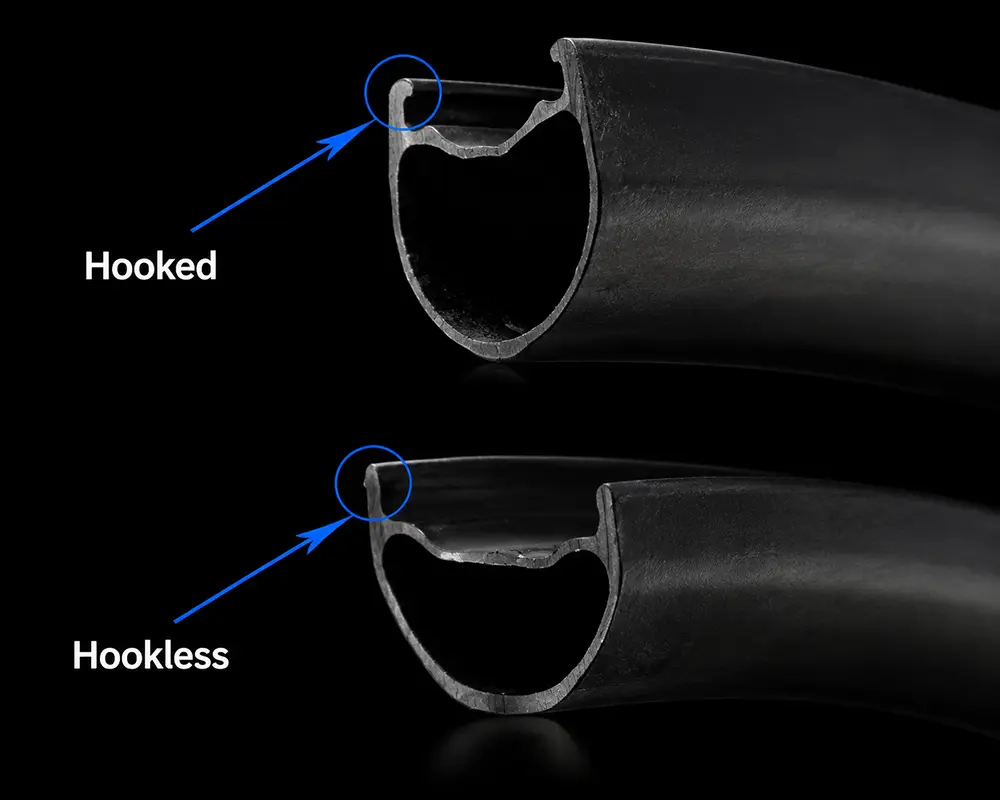
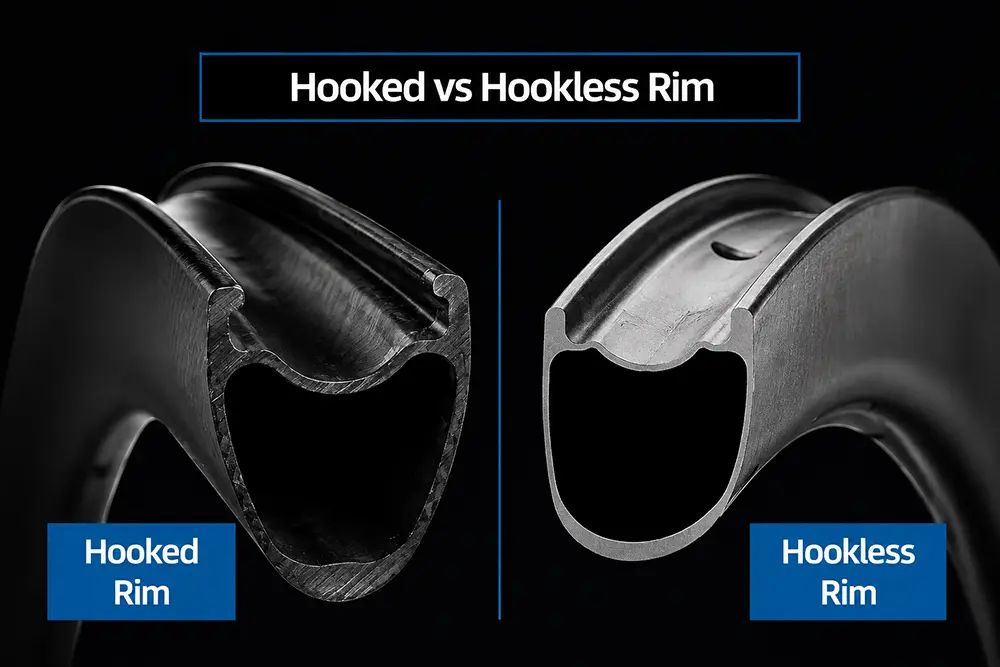
Hooked rims use an inward-facing bead hook to retain the tire and offer the broadest tire compatibility. Hookless rims use straight sidewalls and rely on precise bead tolerances. Hooked rims remain the more versatile choice for most road cyclists.
What Is a Hooked Rim?
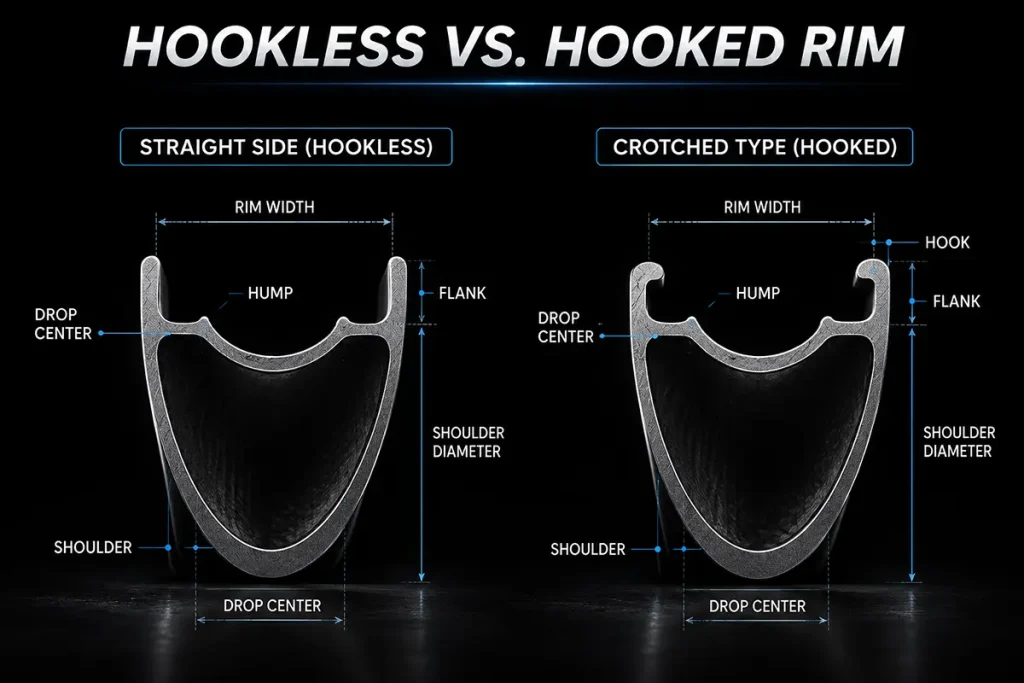
A hooked rim includes a small inward-facing flange at the top of the rim sidewall. This hook mechanically helps retain the tire bead under pressure.
For decades, hooked designs have been the industry standard for both clincher and tubeless road wheels.
Definition
A hooked rim uses an inward-facing bead hook to mechanically retain the tire.
What Is a Hookless Rim?
A hookless rim has straight sidewalls without the traditional retaining hook. Tire retention relies on extremely precise dimensions between the tire bead and rim bead seat.
Hookless systems were first widely adopted in mountain biking and have gradually expanded into gravel and road cycling.
Definition
A hookless rim uses straight sidewalls and relies on precise bead tolerances for tire retention.
Hooked vs Hookless: Quick Comparison
| Feature | Hooked Rims | Hookless Rims |
|---|---|---|
| Tire Compatibility | Excellent | Limited to approved tires |
| Maximum Pressure | Higher | Lower |
| Tubeless Compatibility | Excellent | Excellent |
| Tube Compatibility | Yes | Usually yes* |
| Manufacturing Complexity | Higher | Lower |
| Rim Weight | Slightly heavier | Slightly lighter |
| Tire Security Margin | High | Depends on approved combinations |
| Best Use | General road riding | Tubeless-focused setups |
How Do Hookless Rims Work?
Hookless rims secure the tire through precise bead-seat dimensions rather than a physical hook. When paired with approved tires and correct pressures, the system is reliable and widely used in modern tubeless applications. The absence of a bead hook raises concerns among riders.
Modern hookless systems work because:
- Rim dimensions are tightly controlled.
- Tubeless tire beads are manufactured to strict tolerances.
- The tire bead locks against a precisely shaped bead seat.
- Air pressure pushes the bead outward into the bead shelf.
When compatible tires are used within recommended pressures, properly designed hookless systems are reliable.
Most hookless incidents are linked to incompatible tires or excessive tire pressure.
Advantages of Hooked Rims
The main advantages of hooked rims are wider tire compatibility, higher pressure capability, and greater setup flexibility. These characteristics make hooked rims the preferred option for many road cyclists and wheel builders.
Imagine arriving at a Gran Fondo in the Alps and needing a replacement tire the evening before the event. With a hooked wheelset, finding a compatible tire at a local bike shop is usually straightforward. Riders who travel frequently often value this flexibility.
1. Wider Tire Compatibility
Hooked rims remain the most versatile option.
They are compatible with:
- Tubeless tires.
- Tubeless-ready tires.
- Traditional clincher tires.
- Many tire brands and models.
- Wider pressure ranges.
This flexibility is particularly attractive for wheel builders serving diverse customers.
2. Higher Pressure Capability
Many lightweight riders still prefer relatively high tire pressures for racing.
Hooked rims support:
- Higher inflation pressures.
- Narrow racing tires.
- Legacy tire standards.
This can be important for riders using 25 mm tires or older road frames with limited clearance.
3. Greater Consumer Confidence
Many cyclists have decades of experience with hooked clinchers.
For riders descending long Alpine passes at high speeds, familiarity can inspire confidence.
Advantages of Hookless Rims
Hookless rims simplify rim construction and are optimized for modern tubeless systems. They work best with wider tires run at moderate pressures.
A rider using 30 mm tubeless tires at 60 psi for long Gran Fondo events will rarely notice any practical disadvantage with a modern hookless wheelset. The lower pressures can improve comfort and control on rough mountain roads.
1. Simpler Rim Construction
Removing the hook simplifies the rim profile.
Potential benefits include:
- More consistent manufacturing.
- Improved carbon fiber layup efficiency.
- Better structural continuity at the rim edge.
From an engineering perspective, straight sidewalls can make carbon optimization easier.
2. Potential Weight Savings
Eliminating the hook can reduce material requirements.
Weight reductions are modest—only a few grams—but every gram matters in high-performance wheel design.
3. Optimized for Modern Tubeless Systems
Hookless rims are designed around tubeless use.
For riders already committed to wide tubeless road tires, hookless provides:
- Easy tire seating.
- Reliable bead engagement.
- Lower operating pressures.
The Biggest Limitation of Hookless Road Wheels
Limited tire compatibility is the primary drawback of hookless road wheels. Riders must ensure that both the tire and rim are specifically approved for use together.
Tire Compatibility Matters
The primary drawback in the hooked vs hookless debate is compatibility.
Not every road tire is approved for hookless use.
Before installation, riders should always verify:
- Rim manufacturer’s compatibility list.
- Tire manufacturer’s compatibility list.
- Maximum allowed pressure.
- Actual inflated tire width.
Ignoring compatibility charts is one of the most common causes of problems.
Pressure Limits: Why They Matter
Road hookless systems operate within lower maximum pressure limits than hooked rims. Riders using narrow tires or high pressures may prefer hooked designs.
Hookless road wheels impose lower maximum tire pressures.
A 68 kg rider using 30 mm tires for a 180 km Gran Fondo may only need 58-62 psi. In this scenario, hookless pressure limits are rarely restrictive.
By contrast, a 95 kg rider racing on 25 mm tires and preferring 85 psi may find a hooked rim more suitable.
Most manufacturers recommend staying below approximately:
| Tire Width | Typical Hookless Pressure Range* |
|---|---|
| 28 mm | 55-72 psi |
| 30 mm | 50-65 psi |
| 32 mm | 45-60 psi |
*Always follow specific manufacturer recommendations.
Many modern road cyclists already ride within these ranges.
However, heavier riders or racers preferring pressures above 80 psi may find hooked rims more practical.
Hooked vs Hookless for Different Rider Types
Neither rim standard suits every rider. Tire size, riding style, and pressure preferences largely determine which option works best.
A rider preparing for the Maratona dles Dolomites on 30 mm tubeless tires can confidently choose either system.
Amateur Racers
Recommended: Usually Hooked
Reasons:
- Freedom to choose almost any race tire.
- Higher pressure flexibility.
- Broad compatibility across wheelsets.
Gran Fondo Riders
Recommended: Either System
Many Gran Fondo riders benefit from:
- 28-32 mm tubeless tires.
- Moderate pressures.
- Enhanced comfort.
Both systems perform well when correctly configured.
Gravel Riders
Recommended: Hookless
Lower tire pressures and wider tires make hookless especially attractive for gravel applications.
Wheel Builders
Recommended: Depends on Customer Needs
For custom wheel builders, rider profiling is essential.
Questions to ask include:
- Rider weight?
- Preferred tire size?
- Tubeless or tubes?
- Typical tire pressure?
- Racing or endurance use?
- Existing tire inventory?
Real-World Riding Considerations
Beyond laboratory testing, tire availability, travel convenience, and maintenance simplicity strongly influence long-term satisfaction with a wheelset.
Long Mountain Descents
European cyclists riding routes such as:
- the Alps,
- Dolomites,
- Pyrenees,
- Sierra Nevada,
often prioritize reliability.
Disc brake bikes have largely reduced concerns associated with rim heating, but compatibility remains essential on hookless systems.
Traveling and Events
During multi-day events or cycling holidays, replacing a damaged tire may be easier with hooked rims because compatible tires are widely available.
This practical consideration is overlooked.
Tire Choice Flexibility
Riders who frequently change tires prefer hooked rims because compatibility is rarely an issue.
Hooked vs Hookless: Rider Scenario Table
| Rider Scenario | Recommended Rim Type |
|---|---|
| First premium wheelset | Hooked |
| Rider using tubes | Hooked |
| Rider using 25 mm tires | Hooked |
| Rider above 90 kg | Usually Hooked |
| Dedicated tubeless rider | Either |
| Gravel rider | Hookless |
| Custom race wheel build | Depends |
| Frequent tire experimentation | Hooked |
Expert Insight
From a wheel builder’s perspective, hookless rims are not inherently less safe than hooked rims.
Most issues arise from mismatched tires, excessive pressures, or incomplete installation procedures.
A properly matched hookless wheel and tire combination can deliver thousands of trouble-free kilometres.
However, hooked rims remain easier to support in custom wheel building because they accommodate a wider range of customer preferences and reduce compatibility concerns.
For riders who value simplicity, hooked rims continue to be the safest recommendation.
Frequently Asked Questions
Yes. Hookless rims are safe when used with approved tires and within manufacturer pressure limits.
Yes. Most road hookless rims require tubeless-compatible tires specifically approved for hookless use.
Often yes, but only if both the rim and tire manufacturers allow it.
Hookless rims simplify manufacturing and can improve consistency in carbon rim production.
No. Hookless systems have lower maximum pressure limits.
Usually, but the difference is small—only a few grams.
Both can perform exceptionally well. Riders wanting maximum tire choice prefer hooked rims.
Many heavier riders appreciate the additional pressure flexibility of hooked rims, particularly on narrow road tires.
Final Verdict
Choose hooked rims if you want maximum tire choice, higher pressure capability, and the simplest ownership experience.
Choose hookless rims if you ride exclusively tubeless, use wider tires, and are comfortable following tire compatibility guidelines.
For most road cyclists buying a premium carbon wheelset, hooked rims remain the most versatile option.
- Top 10 Best Spoke Brands for Bicycle Wheels in 2026
- Straight-Pull vs J-Bend Spokes: Complete Bicycle Wheel Guide
- Ratchet vs Pawl Hub Systems: Which Is Better for a Carbon Wheelset?
- Are 29 inch carbon mountain bike wheels worth it?
- 700c Carbon Disc Wheelset: What Really Matters Before You Buy
- Are Carbon Gravel Wheels Worth It? Performance, Ride Feel & Buying Guide
- Wheel Guide · Materials & Ride Feel
- Wide vs. Narrow Rims: The Quiet Revolution in Cycling Performance
- Can Beginners Ride Carbon Wheels?
- Bicycle Hub Bearing Maintenance Guide: Service, Adjustment & Replacement