

The upgrade is real.
The mythology is optional.
Carbon wheels can be a meaningful road-bike upgrade. They can also be an expensive answer to the wrong question. The difference starts with what you expect them to change.
The short answer: carbon wheels are overrated when the material label is treated as a guarantee of speed. They are worth considering when a specific wheel-and-tire system solves a real aerodynamic, weight, handling or compatibility priority.
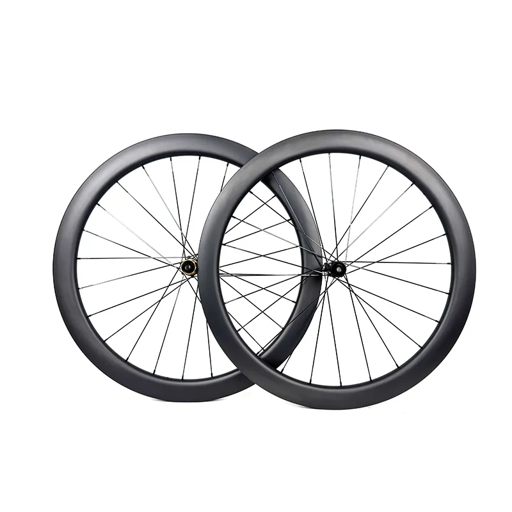
Are carbon wheels the best bike upgrade? There is no universal ranking.
A rider replacing damaged, heavy or poorly matched wheels is making a different purchase from someone replacing an already capable wheelset. So is a road racer compared with a rider whose main concern is comfort on rough lanes.
“Carbon wheels vs aluminum wheels” is therefore only the beginning of a useful comparison. The better question is: which complete setup improves the part of the ride that currently matters most?
Design freedom can deliver real advantages.
Carbon construction lets designers combine shapes, laminate properties and local reinforcement for a particular purpose. The result can be a compelling balance of rim depth, mass and structural behavior.
A well-matched aerodynamic wheel-and-tire system can reduce drag relative to its tested alternative. A lower-mass build can reduce the energy required to climb and accelerate.
The label does not establish the advantage.
Carbon does not automatically mean lighter. Deeper does not automatically mean faster. Expensive does not automatically mean appropriate.
A wheel can be beautifully finished and still be the wrong depth, tire platform, load rating or ownership proposition for the rider buying it.
Five promises worth taking apart.
“Carbon wheels will make you much faster.”
Possibly faster—but the magnitude requires evidence. Drag depends on the rim, spokes, tire, mounted tire width and airflow, not simply the rim material.
Ask which wheel was used as the baseline, at what speed, with which tire and across what wind angles. A single watt figure without those conditions is not a reliable prediction for your ride.
“Rotating weight matters twice as much.”
That shortcut describes a particular idealized acceleration case with mass concentrated at the rim. Real wheel mass is distributed across rims, spokes and hubs.
Lower mass helps during acceleration and climbing. During steady-speed riding, rotational inertia is not a continuous power loss. Do not double a wheel-weight difference when estimating steady climbing benefit.
“More stiffness means less wasted power.”
Elastic deflection is not automatically lost energy: an elastic structure stores and returns energy. Actual dissipation depends on damping and other mechanisms.
Appropriate stiffness can matter for handling, clearance and load support. “Stiffer” alone does not quantify a drivetrain-efficiency improvement or prove a faster ride.
“Carbon smooths every road.”
A material description cannot predict the comfort of an assembled bicycle. Tire volume, construction, pressure, load and surface all matter.
If the main problem is an overinflated or unsuitable tire, changing the rim material may leave the underlying problem untouched.
“Better sound. Better bearings. Better speed.”
Freehub sound is not an efficiency measurement. Engagement describes pickup behavior, not a guaranteed reduction in drag while continuously pedaling.
Bearing material, spoke branding and fiber grades are inputs to a product—not substitutes for complete-system testing and an appropriate specification.
The physics is useful. The missing context is the problem.
In still air, aerodynamic power is approximately proportional to drag area multiplied by speed cubed. That makes aerodynamic improvements increasingly relevant in power terms as speed rises. It does not create a universal minimum speed below which aero wheels suddenly stop working.
Wind changes the airflow, while drafting changes the environment around the bicycle. A solo test should not be treated as a precise forecast for a sheltered group ride.
The rider’s position is also a major aerodynamic consideration. A wheel choice that makes you sit up or ride tensely can undermine the practical benefit you hoped to buy.
Weight needs the same perspective.
As a simple physics illustration, adding 200g requires about 1.1W of extra gravitational power at a steady 20km/h on a 10% climb. That isolates the mass effect; it excludes aero, rolling losses and acceleration.
Small weight savings are real. The mistake is assuming that a real difference must also be a large difference—or that it establishes the outcome of the whole route.
The numerical example is illustrative, not a product test or predicted time saving. Actual route results depend on the complete bike–rider system and conditions.
What might deserve your money before carbon wheels?
There is no fixed upgrade order for every cyclist. Start by identifying the limitation rather than shopping for the most visible replacement.
| What you want to improve | Check before buying wheels | When wheels enter the picture |
|---|---|---|
| Comfort on rough pavement | Tire construction, volume, pressure and riding position | Your existing rim prevents a suitable approved tire setup |
| Sustained road speed | Usable riding position, tire losses and mechanical drag | A suitable wheel offers credible aerodynamic improvement over the baseline |
| Climbing performance | Gearing, pacing and complete-system mass | A lower-mass build provides a relevant benefit at an acceptable cost |
| Confidence in gusts | Current front-wheel behavior, tire setup and local exposure | A more suitable wheel configuration addresses the handling problem |
| Reliability | Bearings, spoke condition, rim condition and service needs | Replacement is more appropriate than repairing the existing build |
| Enjoyment and appearance | Your preferences and affordable budget | You value the purchase honestly without requiring an invented speed gain |
Tire pressure is not a maximum-value contest.
SILCA’s field work shows how surface-related losses can increase when tires are overinflated. Smooth-drum rolling tests do not capture every loss on real pavement.
That does not mean lower is always faster. Pressure must preserve support and avoid excessive deformation or rim impacts. Optimize for the actual load, tire and surface within the approved limits.
When carbon wheels are genuinely worth considering.
- You can identify a specific limitation in the current setup, and the proposed wheelset addresses it.
- Your riding includes conditions where its documented aerodynamic or mass advantage is relevant.
- Its tire platform suits your surfaces, load and frame clearance.
- You can ride it confidently in the conditions you normally face.
- The full installed cost, service parts and replacement risk fit your budget.
When they are probably not the next priority.
The case weakens when the existing wheels are suitable, the tires or riding position remain poorly matched, or the purchase leaves no money for essential maintenance.
It also weakens when the expected gain depends entirely on phrases such as “effortless speed,” “zero power loss” or “instant transformation.” Wheels do not remove the need to supply power.
It does not need a fake watt saving.
Ownership is where the marketing ends.
Compare the complete installed cost: wheelset, any required tires, tape, valves, sealant, drivetrain fittings, rotor hardware and labor. Reuse existing parts only when compatible and serviceable.
Then consider spare spokes, bearings, nipples and freehub availability. Ask who handles warranty claims, what is excluded and who pays shipping.
Carbon wheels are not maintenance-free or indestructible. Follow the manufacturer’s inspection guidance. Stop using a wheel with suspected structural damage and seek assessment, particularly after a significant impact.
Rim-brake and disc-brake carbon wheels are different purchases.
Carbon rim-brake wheels require particular attention to approved pads, brake-track condition and heat-management guidance. Disc-brake wheels move the braking surface to a rotor, but still require correct rotor fit, assembly, tire compatibility and structural inspection.
Do not transfer one manufacturer’s pad, cleaner or service instructions to every carbon rim.
Ask what each build offers, not whether it is “carbon.”
The XDRU examples below illustrate different specification priorities. Their published dimensions and weights help frame a decision. They do not establish an independently measured speed advantage over your current wheels.
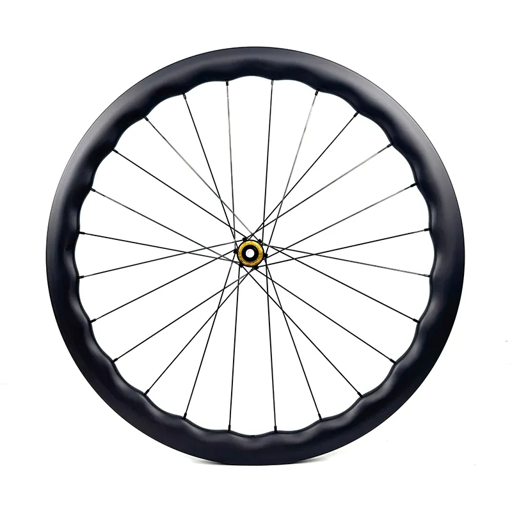
CHASE 45 AERO SL
A relevant configuration to assess when lower published mass and a middle-depth road profile match the brief.
Rim depth: 45mm
Internal / external width: 22 / 28mm
Published wheelset weight: 1244 ± 30g
Hub: 36T ratchet
Spokes: aero bladed, 24 front / 24 rear
Brake interface: Centerlock disc
Axles: 12 × 100mm / 12 × 142mm
Freehub options: HG / XDR
The useful question: is the weight reduction versus your actual setup worth the complete purchase cost?
Review CHASE 45 AERO SL →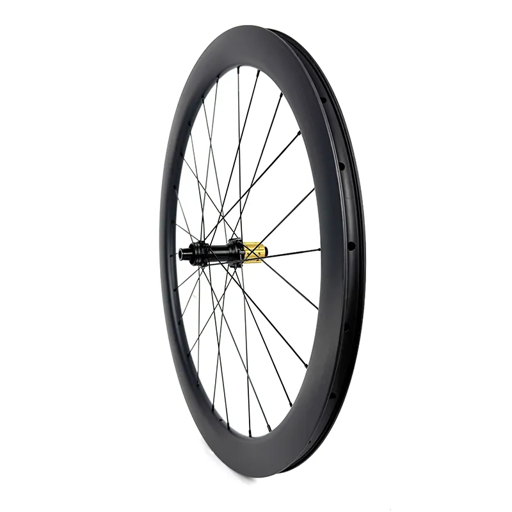
CHASE 50 AERO
A configuration to investigate when a 50mm road profile suits the route and a lower purchase price leaves room for setup.
Rim depth: 50mm
Internal / external width: 21 / 28mm
Published wheelset weight: 1500 ± 30g
Hub: 36T ratchet
Spokes: aero steel, 24 front / 24 rear
Brake format: disc brake
Axles: 12 × 100mm / 12 × 142mm
Freehub options: HG / XDR
The useful question: does this complete configuration improve the system you already ride—not simply its appearance?
Review CHASE 50 AERO →USD prices and specifications reviewed October 27, 2026. Confirm current pricing, supplied configuration, weight-inclusion basis, bead design, approved tires, pressure limits, load rating and rotor compatibility before ordering. No comparative aerodynamic, stiffness, handling or durability test is presented.
These products are different complete builds, not a controlled experiment in rim depth. Their shared carbon construction does not make them interchangeable, and the 5mm depth difference does not explain every difference between them.
A better way to decide whether the upgrade worked.
Write down the objective before buying: lower climbing mass, a compatible tire platform, improved handling, lower measured drag or simply greater enjoyment.
When comparing rides, record tires, pressure, total load, route and conditions. If several variables change together, you are evaluating the whole package—not isolating the effect of carbon rims.
A personal best can be encouraging, but wind, traffic, drafting and pacing prevent it from proving a wheel’s aerodynamic advantage. Likewise, a different sound or sharper sensation does not quantify a watt saving.
The upgrade succeeds when it meets the original objective at a cost and level of maintenance you accept. It does not need to win a fictional universal upgrade ranking.
Are carbon wheels overrated? Common questions.
Do carbon wheels make a difference for recreational riders?
They can, but relevance depends on the design and the current setup. A recreational rider may value appearance, handling or tire compatibility more than a small measured speed difference. None requires pretending that all carbon wheels are faster.
Are aero wheels useful below racing speed?
There is no universal on/off threshold. Aerodynamic differences change continuously with airflow. Whether the benefit is worth buying depends on its magnitude, your rides, the cost and the alternative uses of the money.
Are carbon wheels always lighter than aluminum wheels?
No. Compare complete wheels on the same inclusion basis. Rim depth, hubs, spokes and design requirements can outweigh a material-based assumption.
Should I upgrade wheels or improve my fitness?
They are different decisions. Wheels change equipment characteristics; training changes rider capability. Neither guarantees the outcome of the other, and equipment cannot replace the power needed to ride.
Is aluminum still a good choice?
Yes. A suitable, well-supported aluminum wheelset can be a rational purchase, particularly when cost and maintenance matter more than a specialized carbon design. Compare products rather than treating material as a ranking.
What should come before the carbon label?
Fit: the correct tire system, axle, brake and freehub interfaces, clearance and intended load. A premium wheel that does not suit the bicycle is not an upgrade.
Not a miracle.
Not a gimmick.
A design choice.
Carbon wheels are overrated when marketing turns a material into a promise. They can be worthwhile when a particular design solves a particular problem.
Start with the current bicycle, define the improvement, examine the evidence and budget for the complete system. Buy the result you can explain—not the transformation you are asked to imagine.
