
Up. Fast. Everywhere.
Choose your advantage.
Lightweight climbing wheels, deep-section aero wheels and all-round carbon wheelsets solve different problems. Here is how their priorities overlap—and how to choose the right balance for your roads, tires and riding style.
Choose climbing-led
When prolonged uphill riding and a lower-mass build dominate your priorities.
Choose aero-led
When sustained speed matters most and the handling suits your normal wind conditions.
Choose all-round
When one wheelset needs to cover changing gradients, weather and everyday riding.
These are priorities—not sealed boxes.
A climbing wheel can have meaningful aerodynamic development. A deep carbon wheel can be remarkably light. An all-round wheel does not have to sit exactly halfway between them.
The useful distinction is what the designer chooses to prioritize and what the complete build delivers: mass, aerodynamic behavior, tire fit, handling, load capacity and serviceability.
Rim depth gives you a first sorting tool. It does not tell you the drag, weight or crosswind behavior on its own. Choosing carbon road wheels by depth alone is like choosing a bicycle by frame size without checking whether it fits.
What each category is trying to do.
Less mass.
More uphill focus.
≈ 30–45mm
A common search range—not a definition of a climbing wheel.
Where lightweight climbing wheels make sense
Long climbs, mountain-focused rides and uphill events give low mass a clear job. Reducing mass reduces the energy required to gain height, provided the rest of the system remains comparable.
Lower rotational inertia also reduces the energy needed during acceleration. But total wheelset weight does not reveal inertia by itself: mass near the rim contributes more than mass close to the hub.
What the label does not promise
A shallow rim is not automatically lighter than every deeper rim, and a low weight does not establish impact strength or high-speed handling. A climbing wheel still needs to suit the descent, the rider’s load and the tire system.
When to reconsider
If your “hilly” ride is mostly fast connecting roads with short rises, a climbing-only buying brief may overemphasize grams. Assess the entire route, not only its steepest segment.
Less drag.
More sustained pace.
≈ 50–65mm
A useful road shortlist. Deeper specialist options also exist.
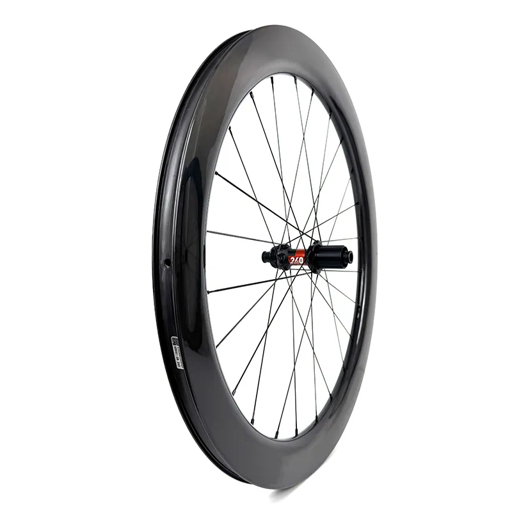
Where aero carbon wheels make sense
Fast flat-road riding, breakaways and sustained road-race efforts are natural reasons to investigate aerodynamic wheelsets. Aero also matters on gentler climbs and rolling roads; it does not disappear whenever the gradient turns positive.
In still air, aerodynamic power rises approximately with the cube of speed when the drag area stays constant. That makes drag reduction increasingly important in power terms as speed rises—not suddenly relevant above one magic threshold.
What determines the result
Rim shape, tire model, actual mounted tire width, spokes and airflow all contribute. A 60mm wheel is not automatically faster than a well-developed 50mm wheel.
Where the compromise becomes real
Gust response and steering confidence deserve attention, particularly at the front. If the wheel forces you to sit up or grip the bars rigidly, the potential advantage may not translate into a better ride.
Fewer weak spots.
More useful days.
≈ 40–55mm
A practical middle-depth search band with deliberate overlap.
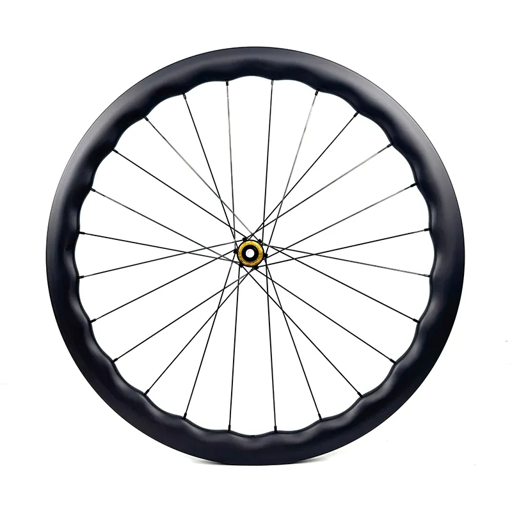
Where all-round carbon wheels make sense
Mixed gradients, group rides, endurance loops and changing weather create a strong case for a balanced wheelset. The objective is not to win every specialist comparison, but to avoid large compromises across normal riding.
What “balanced” should actually mean
Useful aerodynamics, manageable handling, an appropriate weight and a tire platform that suits the road. Add serviceable hubs and accessible replacement parts, and the ownership proposition becomes stronger.
What not to assume
All-round is not a standardized certification. One brand’s all-round wheel may be another brand’s aero option. Read the actual dimensions and intended-use information.
Depth ranges throughout this article are editorial selection heuristics, not technical standards, wind ratings or performance rankings. The overlaps are intentional.
Climbing vs aero vs all-round wheels: the useful comparison.
| Selection factor | Climbing-led | Aero-led | All-round |
|---|---|---|---|
| Main objective | Reduce mass for uphill-focused riding | Reduce aerodynamic losses at relevant riding speeds | Balance performance across varied conditions |
| Most persuasive route | Long climbs or an uphill finish | Fast roads and sustained efforts | Rolling loops and mixed daily riding |
| Key evidence to request | Complete-pair weight, inclusion basis and load rating | Tire-specific drag and steering data with a test protocol | Weight, tire fit, handling evidence and service support |
| Potential compromise | Less aero emphasis on faster sections | Handling demands or added mass, depending on design | May not lead specialist uphill or aero comparisons |
| Misleading shortcut | “The shallowest wheel must be the lightest” | “The deepest wheel must be the fastest” | “50mm automatically means perfect for everyone” |
| Shared requirements | Safe tire pairing, correct interfaces, approved load | Safe tire pairing, correct interfaces, approved load | Safe tire pairing, correct interfaces, approved load |
Aero vs weight: compare the whole ride, not a slogan.
On a steady climb, gravitational power is approximately total mass × gravitational acceleration × vertical speed. Less mass reduces this requirement. On faster sections, aerodynamic differences can become more consequential.
Neither relationship supplies a universal answer. Rider power, wind, tire losses, the size of the mass difference and the size of the drag difference determine where a particular comparison changes direction.
Nor does zero net elevation make mass irrelevant. A loop that finishes where it started can still contain long climbs, braking zones and descents where extra speed cannot safely be used. Elevation distribution matters more than a simplistic “uphill versus flat” label.
A useful example—and its limits
In Swiss Side’s published simulation of the 2021 Tour de France Mont Ventoux stage, a modeled aero bicycle that was 1kg heavier was faster over the full stage, while the lightweight bicycle was faster on the final climb alone.
The model used a 63kg rider, 360W critical power and dry, windless conditions. It compared complete bicycle setups, not two wheelsets. The lesson is that course context can reverse a result—not that an aero wheel always beats a climbing wheel.
is not automatically the best wheel for the loop.
What about acceleration?
Reducing rotational inertia reduces the energy required to change wheel speed. But the phrase “rotating weight counts twice” describes an idealized case with mass concentrated at the rim during acceleration—not a rule that doubles wheel weight on a steady climb.
Once speed is steady, rotational inertia is not a continuous drain on power. A wheel that feels lively is enjoyable; that sensation alone does not prove a faster route time.
Crosswind stability can change the right answer.
Crosswind behavior is not simply how hard the wheel is pushed sideways. Front-wheel steering moment—and how it changes as the apparent wind angle changes—helps determine what reaches the rider’s hands.
That is why “stable rim shape” should not replace meaningful evidence. Useful testing shows the wheel-and-tire configuration and behavior over a range of wind angles. A result from one wheel cannot be transferred to every wheel of similar depth.
Lighter riders may prefer more handling margin, but there is no universal rider-weight cutoff for a 50mm or 60mm rim. Geometry, position, experience, speed and gust exposure matter too.
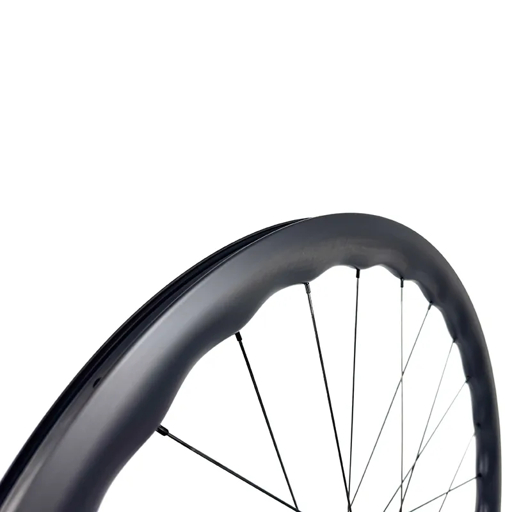
A shallower front, a deeper rear?
This can be a useful configuration to investigate where compatible options exist. Front-wheel aerodynamic loads feed directly into the steering system; the rear does not steer the bicycle in the same way.
It is a tuning option, not a guarantee. Confirm the available build, tire pairing and interfaces, and remember that the rear wheel still experiences wind loads.
The tire can support—or undermine—the category choice.
A lightweight wheel with an inefficient tire is not automatically a faster climbing setup. A deep rim with an unsuitable tire shape is not automatically a good aerodynamic package. Tire casing, compound, actual width and pressure belong in the same decision.
Internal width supports the tire.
It affects mounted shape and must suit the approved tire range. Wider is not universally better, and the sidewall size does not guarantee the final installed width.
External width informs the aero transition.
Compare it with the actual mounted tire, not only the printed size. A simple width ratio is not a substitute for wheel-specific aerodynamic data.
Pressure is optimized, not maximized.
Excessive pressure can increase vibration-related losses on rough pavement. Too little can compromise support and increase rim-impact risk. Start with load, measured width and surface conditions.
Volume should follow the road.
Compatible 28–30mm performance tires are useful candidates for many paved-road setups; rougher routes may justify more volume. Exact approvals and clearance take priority.
“Tubeless ready” does not identify the bead design.
Confirm whether the rim is hooked or hookless, then verify the exact tire model, permitted width and pressure limits. Follow the lowest applicable limit from the wheel and tire manufacturers. Adding an inner tube does not make an unapproved hookless tire combination safe.
Two XDRU builds show why the categories overlap.
The CHASE 45 AERO SL and CHASE 60 AERO illustrate a lower-mass middle-depth option and a deeper road option. Both combine features associated with more than one category. Their published specifications do not establish a measured head-to-head performance result.
CHASE 45 AERO SL
A candidate for riders weighing climbing-focused mass against all-round road use. Its 45mm depth sits in an intentionally overlapping design space.
Published wheelset weight: 1244 ± 30g
Internal / external width: 22 / 28mm
Hub: 36T ratchet
Spokes: aero bladed, 24 front / 24 rear
Brake interface: Centerlock disc
Axles: 12 × 100mm / 12 × 142mm
Freehub options: HG / XDR
CHASE 60 AERO
A deeper configuration to investigate when sustained road speed is central to the brief, without assuming that depth automatically determines weight or handling.
Published wheelset weight: 1305 ± 30g
Internal / external width: 21 / 28mm
Hub: DT Swiss 240 EXP
Spokes: Sapim CX-Ray, 24 front / 24 rear
Brake format: disc brake
Axles: 12 × 100mm / 12 × 142mm
Freehub options: HG / XDR
Figures follow the manufacturer’s specification tables. Confirm the current supplied configuration, weight-inclusion basis, rotor interface, bead design, tire approvals, pressure limits and maximum system load before purchase. No independent aerodynamic or crosswind comparison between these products is presented.
Notice how closely the published weights sit despite the difference in depth. These are different complete builds, with different hubs, spokes and rim dimensions. They are not a controlled test of what adding 15mm of rim depth does.
Likewise, their common 28mm external width does not prove the same tire will produce identical mounted dimensions or airflow: internal width and rim shape also differ.
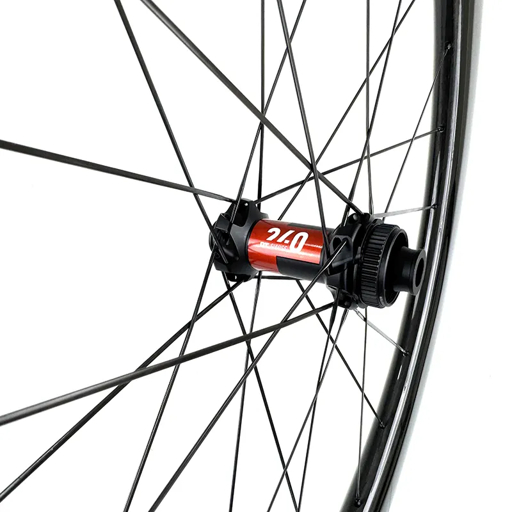
Compare the build, not only the badge.
Check bearing and freehub service, replacement spokes, nipple access and warranty support. “Premium hub” and “higher engagement” are not substitutes for tire fit, handling evidence or a suitable load rating.
A cassette’s speed count is not enough to choose a freehub. Match the exact cassette and required body before ordering.
A route-first decision process.
- Define the ride that matters most. A summit finish, a fast flat race and a mixed endurance loop create different briefs.
- Establish non-negotiables: brake format, axle standards, freehub, tire compatibility, clearance and approved system load.
- Choose your primary emphasis: lower mass, aerodynamic performance or broad versatility. Accept that overlap is normal.
- Check front-wheel handling against your local conditions. Do not let a calm-day test define your entire decision.
- Compare complete wheel-and-tire setups. Normalize quoted weights and examine the conditions behind watt-saving claims.
- Finish with ownership: service parts, maintenance, warranty and the realistic cost of keeping the wheels in use.
The distinctions riders actually ask about.
Can aero wheels climb well?
Yes. A deeper wheel can have a competitive complete weight and remain useful uphill. Whether it is preferable depends on the climb, wind, tire losses and the alternative—not the aero label alone.
Are climbing wheels always better in crosswinds?
No. Shallower rims are a reasonable place to start when seeking more margin, but actual steering behavior depends on the specific rim, tire and conditions. Depth is not a handling certification.
Is a 50mm carbon wheelset the best one-wheelset option?
It is a sensible shortlist for many road riders, not a universal answer. A lighter rider on gusty roads or a rider focused on long climbs may prefer another balance.
Do I need two wheelsets: climbing and aero?
Not necessarily. A well-chosen all-round build can cover a wide range of road riding. Two wheelsets become more compelling when your events or routes genuinely demand different systems and the cost and maintenance make sense.
Are the lightest carbon wheels always the fastest?
No. Weight is one input. Aerodynamic differences, tires, pressure, handling and the route can change the outcome. Fastest on a climb and fastest over a complete ride can be different answers.
Can this advice be applied to rim-brake wheels?
The general trade-offs still matter, but product fit and braking requirements differ. Choose a dedicated rim-brake wheel and follow its approved pads, tire limits and descending guidance. The featured XDRU products are disc-brake configurations.
Buy for the roads you repeat.
Not the category you admire.
Choose climbing-led wheels when uphill mass is the central requirement. Choose aero-led wheels when sustained speed deserves the emphasis. Choose an all-round setup when consistency across different days matters more than specialization.
In every case, match the tires, confirm the interfaces and keep enough handling margin to enjoy the advantage.