
Already under tension.
Before the first ride.
Why do carbon wheels need spoke pretension? Because a conventional bicycle wheel works as a prestressed structure—not as a rim held up by a bundle of rigid rods.
Spokes need a starting pull because they are poor compression struts.
A slender conventional spoke carries a useful axial tensile force: it pulls between hub and rim. Ask that same spoke to act as a compression column, and it can buckle with very little compressive load.
Wheel builders solve this by stretching the spokes elastically during assembly. Tightening the nipples establishes an initial tensile force—spoke pretension, also called preload.
The rim, in turn, is pulled inward at many points and develops circumferential compression. Hub, spokes and rim settle into a self-equilibrated structure before the rider adds any load.
That internal force is not wasted effort. It allows the wheel to respond to service loads through changes in existing tension, rather than asking loose wires to alternate between pulling and pushing.
Without adequate preload
A load that shortens the hub-to-rim distance can unload a spoke early. A slack spoke no longer supplies its intended tensile contribution.
With appropriate preload
The spoke can lose some tension under load and still remain active in the structure. The target is an appropriate operating range—not maximum possible tightness.
The surprising part: the lower spokes mainly lose tension.
When the rider loads the axle and the ground supports the tire, the wheel deforms slightly. The rim near the contact region moves closer to the hub, reducing the extension of the spokes in that region.
In the conventional wheel under radial loading, the dominant response is a reduction in tension in a group of lower spokes. It is not simply a large increase in tension in the top spokes, as though the hub were hanging from the top of a rigid hoop.
Consider one lower spoke. Before loading, it pulls the hub downward. If that downward pull becomes smaller, the net change in spoke force on the hub is upward. Taken together, these force changes balance the applied axle load.
That does not mean the lower spoke becomes a compression rod. It means its tensile force has decreased from an already positive starting value.
For a lower spoke under typical radial loading, the load-induced change is negative. Other loading directions produce different patterns.
This is also why “the wheel stands on the bottom spokes” and “the hub hangs from the top spokes” are incomplete slogans. The useful description is a prestressed rim-and-spoke system responding through deformation and changes in force.
Preload helps the wheel survive repeated unloading.
As a wheel rotates under a reasonably steady load, each spoke repeatedly passes through the lower loaded region. Its tension falls and recovers. Real roads add impacts, braking, pedaling and side loads to that repeating cycle.
The reason to build with suitable pretension is not to eliminate those cycles. It is to keep the intended structure working through them, with sufficient residual tension under expected service conditions.
When a spoke repeatedly becomes slack, its support is lost temporarily. Components can move or reseat, and nipple loosening becomes more likely. Load redistribution and repeated movement can compromise durability and trueness.
Fatigue still depends on the full stress history, material, geometry and local details such as spoke bends, threads and seating. More preload is not a universal fatigue cure.
It is a wheel that manages those changes.
A carbon rim still needs the rest of the structure.
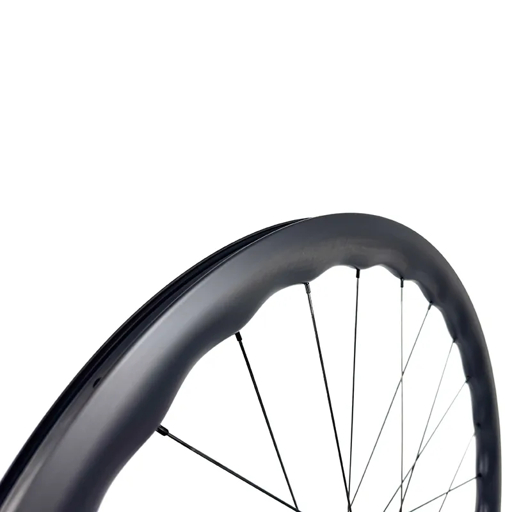
Carbon construction does not remove the need for pretension. The rim still receives many inward spoke forces and local loads at the nipple seats. It must combine those with tire pressure, road impacts and bending.
Laminate design, cross-section and reinforcement around spoke attachments affect how those loads are carried. Hub flange geometry, nipple support, spoke length and lacing must suit the design.
A deeper rim may distribute a local load differently from a shallower rim, but depth alone cannot specify the required tension. Nor does a carbon fiber grade establish an allowable nipple load.
More tension also means more internal load.
Increasing spoke pretension raises the rim’s compressive loading and the forces at the attachments. Excessive tension can damage components or reduce structural stability.
The correct target comes from the approved wheel or rim specification, with the other component limits respected. It is not a number chosen because the wheel is carbon.
Road load, side load and torque change tension differently.
Radial loading
Rider load and road reaction deform the rim locally. In a conventional wheel, the lower group of spokes chiefly experiences reduced tension.
Lateral loading
Sideways rim movement changes spoke lengths and their force components. Spokes on the two sides respond differently; bracing angles and rim behavior matter.
Drive and brake torque
Torque-transmitting lacing makes some spokes gain tension while others lose it. Geometry, flange arrangement and the load path determine the pattern.
Crossed spokes are useful for transmitting hub torque because their forces have tangential components at the flange. Pedaling applies torque through the rear hub; disc braking also transmits braking torque between hub and rim through the spoke structure.
Rim braking has a different torque path: the pads act directly on the rim. That is one reason lacing rules cannot simply be transferred between every front, rear, rim-brake and disc-brake wheel.
Do not convert a torque-carrying wheel to radial lacing unless the manufacturer explicitly approves that configuration. Lacing is an engineering choice, not only an appearance.
Balanced tension does not mean identical tension everywhere.
Rear cassette clearance and disc-brake packaging often produce unequal spoke bracing angles. To hold the rim in its correct lateral position, the two sides can need different average tensions.
For a simplified wheel, lateral equilibrium requires the sum of the spokes’ leftward force components to balance the sum of their rightward components. Equal spoke counts with unequal bracing angles therefore generally require unequal tensions.
On many conventional rear wheels, the drive side runs at the higher average tension. Other layouts differ. Offset rims, flange geometry and unequal spoke counts can change the ratio.
Tension balancing normally means comparing equivalent spokes within the same side or specified group—not forcing every spoke in the entire wheel to the same reading.
A true wheel is not proof of a good tension map.
A wheel can look straight while containing very uneven tension. Conversely, forcing identical readings can spoil dish or trueness when geometry or component condition prevents it. Professional assessment considers tension, lateral and radial runout, dish and component condition together.
Does tightening the spokes make carbon wheels stiffer?
Not in the simple “tighter equals proportionally stiffer” sense. A conventional spoke’s axial elastic stiffness is governed chiefly by material modulus, cross-sectional area and length. Raising its initial tensile force is not the same thing as fitting a thicker spoke.
Whole-wheel stiffness also depends on rim bending and torsional properties, spoke arrangement, bracing angles and hub geometry. Prestress has geometric effects too; detailed research shows that increased tension can reduce lateral stiffness through the rim’s compressive prestress.
The practical distinction is between the wheel’s elastic response while its spokes remain active and what happens when one or more spokes unload completely. Suitable preload helps delay that loss of tensile support. It is not a universal ride-feel adjustment.
Do not use spoke tension as a comfort dial.
Deliberately detensioning a wheel to soften the ride can reduce its margin against slackness and compromise durability. For everyday setup, tire selection and approved pressure adjustment are more appropriate starting points. Change wheel-build parameters only within the manufacturer’s engineering and service guidance.
How much spoke tension should a carbon wheel have?
There is no universal carbon-wheel spoke tension. The target depends on the rim, hub, spoke, nipple, lacing and build design. A number copied from another wheel can be inappropriate even if both rims have the same depth.
Tension is a force, commonly specified in newtons or kilograms-force. Approximately 1kgf equals 9.81N. A nipple torque reading is not a direct substitute for spoke tension because friction and thread conditions affect the relationship.
A tensiometer reading also needs interpretation. Use the correct conversion for the spoke’s material and actual cross-section, with a suitable calibrated instrument. Bladed and butted spokes require attention to measurement position and tool orientation.
A plucked spoke’s pitch can help compare genuinely equivalent spokes, but pitch also depends on vibrating length, mass and boundary conditions. Sound alone is not an adequate absolute tension check for an unfamiliar build.
| Check | Why it matters | Avoid |
|---|---|---|
| Approved target and limit | The rim and complete build define the allowable range | Applying a generic “carbon wheel” value |
| Correct spoke conversion | Instrument deflection depends on spoke material and section | Using the wrong chart or measuring an unsuitable section |
| Same-side comparison | Left and right averages may legitimately differ | Equalizing the entire wheel indiscriminately |
| Measurement condition | Tire pressure can alter the tension readings | Comparing inflated and uninflated results without context |
| Trueness and dish | Tension is one part of complete-wheel geometry | Accepting a good average while ignoring runout or offset |
Why tire pressure belongs in the record
Inflating a tire can compress the rim and lower spoke tension. The size of the change varies with the tire, pressure and rim structure.
Follow the manufacturer’s specified measurement state. Do not compensate for an inflated reading by exceeding the permitted uninflated build tension. A lower reading after inflation does not automatically mean the nipples have loosened.
Pretension is a process, not a final twist of the wrench.
A sound build requires the correct spoke lengths and component interfaces, gradual tensioning, controlled truing and repeated checks of dish and relative tension.
Builders also manage spoke wind-up and settle the assembly with controlled procedures appropriate to the components. In steel-spoke wheel building, “stress relieving” refers to specific mechanical operations—not heating the carbon rim and not simply loosening the wheel.
Proprietary carbon spokes, bonded interfaces and integrated nipples may have different restrictions. Do not copy a steel-spoke squeezing technique onto an unfamiliar system.
Locking nipples or approved thread treatments can help resist rotation, but they do not replace correct pretension, seating and geometry.
What riders should actually check
New wheel wobble, a clearly loose spoke, recurrent loss of true or damage around an attachment deserves assessment. First exclude unrelated issues such as tire seating, axle security and bearing play.
Do not tighten one visibly loose spoke at random and assume the job is finished. The wheel may need a complete tension, dish and damage check.
After a significant impact or suspected carbon damage, stop riding until the wheel has been assessed.
Different builds. The same structural principle.
These XDRU configurations show why a complete wheel is more than a rim specification. Both list 24 spokes per wheel, but that shared count does not imply identical stiffness, tension targets or durability.
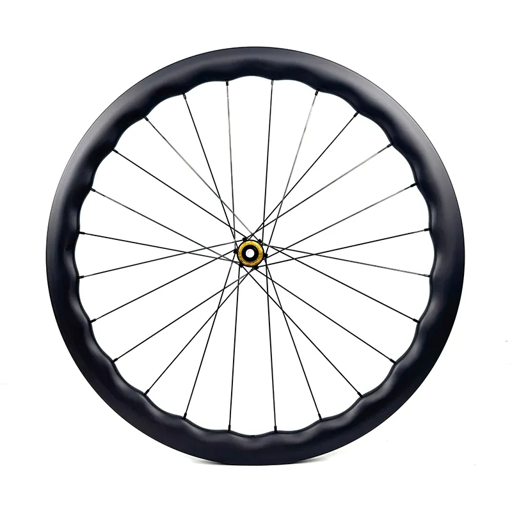
CHASE 45 AERO SL
A 45mm carbon road build using aero bladed spokes, aluminum nipples and a 36T ratchet hub.
Internal / external width: 22 / 28mm
Published wheelset weight: 1244 ± 30g
Spokes: 24 front / 24 rear
Brake interface: Centerlock disc
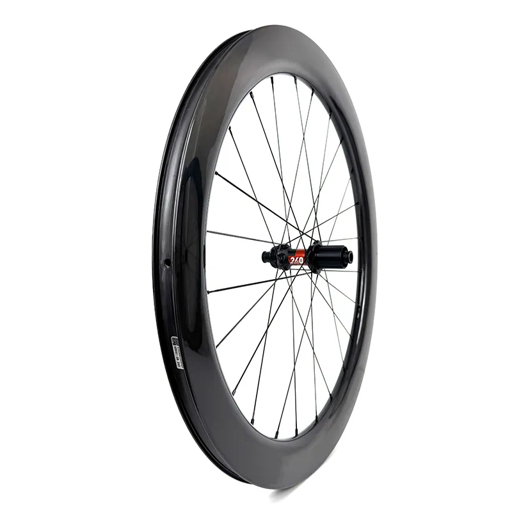
CHASE 60 AERO
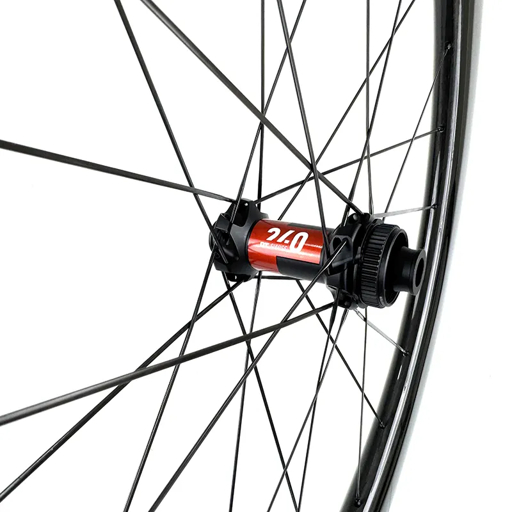
A 60mm carbon road build listing Sapim CX-Ray spokes, locking aluminum nipples and a DT Swiss 240 EXP hub.
Internal / external width: 21 / 28mm
Published wheelset weight: 1305 ± 30g
Spokes: 24 front / 24 rear
Brake format: disc brake
Specifications follow the published component tables. They do not disclose a wheel-specific tension map, allowable tension tolerance or independent stiffness test. Obtain the current build and service specifications from XDRU before any spoke adjustment. No comparative performance result is claimed here.
Spoke pretension, without the shortcuts.
Do carbon rims need less spoke tension than aluminum rims?
Not as a general rule. Material alone does not specify the target. Rim construction, attachment details and the complete build determine the approved tension.
Do the bottom spokes push upward on the hub?
Conventional spokes normally remain tensile. Under typical radial loading, the lower spokes pull downward less strongly. That reduction creates an upward change in the resultant force on the hub.
Does a higher spoke count remove the need for preload?
No. More spokes change the structure and load distribution, but conventional tension spokes still need appropriate pretension to work as intended.
Should both sides of a rear wheel have equal tension?
Often not. Different bracing angles commonly require different side averages. Compare equivalent spokes within each side and follow the build specification.
Why did tension readings drop after tire inflation?
Tire pressure can compress the rim and reduce spoke tension. Check the specified measurement condition before interpreting that as loosening. Do not exceed the approved build tension to compensate.
Can I tighten the spokes to make the wheel feel faster?
That is not a sound performance adjustment. Extra tension does not automatically increase useful stiffness and can overload the structure. Diagnose a suspected build problem with appropriate measurement and service guidance.
The rim provides the shape.
Pretension makes the system work.
A carbon wheel does not carry the rider through carbon alone. It relies on a carefully balanced structure that manages compression in the rim, tension in the spokes and changing forces at every revolution.
The right target is not the tightest spoke or the straightest unloaded rim in isolation. It is an approved, balanced build with the geometry and residual tension to do its job under load.