
Read the numbers.
Understand the wheel.
Carbon wheelset specifications explained: rim depth, internal width, external width, wheelset weight and load limits—and how those five numbers work together on the road.
A specification sheet can tell you a great deal. It can also encourage the wrong comparison. A deeper rim is not automatically a better rim. A lighter wheel is not automatically a better wheel. And a “120 kg limit” is incomplete information until you know exactly what is being weighed.
These illustrative numbers are not a compatibility approval. Tire type, pressure limits, included parts and intended use still need to be checked.
Read a carbon wheelset specification in this order: confirm bicycle and tire compatibility; interpret rim depth for your riding conditions; match internal width to an approved tire; assess external width with the mounted tire; compare weight on equal terms; then verify the exact load-limit definition. Compatibility comes before optimization.
Three dimensions. Three different jobs.
Rim depth, internal width and external width are independent measurements. Two rims can have the same depth and quite different tire compatibility. Two rims can share an internal width yet have different external shapes and aerodynamic behavior.
Measurement conventions matter. A disc-brake rim may be widest below the bead area, while a rim-brake specification may separately identify brake-track width. If a product drawing gives several external dimensions, preserve those distinctions instead of treating them as one interchangeable number.
Rim depth
Usually stated in millimeters
A shape and handling decision
Rim depth: what “45 mm” actually describes.
Rim depth is the radial height of the rim section, from its outer edge toward the hub. It is not the wheel diameter, tire height or total wheel-and-tire depth. A front/rear specification such as “45/55 mm” usually describes different rim depths at the two ends of the bicycle; confirm the manufacturer’s notation.
Increasing depth gives a designer more surface with which to manage airflow. A well-designed deeper rim can reduce drag in relevant conditions, but depth alone does not establish the result. Rim shape, mounted tire, spokes, yaw angle and the test method all influence measured performance.
| Approximate road-rim depth | Common design emphasis | What to examine |
|---|---|---|
| Under about 35 mm | Lower-profile climbing or handling-focused builds | Actual weight, stiffness, intended use and tire fit |
| About 35–50 mm | Mixed-terrain and all-round road performance | Wheel-and-tire aero evidence and gust response |
| About 50–65 mm | Greater aerodynamic emphasis | Front-wheel steering behavior and route exposure |
| Over about 65 mm | Specialized aero, racing or time-trial applications | Conditions, event rules and rider control |
These are editorial groupings, not technical standards, speed thresholds or guarantees of suitability.
Crosswinds are not just a question of depth.
Wind can generate side forces and steering moments. A rim’s shape and its response as the wind angle changes can matter as much as its nominal depth. Rider mass, riding position, road exposure and gustiness also influence how manageable the wheel feels.
The front wheel deserves particular attention because wind-induced steering effects are felt directly at the handlebar. A shallower front paired with a deeper rear can be a useful design choice, but it is not a universal prescription.
The fastest wheel on a test fixture is not necessarily the wheel you can ride fastest on an exposed descent.
There is no universal riding speed at which a deep rim suddenly “starts working.” Aerodynamic differences do not switch on at a threshold. Their practical value changes with speed, wind, terrain and how confidently you can use the wheel.
Internal width
Often written as “23 mm internal”
The tire interface comes first
Internal width: the number that changes the tire.
Internal rim width describes the spacing of the tire-supporting sidewalls at the specified location. It influences the mounted tire’s shape and volume, and it is central to tire/rim compatibility.
With the same tire model, a wider approved rim will often produce a wider mounted tire. The exact change depends on casing construction, rim geometry, pressure and settling time. There is no reliable universal rule that every additional millimeter of rim width adds a fixed amount of tire width.
Start with an approved combination—not a fashionable width.
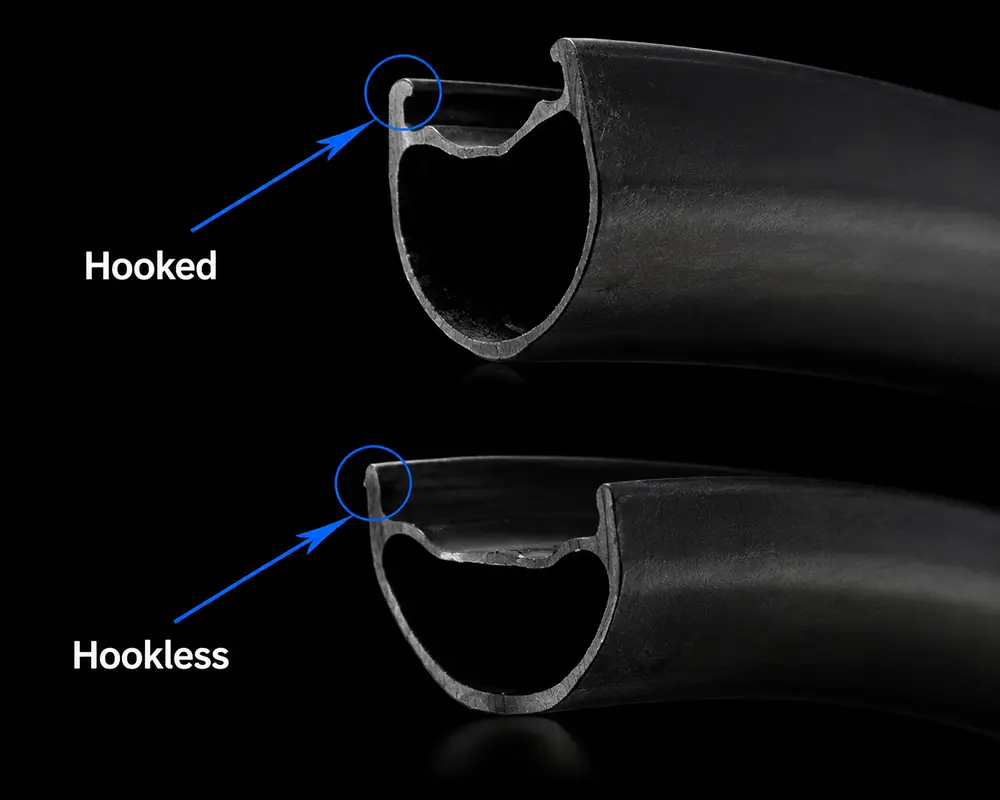
Check the wheel maker’s permitted tire sizes and the tire maker’s rim-width guidance for the exact model and construction. A nominal “28 mm” tire is not automatically approved for every modern road rim. Likewise, a tubeless-ready label does not by itself approve every hookless application.
“Hooked” and “hookless” describe the rim’s bead-retaining geometry. “Tubeless” describes a tire setup without an inner tube. A hooked rim can be tubeless-ready, and adding an inner tube does not make an otherwise incompatible tire safe on a hookless rim.
Pressure limits belong to the complete combination.
Follow the lowest applicable maximum from the wheel/rim, tire and relevant compatibility instructions. Limits can depend on tire size and rim type. Do not treat the tire sidewall’s maximum as permission to exceed the rim’s limit.
Schwalbe’s published guidance, for example, lists a 5 bar maximum for its 25–29 mm TLE/TLR tires on hookless rims, with lower maxima for several wider categories. This is an example of size-dependent guidance—not a blanket pressure recommendation for all wheels or tires.
Maximum pressure is a ceiling, not the desired riding pressure. Choose operating pressure using the approved setup, load distribution, measured tire size, surface and manufacturer guidance. If the required operating pressure would exceed an applicable maximum, choose a different approved configuration.
External width
Check where it is measured
Relevant to airflow and clearance
External width: read it beside the mounted tire.
External rim width is the outside-to-outside dimension at the stated location. It is not interchangeable with internal width: the difference includes the rim walls and their geometry, and the maximum width may occur lower down the section.
Aerodynamically, the tire and rim form a combined leading profile. That makes the actual inflated tire width more informative than the number printed on its sidewall. A tire sold as 28 mm may not measure 28 mm on your wheel at your operating pressure.
The often-quoted “105% rule” compares external rim width with measured tire width. It is a design heuristic, not a tire-fit approval, universal drag threshold or substitute for testing. A ratio alone cannot describe a modern rim’s full shape or predict its performance across wind angles.
Clearance requires more than a nominal tire size.
Check the actual inflated tire width and height against the bicycle manufacturer’s clearance requirements. Also confirm rim clearance, especially with wide profiles and rim-brake systems. Allow the required room for wheel movement and, where relevant, mud and debris.
On a rim-brake bike, brake-track dimensions, approved pads and caliper opening are additional constraints. A disc-brake wheel is not a rim-brake wheel simply because its diameter matches.
Wheelset mass
Usually quoted in grams
Only comparable on equal terms
Wheelset weight: first find out what is on the scale.
A claimed “1,450 g” needs a definition. Is it the pair or one wheel? Does it include rim tape, valves and the chosen freehub? Is it a nominal production figure, an individually measured example or a target with a stated tolerance?
Compare the same build state.
Use equivalent axle, freehub and spoke configurations. Check whether tape, valves, rotor lockrings or other accessories are included. Tires, sealant, cassette and rotors add further mass to the ready-to-ride assembly.
Do not confuse mass with quality.
Lower mass says nothing by itself about impact resistance, braking compatibility, bearing durability, lateral stiffness or spare-parts support. Those qualities need their own specifications and evidence.
Why location matters—but does not create “free” weight savings.
Mass near the rim contributes more rotational inertia than the same mass close to the axle. During acceleration, a wheel gains both forward-motion energy and rotational energy. The often-heard claim that wheel weight “counts double” is only a simplified special case for mass concentrated at the rolling radius—not a universal multiplier for an entire wheelset.
At steady speed, you are not repeatedly paying an acceleration cost just to keep the wheel rotating. On a climb, the gravitational cost of lifting a given mass depends on the total mass and elevation gained, not whether that mass sits in the hub or the frame.
Saving 200 g reduces the gravitational work of a 1,000 m ascent by approximately 1.96 kJ. This does not predict a finish-time saving: speed, drag, rolling resistance, drivetrain losses and rider output still matter.
Load rating
Usually stated in kilograms
The definition is safety-critical
Weight limits: rider mass is not system mass.
“Maximum rider weight” usually refers to the rider, but the manufacturer’s definition may include clothing or carried equipment. “Maximum system weight” generally includes the rider, bicycle and equipment or luggage. Always use the definition supplied for the exact product.
A limit labeled only “maximum weight” is ambiguous. Obtain a written clarification rather than assuming it excludes the bike. Two products displaying “120 kg” may therefore have materially different permitted use.
A load rating is not a permission slip for every surface.
Weight limits operate alongside intended-use categories. A road wheel rated for a particular system mass does not automatically become suitable for jumps, downhill riding or e-bike use. Impact loads, fatigue requirements and operating conditions differ.
Equally, dividing a system limit by two is not a valid way to calculate allowable load per wheel. Front/rear loads are unequal and change during braking, climbing and impacts. Use the wheelset manufacturer’s rating as intended.
The bicycle, wheels, tires and other components can carry different restrictions. All must be satisfied. When two limits use the same definition, the lower applicable limit governs. Do not directly compare a rider-only limit with a system limit without converting the load definition.
If your normal riding load sits close to a maximum, include water, tools, bags, seasonal clothing and expected load changes. Do not assume that a manufacturer’s test margin is spare capacity you are entitled to use.
How to read a wheelset specification as one connected system.
Revisit the illustrative 45 mm-deep, 23 mm-internal, 30 mm-external, 1,450 g wheelset with a 120 kg system limit. Those numbers describe a starting point—not a complete buying decision.
- 45 mm depth
- Suggests a mid-depth road profile. It does not establish a drag figure, crosswind rating or suitability for your exposed routes.
- 23 mm internal width
- Helps identify an approved tire range. It does not establish that every 28 mm tire is safe, particularly on a hookless rim.
- 30 mm external width
- Must be interpreted at its stated measurement location and beside the actual mounted tire—not used as a stand-alone aero score.
- 1,450 g claimed weight
- Needs a declared build state, freehub configuration and tolerance before comparison with another wheelset.
- 120 kg system limit
- Must include all items specified by the maker. It is not a 120 kg rider allowance unless explicitly defined that way.
- The missing information
- Rim type, tire approval, pressure limits, axle and freehub fit, braking system, use category, service support and warranty.
A better sequence for choosing carbon wheels.
- Confirm wheel diameter and bead-seat diameter, axle dimensions, brake interface and freehub compatibility with the bicycle.
- Choose an approved tire model and size for the intended surface, then verify rim type, internal-width compatibility and pressure limits.
- Check mounted-tire and rim clearance against the bicycle manufacturer’s requirements.
- Select depth around route exposure, handling confidence and the wheel-and-tire aerodynamic evidence available.
- Compare wheelset weight only after aligning configurations and included accessories.
- Calculate your normal loaded system mass and confirm every applicable limit and intended-use restriction.
- Ask about replacement spokes, bearings, freehub parts, service procedures and warranty terms.
Compare the configuration.
Not just the headline.
Use the XDRU carbon road wheelset collection to build a shortlist, then compare the current specification of each exact model and selected option.
Request the rim-section drawing, tire and pressure guidance, declared weighing conditions and precise load-limit definition. These make a more useful comparison than a model name or a single advertised weight.
Model names identify collection entries only. No shared rim width, weight, tire approval or load rating is implied here.
Carbon wheelset specifications: FAQ
Is a deeper carbon rim always faster?
No. A deeper rim can offer aerodynamic benefits, but the result depends on its shape, tire pairing, spokes and airflow conditions. Handling also matters: an aerodynamic advantage is less useful if gusts force you to brake, change position or ride cautiously.
Does a wider internal rim always improve comfort?
Not automatically. Internal width influences casing shape and volume, but comfort depends strongly on the tire, operating pressure, load and surface. Use an approved tire/rim pairing and appropriate pressure rather than treating width alone as a comfort rating.
Why does my 28 mm tire measure wider than 28 mm?
The printed size is nominal. Actual width depends on the tire’s construction, rim width, pressure and settling. Measure the installed tire at the intended operating pressure and check the required frame and fork clearances.
Can an inner tube make a non-approved tire safe on hookless rims?
No. A tube does not change the rim’s bead-retention geometry or establish tire compatibility. Use a tire and size explicitly approved for the rim and follow both manufacturers’ guidance.
Does a 120 kg wheel limit mean the rider can weigh 120 kg?
Only if the manufacturer explicitly defines it as a rider limit. A 120 kg system limit generally includes the rider, bicycle and equipment or luggage. Obtain the exact definition before deciding whether the wheel is suitable.
Should I choose a lighter wheelset or a deeper wheelset?
Neither attribute decides the question alone. Compare compatible complete builds for your terrain, wind exposure, tires, loaded mass and handling needs. Use actual weight and relevant aerodynamic evidence rather than assuming every light wheel climbs best or every deep wheel is faster everywhere.