
The Spoke Connection
That is a mistake.
The spoke-to-hub connection affects wheel design, serviceability, fatigue behavior, replacement options, and the way a builder manages tension during assembly. But it is also an area full of oversimplified claims. Straight-pull spokes are not automatically stronger. J-bend spokes are not automatically outdated. In both systems, the quality of the spoke, hub interface, rim, lacing pattern, and wheel build matters more than the name printed on the specification sheet.
The most useful way to understand the difference is to separate the spoke itself from the wheel around it.
It works as part of a pre‑tensioned structure.
01 What Is a J‑Bend Spoke?
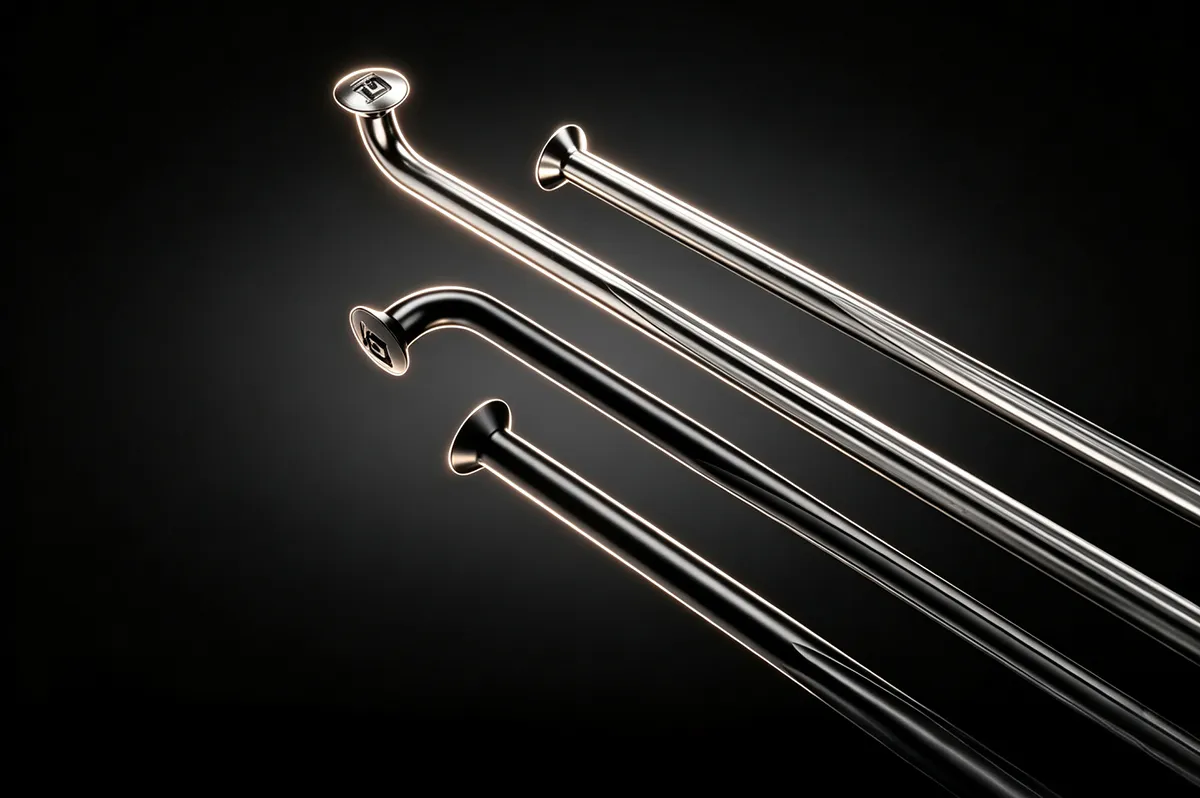
A J-bend spoke has a hooked section near the hub end. The spoke passes through a hole in the hub flange, and the bend rests against the flange as the wheel is tensioned.
The bend is typically close to 90 degrees, although the exact shape depends on the spoke and hub design. The spoke head may sit on the inside or outside of the flange, depending on the lacing pattern and the builder’s chosen arrangement.
The other end of the spoke is threaded and receives a nipple at the rim.
How a J-bend spoke transfers load
- The spoke head bears against the hub flange.
- The bent elbow is supported by the flange hole and surrounding metal.
- The straight spoke section carries tension toward the rim.
- The nipple transfers tension into the rim’s spoke bed.
This is the source of many J-bend problems—not simply the existence of the bend.
Why J-Bend Spokes Remain Popular
- They work with a broad range of hub designs.
- Replacement spokes are widely available.
- Hub geometry is relatively easy to standardize.
- Spoke installation is familiar to most wheel builders.
- The bent head helps prevent the spoke from spinning during tensioning.
- Many different lengths and profiles are available.
- A damaged spoke can often be replaced without removing the cassette or tire.
For custom wheels and long-term ownership, replacement availability is a serious advantage. A wheelset may remain structurally sound for many years, but the original spoke model may eventually become unavailable. A standard J-bend format generally offers more alternatives.
02 What Is a Straight‑Pull Spoke?
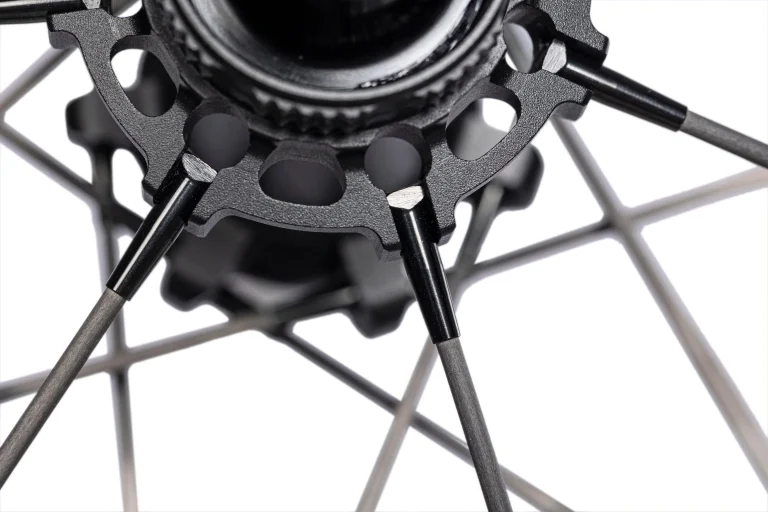
A straight-pull spoke has no hooked elbow at the hub end. Both ends remain essentially straight, although the hub end includes a specially formed head, shoulder, or anchor that locks into a dedicated hub flange.
Because the spoke has no J-shaped bend, the hub must be designed specifically for straight-pull spokes. The spoke holes, slots, flange thickness, and spoke-head support all differ from a traditional J-bend hub.
How a straight-pull spoke transfers load
- Its formed head or anchor.
- The hub’s dedicated slot or pocket.
- The flange material surrounding that interface.
- The straight spoke shaft.
- The threaded end and nipple at the rim.
That distinction matters.
Straight-pull does not eliminate stress. It changes where the stress is concentrated and how the hub must support it.
Why Straight-Pull Spokes Are Used
- A direct, clean spoke path.
- Greater freedom in flange and hub geometry.
- Potentially lower spoke bend stress.
- A visually tidy appearance.
- Fewer traditional elbow-related variables.
- Opportunities for compact or highly integrated hub designs.
The spoke and hub must be designed as a matched system. A straight-pull spoke is not a universal replacement for a J-bend spoke of the same length and diameter.
03 The Most Important Point: Spokes Carry Tension
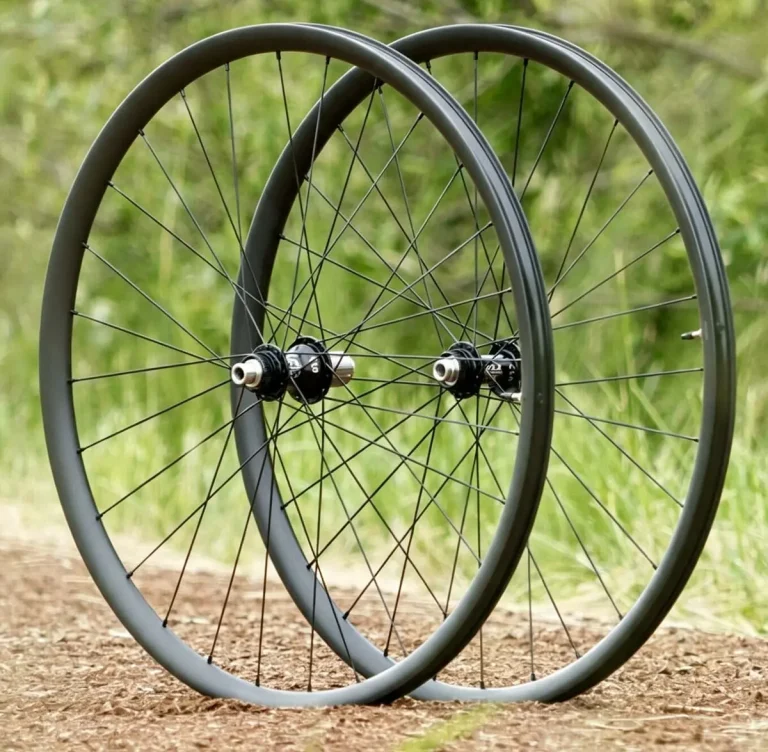
A bicycle wheel is not strong because the spokes act like rigid rods supporting the rider from below. A well-built wheel works mainly through tension. Bicycle Wheel Spoke Patterns and Spoke Fatigue
The rim is held in compression by the tensioned spokes. When the rider’s weight loads the wheel, the spokes near the contact area lose some tension, while the rest of the wheel continues carrying the load.
If a spoke loses most or all of its tension every wheel revolution, it can experience larger stress changes. Repeated stress cycles are a major contributor to fatigue.
A useful simplified relationship is:
For fatigue life, stress range is often more important than static strength alone. A spoke that is extremely strong when pulled once may still fail prematurely if it experiences repeated, poorly controlled stress cycles.
This is why a high-quality wheel build requires:
- Correct initial tension.
- Even tension distribution.
- Adequate rim support.
- Proper spoke seating.
- Stress relieving.
- Suitable lacing geometry.
- Correct tension limits for the rim and hub.
04 Straight‑Pull vs J‑Bend: The Structural Difference
| Feature | Straight-pull | J-bend |
|---|---|---|
| Hub connection | Dedicated head, slot, or pocket | Hooked elbow through flange hole |
| Spoke shaft | No bend near the hub | Contains a formed elbow |
| Hub compatibility | Requires a specific hub design | Works with standard J-bend hubs |
| Replacement availability | Often more limited | Usually broad |
| Installation | May require anti-rotation control | Generally familiar and straightforward |
| Potential stress location | Spoke head and hub slot | Elbow, head, flange hole, or interface |
| Design flexibility | Strong within a dedicated system | Broad across conventional hub formats |
| Visual appearance | Clean and direct | Traditional and widely recognized |
| Serviceability | Can be more model-specific | Often easier in the field |
| Absolute strength | Depends on system design | Depends on system design |
The table is useful, but it does not prove that one style is stronger. Strength must be evaluated at the system level.
05 Is Straight‑Pull Stronger?
This is the question riders ask most often.
Straight-pull spokes remove the traditional elbow, which can be a fatigue-sensitive area if it is poorly supported or repeatedly flexed. That is a genuine engineering advantage.
However, a straight-pull design introduces other highly loaded areas:
- The spoke head.
- The transition between the head and shaft.
- The hub slot.
- The flange material around the slot.
- The seating surface inside the hub.
If the spoke head is poorly shaped or the hub slot does not support it properly, stress can concentrate there instead.
The same principle applies to J-bend spokes. A correctly supported J-bend can be extremely durable. A poorly supported elbow can move under load, producing fretting, bending, and fatigue.
06 What Makes Each Reliable?
J‑Bend Reliability
- The flange hole matches the spoke head and diameter.
- The elbow is supported by the flange.
- The spoke exits the hole without a sharp kink.
- The lacing pattern does not force excessive bending.
- The wheel is correctly tensioned.
- The spokes are stress-relieved after assembly.
- The spoke is not allowed to wind up during tensioning.
Straight‑Pull Reliability
- The spoke head fits the hub pocket correctly.
- The slot provides adequate support.
- The spoke exits the hub on a clean line.
- The flange has sufficient material around the slot.
- The hub prevents excessive spoke movement.
- The builder controls wind-up during tensioning.
- Replacement spokes match the original specification.
Straight-pull removes one common failure mode. It does not remove the need for good engineering.
07 Fatigue: Where Spokes Usually Fail
Spoke failure is normally associated with repeated loading rather than a single ordinary pedal stroke.
A spoke may eventually fail at:
- The hub elbow.
- The spoke head.
- The thread.
- The transition between butted sections.
- A damaged or corroded area.
- A point that has repeatedly rubbed against another spoke.
- A location affected by poor tension or excessive flexing.
J‑bend fatigue
J-bend failures often occur near the elbow because this region experiences a change in direction and may flex if unsupported.
Risk increases when:
- The hub hole is too large.
- The spoke elbow is not seated against the flange.
- The spoke exits at an angle that does not match the hub.
- The wheel has low or uneven tension.
- The spoke was not stress-relieved.
- The spoke repeatedly moves against the flange.
Straight‑pull fatigue
Straight-pull spokes may reduce elbow-related fatigue, but the spoke head and hub slot still experience repeated load.
Possible failure points:
- The transition from spoke shaft to head.
- The retaining shoulder.
- The hub slot edge.
- The area where the spoke head contacts the flange.
- A section that has been damaged during installation.
08 Torque Distribution and Hub Geometry
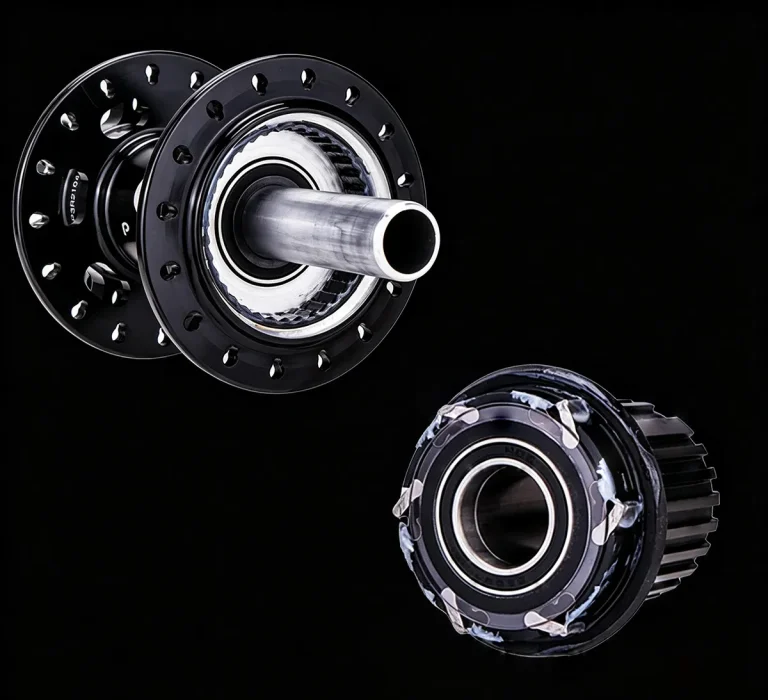
A rear hub must balance lateral bracing angle, flange spacing, drive-side and non-drive-side tension, crossing pattern, cassette position, axle stiffness, bearing support, and wheel dish.
Why rear-wheel tension is unequal – on a dished rear wheel, the drive-side flange is closer to the centerline, reducing the bracing angle. Drive-side spokes often require higher tension.
This imbalance is not caused by straight-pull or J-bend construction – it is mainly a consequence of wheel dish and hub geometry.
Straight‑pull flange design
Gives engineers more freedom to position spoke anchors and shape the flange. Can optimize bracing angles, flange diameter, spoke alignment, clearance, load paths, and hub-shell stiffness.
But the result depends on the particular hub. A straight-pull hub does not automatically have better geometry.
J‑bend flange design
Offers a more traditional arrangement with circular flange holes. Geometry can still be highly optimized – good bracing angles, adequate flange diameter, proper elbow support, easy replacement, and strong torque transfer.
Flange diameter and spacing generally have a greater influence than the spoke-end format alone.
09 Does Straight‑Pull Improve Power Transfer?
Straight-pull marketing often suggests a stiffer or more efficient wheel. There can be a benefit if hub geometry improves bracing angle or reduces unwanted bending. But the effect should not be exaggerated.
Pedaling torque transfer depends on spoke count, diameter, tension, flange diameter, spacing, lacing, rim stiffness, depth, tire pressure, rider power, frame, and axle stiffness.
In many real-world wheels, the largest differences in lateral stiffness come from wheel geometry and spoke tension rather than straight-pull vs J-bend.
A research study of bicycle wheel behavior found that spoke strain under real riding conditions was relatively insensitive to spoke pattern, with fatigue life influenced more by spoke fatigue resistance, diameter, arrangement, and rim properties.
10 Engagement at the Hub: A More Precise View
The spoke does not pull directly from the center of the hub – it anchors at the flange. The distance from the axle center to the spoke hole is the flange radius, creating leverage.
A larger flange radius can reduce the tangential spoke force required to transmit a given torque. Flange geometry often matters more to torque transfer than whether the spoke is straight-pull or J-bend.
11 Wheel‑Building Differences
Building with J‑bend
- Spoke head naturally locates in the flange hole.
- Bend helps resist rotation during tensioning.
- Predictable lacing sequence.
- Easy to identify inside/outside.
- Straightforward replacement.
Ensure every elbow is properly seated – a spoke that looks correctly installed may still settle during tensioning.
Building with straight‑pull
- Requires more attention to prevent rotation within the hub interface.
- Especially with bladed, lightweight, or high‑tension spokes.
- May need to hold spoke with a tool while tightening.
- Twist can retain torsional wind‑up.
A professional build should include controlled tension increase, anti‑rotation technique, stress relieving, final tension measurement, and rechecking after settling.
12 Serviceability and Replacement Spokes
J-bend spokes have a practical advantage: a broken spoke can often be replaced with a common model matching length, diameter, profile, thread, head style, and material.
Straight-pull spokes are more dependent on the exact hub interface – replacement must match length, diameter, head design, anchor shape, orientation, and hub model. A visually similar spoke may not fit correctly.
For premium carbon wheelsets, replacement support should be considered at the time of purchase—not after a spoke breaks.
13 Maintenance Requirements
Critical areas: spoke tension, rim condition, hub flange wear, spoke‑head seating, corrosion, thread condition, nipple movement, cross‑spoke contact, wheel trueness.
J‑bend maintenance
- Inspect elbow for cracks, polished wear marks, fretting.
- Check if bend is still fully supported.
- If repeatedly breaking at elbow, check hole size, elbow fit, lacing, tension, alignment.
Straight‑pull maintenance
- Inspect spoke head, hub slot, shoulder, fretting, flange cracks.
- Check spoke rotation or looseness.
- Ensure replacement spokes seat correctly.
A tension meter provides more useful information than appearance alone.
14 Spoke Tension, Stress Relief, and Fatigue
A newly built wheel contains residual stresses and small seating changes. Stress relief helps seat heads, settle elbows, stabilize threads, release torsional wind‑up, and make tension more consistent. This matters for both spoke types.
If stress relief is skipped, a wheel may change tension after its first rides – leading to loose spokes, loss of true, repeated re‑truing, uneven load sharing, and increased fatigue stress.
15 Weight: Is Straight‑Pull Lighter?
Straight-pull spokes can contribute to a lighter hub or wheel design, but the difference is not guaranteed. Potential savings include compact heads, flange optimization, reduced material. However, straight‑pull hubs may require reinforced slots or extra material.
When comparing complete systems, examine rim + hub + spokes + nipples + tape + valves + bearings + end caps + freehub body. A few grams at the hub are often less important than tire choice, rim depth, and aerodynamics.
16 Aerodynamics and Spoke Shape
Spoke profile can affect drag – bladed or ovalized spokes may reduce drag compared with round spokes. This is separate from straight‑pull vs J‑bend. Both formats can use round, bladed, aero, butted, stainless, or other profiles.
The majority of aerodynamic interaction occurs along the exposed spoke length and around the rim – not at the hub connection.
17 Straight‑Pull vs J‑Bend for …
Road Wheels
Straight‑pull
- Clean spoke path
- Good for lightweight performance when hub geometry is excellent
- Check replacement availability
J‑bend
- Excellent practicality
- Standard replacement spokes
- Durable with proper tension and lacing
Choose based on rim/spoke aerodynamics, weight, bracing angle, spoke count, tension consistency, hub quality, service support – not just fashion.
Gravel
Prioritize durable material, strong rim‑spoke interface, tension retention, easy replacement, contamination resistance, appropriate spoke count, impact tolerance. J-bend is attractive for remote riding; straight‑pull can be reliable with correct spares.
MTB
High lateral impacts, torque changes, rock strikes, mud. Straight‑pull needs robust spoke‑head and flange‑slot design. J‑bend offers excellent serviceability and rebuildability with standard components – a meaningful benefit for remote racing.
E‑Bikes
Confirm max approved rider/bike weight, motor torque compatibility, wheel load rating, spoke gauge, rim impact rating, bearing support, freehub durability, and replacement availability. Load rating matters more than visual appearance.
18 Common Myths
19 How to Choose the Right Spoke System
Choose straight‑pull when:
- Hub has well‑supported anchors.
- Wheel is designed as an integrated system.
- You value a clean spoke path.
- Manufacturer provides replacement parts.
- Geometry suits your riding.
- You have access to a competent builder.
Choose J‑bend when:
- You want broad replacement availability.
- You value field serviceability.
- You prefer standard components.
- You want freedom in hub and spoke selection.
- Building touring, gravel, or utility wheels.
- Working with a builder experienced in conventional wheels.
For both systems: use a spoke spec appropriate for rider and terrain, match length carefully, check tension limits, stress‑relieve, measure final tension, inspect after first rides, keep replacement parts available.
20 What Matters More Than Straight‑Pull or J‑Bend?
- Correct rim design.
- Appropriate spoke count.
- Accurate spoke length.
- Proper bracing angles.
- Even spoke tension.
- Correct maximum tension.
- High‑quality nipples.
- Adequate hub‑flange support.
- Stress relief.
- Professional quality control.
21 Final Verdict
Straight-pull and J-bend spokes are two different ways of connecting a tensioned spoke to a hub. Straight-pull removes the traditional elbow and allows dedicated hub designs; J-bend uses a proven hooked interface with broad compatibility and excellent serviceability.
Straight-pull can reduce elbow‑related stress and provide greater hub packaging freedom. J-bend can be easier to source, easier to repair, and highly reliable when the elbow is properly supported.
Neither is universally stronger.
The best choice depends on hub geometry, spoke material, rim design, spoke count, lacing, tension, stress relief, rider weight, terrain, and replacement support.
That is where durable wheels are made.