
Why are carbon fiber wheelsets so expensive? Is the material expensive or the process complicated? Today I will take you into the carbon fiber wheelset rim factory to reveal the whole process of carbon fiber wheelset production from pre-processing to finished product testing.
These refrigeration rolls are aviation-grade prepregs, the same carbon fiber base materials used by Airbus and Boeing. The resin must be stored at low temperature after impregnation to prevent heat-activated curing:
Once out of the warehouse, the resin activity countdown starts, and the unidirectional carbon fiber layup officially debuts. The fibers of the first layer are oriented;
The second layer is 45° cross-stacked, like intertwined super-strong muscles, achieving high strength in both directions. This is also the key to both lightweight and durability of the wheel. CNC vibrating knife cutting replaces laser cutting to avoid premature thermal curing of the resin, cuts neatly without pulling fibers, and accurately cuts out customized parts such as the rim body, spoke hole reinforcement sheets, and bead hook blanks. In the manual rolling of bead hooks, the accuracy of workers’ operations directly determines the quality of the finished product.
This production line adopts the design of separating the lamination mold and the curing mold, breaking the public’s misunderstanding of one-step molding. Under laser positioning, the spoke hole reinforcement sheets are accurately pasted; the air bag is carefully placed and stretched to remove pleats; the bead hooks are accurately installed; the carbon fiber sheet is folded and packaged into a tire bed, and the rubber mold is escorted throughout the process to prevent the uncured prepreg from being deformed by force and directly scrapped. Finally, a weighing check is performed to ensure that each blank meets the specifications.
Hundreds of kilograms of solid steel molds are first pre-processed and cleaned, loaded into wheel rim blanks, and then tightly sealed. The production line abandons the traditional autoclave process and adopts air bag inflation and pressurization and thermal oil circulation heating processes to allow the resin to fully flow and solidify evenly. During the cooling stage, circulating water is used to rapidly cool down, which not only ensures a stable solidification effect, but also greatly improves the overall production efficiency.
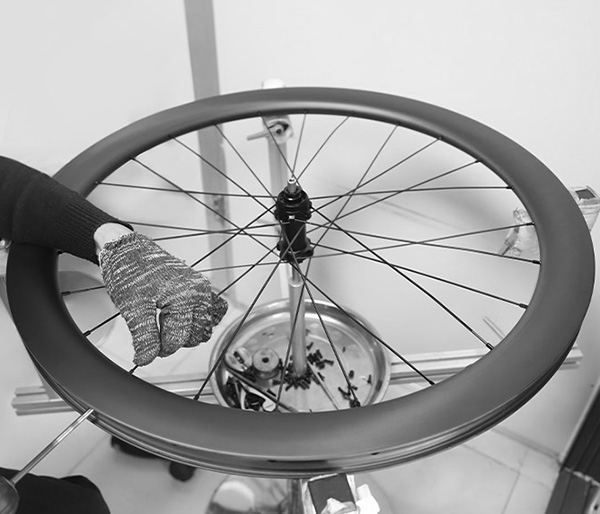
The mold is opened, and the cured wheel rim is revealed. Workers first cut off the edge burrs, then completely pulled out the air bag from the valve hole, and then accurately drilled holes by automated equipment. The entire workshop is equipped with dust collection equipment for continuous operation to eliminate the health irritation caused by carbon fiber dust, while taking into account process accuracy and production safety.
Each rim must pass five tests and six tests, and complete all-round inspections of weight, deflection, and appearance. The 160 psi high-pressure air tightness test has zero leakage. Special quality inspection of spoke holes thoroughly eliminates structural hidden dangers.
Prepregs must be sampled and inspected in batches before being put into storage, and 32 layers of standard samples are used to retain mechanical data through pull-off tests. The destructive test of the wheel set is even more shocking: heavy objects are freely dropped from a specific height and impacted until the wheel rim is structurally damaged. Test results show that the rim can ultimately withstand an impact of 130 joules before failing. Behind the hard-core performance is the accumulation of countless experiments by the R&D team!
After reading this complete process, do you still think the price of carbon fiber wheelset is unreasonably expensive?
- Top 10 Best Spoke Brands for Bicycle Wheels in 2026
- Straight-Pull vs J-Bend Spokes: Complete Bicycle Wheel Guide
- Ratchet vs Pawl Hub Systems: Which Is Better for a Carbon Wheelset?
- Are 29 inch carbon mountain bike wheels worth it?
- 700c Carbon Disc Wheelset: What Really Matters Before You Buy
- Are Carbon Gravel Wheels Worth It? Performance, Ride Feel & Buying Guide
- Wheel Guide · Materials & Ride Feel
- Wide vs. Narrow Rims: The Quiet Revolution in Cycling Performance
- Can Beginners Ride Carbon Wheels?
- Bicycle Hub Bearing Maintenance Guide: Service, Adjustment & Replacement