
The Freehub Engagement Decision
The two dominant freehub designs are the pawl system and the ratchet system. Both allow the rear wheel to drive forward while freewheeling smoothly in the opposite direction. The difference lies in how they engage, how they distribute torque, how they wear, and how they behave in real-world riding conditions.
Neither system is automatically “better” in every situation. A well-designed pawl hub can outperform a poorly engineered ratchet hub, while a properly manufactured ratchet hub can deliver outstanding durability and consistent engagement over many seasons.
It is: Which engagement mechanism matches your riding style, torque demands, maintenance habits, and expectations for a wheelset?
01 What Does a Freehub System Do?
The rear hub has two separate jobs.
First, it supports the rear wheel and transfers pedaling force to the rim through the hub shell, axle, and spokes.
Second, it must allow the cassette and chain to stop driving the wheel when you coast.
If the rear wheel were permanently connected to the cassette, the pedals would continue rotating whenever the wheel moved. The freehub mechanism solves this problem by allowing power transmission in one direction while permitting overrunning in the other.
During pedaling
When you apply force to the pedals:
- The chain turns the cassette.
- The cassette turns the freehub body.
- The freehub mechanism locks against the hub shell.
- Torque passes through the hub shell and into the spokes.
- The spokes transfer that force to the rim and tire.
During coasting
When you stop pedaling:
- The wheel continues rotating.
- The hub shell rotates with the wheel.
- The freehub body turns more slowly or remains relatively stationary.
- The engagement components slide, click, or roll over one another.
- The wheel continues moving without forcing the crankset to rotate.
⚡ That clicking sound is not wasted power by itself. It is the audible result of the freehub’s engagement components moving over one another while the hub is overrunning.
A loud freehub is not necessarily more efficient, and a quiet freehub is not automatically weaker. Sound depends on tooth geometry, spring tension, lubrication, sealing, material, and hub-shell design.
02 How a Pawl Hub Works
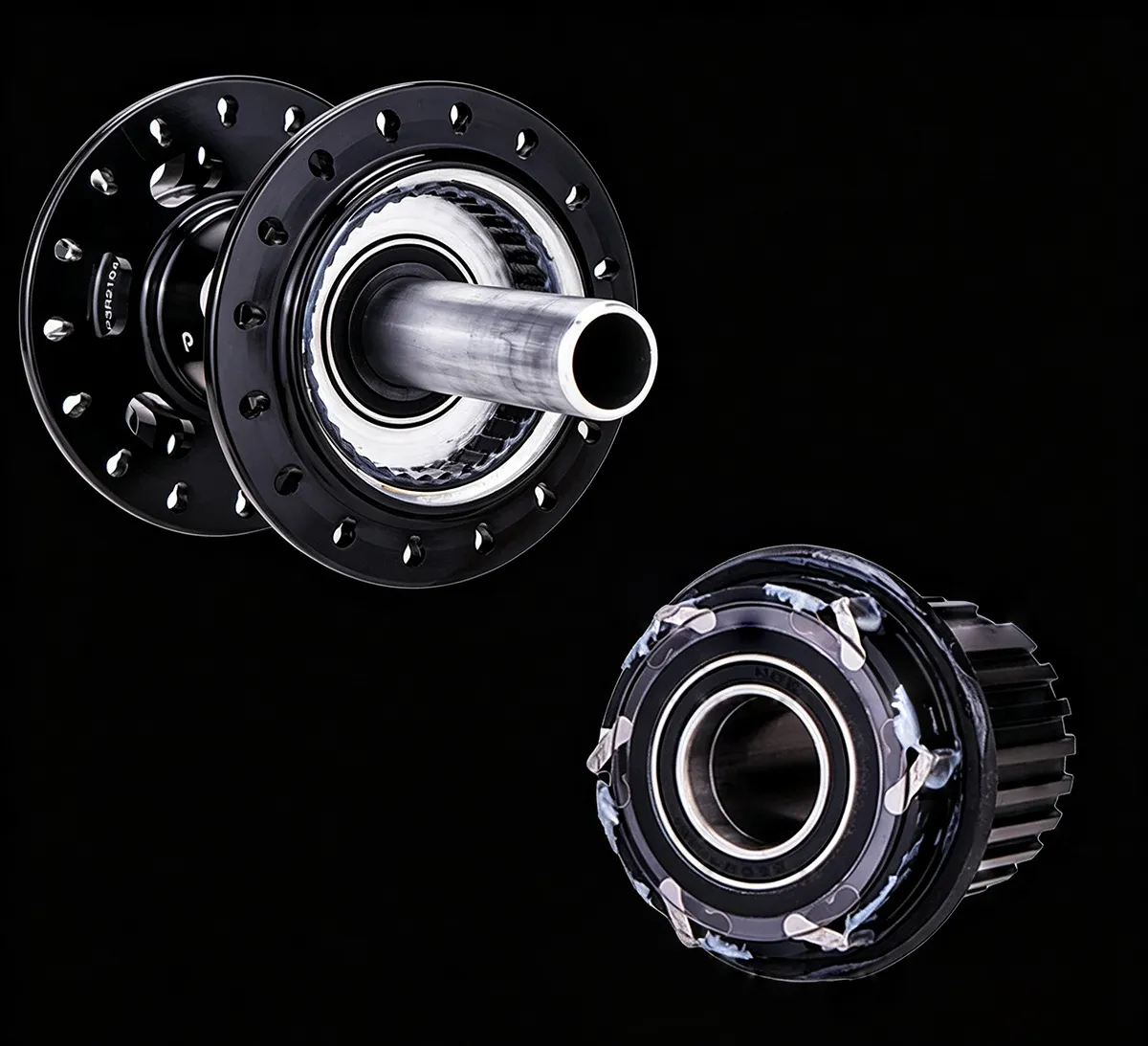
A pawl freehub uses several small mechanical levers called pawls. These pawls are usually mounted either inside the freehub body or inside the hub shell, depending on the design.
Each pawl is pushed outward by a small spring. Inside the hub is a toothed ring, commonly called a drive ring or ratchet ring. When the rider pedals, the pawls catch against the teeth of this ring and lock the freehub body to the hub shell.
When the rider coasts, the pawls slide over the teeth. Their spring-loaded design allows them to repeatedly rise and fall, creating the familiar clicking noise.
Basic pawl engagement sequence
A typical pawl system works like this:
- The cassette rotates the freehub body.
- The pawls rotate with the freehub.
- Spring force pushes the pawls toward the drive ring.
- The pawl tips contact the ratchet teeth.
- The angled surfaces allow forward engagement and reverse overrunning.
- Once engaged, the pawls transfer torque into the hub shell.
Pawl systems generally use two, three, four, six, or more pawls. Some designs place the pawls at different angles or use multiple pawl groups that engage progressively.
What Determines Pawl Engagement?
Engagement is influenced by several factors:
- Number of ratchet teeth.
- Number of pawls.
- Pawl timing or phasing.
- Shape and height of the pawl teeth.
- Spring tension.
- Manufacturing tolerances.
- Clearances between the freehub body and hub shell.
- Condition of the lubrication and sealing system.
If a pawl hub has 36 equally spaced ratchet teeth, the theoretical engagement interval is:
That means the freehub can rotate up to 10 degrees before the next tooth engages. Depending on the pawl arrangement, the effective engagement interval may be reduced.
For example, a phased pawl system may use several pawls that engage at slightly different points. In that case, the advertised engagement figure may be higher than the number of teeth in the drive ring alone.
This is why “six pawls” does not automatically mean “six times faster engagement.”
03 How a Ratchet Hub Works
A ratchet freehub, often called a star ratchet system, replaces individual pawls with two toothed rings.
These rings face one another inside the hub. Each ring has teeth around its entire circumference. Springs push the rings together so that their teeth remain meshed when the rider applies power.
One ring is connected to the freehub body. The other is connected to the hub shell. When the rider pedals, the two rings lock together and rotate as one unit.
When the rider coasts, the angled tooth faces slide over one another. The springs compress and release as the rings pass across the teeth, creating the clicking sound.
Basic ratchet engagement sequence
- The cassette rotates the freehub body.
- The freehub drives one toothed ring.
- Springs push the two rings together.
- The teeth mesh across the complete circumference.
- Torque is distributed through the engaged tooth faces.
- During coasting, the rings slide over one another in the opposite direction.
A pawl system engages through several separate levers. A ratchet system engages through two complete toothed rings.
This does not mean that every tooth carries exactly the same amount of load under every condition. Tolerances, alignment, axial movement, lubrication, and tooth geometry still matter. However, the load is generally distributed over a broader contact area than in a conventional point-contact pawl design.
04 Ratchet vs Pawl: The Core Differences
| Feature | Pawl system | Ratchet system |
|---|---|---|
| Main components | Pawls, springs, and toothed drive ring | Two opposing toothed rings and springs |
| Engagement style | Several localized contact points | Broad ring-to-ring tooth engagement |
| Typical design flexibility | Very high | More standardized, depending on design |
| High engagement potential | Excellent in advanced designs | Good, but tooth count is limited by tooth size |
| Load distribution | Concentrated at pawl tips | Distributed across multiple tooth contacts |
| Small-part count | Higher | Usually lower |
| Maintenance sensitivity | Higher around pawls and springs | Generally simpler internally |
| Common failure concerns | Pawl sticking, spring fatigue, tooth damage | Ring wear, spring damage, poor seating, contamination |
| Weight potential | Often very light | Can be slightly heavier, depending on design |
| Sound | Often sharp and distinct | Can be smooth, loud, or relatively subdued |
| Upgrade path | May require freehub or internal components | Often changed by replacing ratchet rings |
| Best-known advantage | Fast engagement and design flexibility | Consistent engagement and broad load distribution |
The table gives a useful overview, but the real engineering differences deserve closer attention.
05 Engagement Speed & Engagement Angle
Many riders focus on engagement points because they want the rear wheel to respond immediately when they resume pedaling.
The key measurement is not simply the number of points. It is the engagement angle.
A smaller engagement angle means less crank or freehub rotation before the drivetrain begins driving the wheel again.
When faster engagement matters
Fast engagement can be especially useful in:
- Technical mountain-bike sections.
- Rock gardens and repeated pedal corrections.
- Cyclocross.
- Short, steep climbs.
- Trials-style riding.
- Sprinting out of slow corners.
- Gravel riding on loose, irregular terrain.
On a smooth road, however, the practical difference may be less dramatic than the specification suggests. Once the bike is moving quickly, a few degrees of freehub movement rarely determine the result of a sprint or climb.
Pawl engagement options
Pawl systems have considerable freedom in how they achieve fast engagement. Manufacturers may use:
- More ratchet teeth.
- More pawls.
- Offset pawls.
- Multiple pawl groups.
- Larger or more complex drive rings.
This flexibility allows some pawl hubs to achieve extremely small engagement angles. The trade-off is that adding more components can increase manufacturing complexity and maintenance demands.
Ratchet engagement options
Ratchet systems can also be upgraded with higher-tooth rings. A common example is moving from a lower-tooth ring to a 54-tooth or similar design.
However, increasing tooth count reduces tooth size. If the teeth become too small, they may be less resistant to high torque, impact loading, contamination, or manufacturing variation.
Faster engagement is useful, but a tooth must still be large enough and strong enough to survive real-world loads.
For road use, a moderate-tooth ratchet can offer an excellent balance between responsiveness and durability. For aggressive mountain-bike use, the ideal choice depends on rider weight, torque, terrain, and the manufacturer’s tooth geometry rather than the tooth count alone.
06 Torque Transmission & Load Distribution
The most important difference between the two systems appears when the rider applies high torque.
A bicycle drivetrain can produce substantial instantaneous force during:
- Standing climbs.
- Low-cadence climbing.
- Sprinting.
- E-bike acceleration.
- Loaded touring.
- Technical off-road riding.
- Riding by heavier or especially powerful cyclists.
⚙️ Pawl load concentration
In a pawl hub, the drive force is transferred through the pawl tips and the mating teeth in the drive ring.
Although several pawls may be present, the actual load distribution is not always perfectly equal. Tiny differences in manufacturing tolerance, spring force, alignment, or contact timing can cause one pawl to carry more load than another.
This does not make pawl systems inherently weak. Quality pawl hubs are designed specifically to handle these forces. But the contact area is typically smaller and more localized than in a face-to-face ratchet system.
Potential consequences of poor design or poor maintenance: Rounded pawl tips, chipped ratchet teeth, pawls failing to seat fully, uneven load transfer, freehub skipping under heavy torque, damage caused by partial engagement.
The most dangerous condition is not necessarily normal wear. It is incomplete engagement.
If a pawl is only partly seated against a drive tooth, the contact area becomes very small. The resulting stress can be much higher than during full engagement. Under a powerful pedal stroke, the pawl may slip, deform, or damage the drive ring.
⏺ Ratchet load distribution
A ratchet system uses multiple teeth distributed around the circumference. When properly seated, the load is shared across a much larger engagement interface.
This can reduce localized stress and help maintain consistent performance over time. It is one reason ratchet systems are often favored for riders who prioritize long-term reliability and predictable torque transfer.
But “more contact” does not mean “indestructible.”
Ratchet rings can still wear or fail because of:
- Excessive torque.
- Incorrect lubrication.
- Contamination.
- Misalignment.
- Damaged springs.
- Improper assembly.
- Worn splines.
- Using a high-tooth ring outside its intended application.
A ratchet system also depends on the two rings sitting squarely against one another. If one ring is damaged, contaminated, or not fully seated, the intended load distribution can be compromised.
07 Durability: What Actually Determines Service Life?
It is tempting to say that ratchet systems last longer because they distribute force more evenly. There is truth in that, but the complete answer is more nuanced.
Durability depends on the interaction of:
- Material quality.
- Heat treatment.
- Tooth geometry.
- Surface finish.
- Axle and bearing alignment.
- Spring design.
- Sealing.
- Lubricant choice.
- Rider weight and torque.
- Weather and terrain.
- Maintenance frequency.
- Manufacturing tolerances.
A premium pawl hub can last for years with minimal trouble. A low-quality ratchet hub can suffer premature wear if its rings are poorly machined or its springs do not provide adequate preload.
Pawl durability
A pawl system has more small moving parts. Each pawl must pivot or move freely, and each spring must maintain sufficient force to keep the pawl in contact with the drive ring.
Common causes of pawl problems:
- Thick or unsuitable grease.
- Dirt and moisture inside the mechanism.
- Corrosion.
- Spring fatigue.
- Pawl pivot wear.
- Poor freehub sealing.
- Insufficient inspection after water exposure.
A pawl can appear visually intact but still fail to engage reliably if it moves slowly or does not return completely.
Ratchet durability
A ratchet system is mechanically simpler in one important respect: it eliminates individual pawl pivots and tiny pawl springs.
The rings normally require:
- Correct cleaning.
- A thin layer of suitable grease.
- Inspection for chipped or rounded teeth.
- Inspection of the springs.
- Correct seating on the splines.
- Correct end-cap and freehub assembly.
Because the system has fewer delicate levers, it can be more tolerant of certain types of contamination. However, the rings are precision components. Damage to the teeth or splines can affect the entire engagement interface.
Ratchets often offer more consistent long-term engagement, while pawls can offer excellent durability when their small components are kept clean, mobile, and correctly lubricated.
08 Maintenance & Serviceability
A hub’s service life is strongly influenced by whether the owner can maintain it easily.
Pawl maintenance
Pawl maintenance commonly involves:
- Removing the freehub body.
- Cleaning the pawls and drive ring.
- Inspecting the pawl springs.
- Checking that each pawl pivots freely.
- Applying a light lubricant or manufacturer-approved grease.
- Reassembling without trapping or dislodging the springs.
The most common maintenance mistake is using too much grease.
Heavy grease can slow the pawls’ movement, especially in cold conditions. If a pawl cannot spring outward quickly enough, it may fail to engage fully. The hub may then skip under load.
A thin, appropriate lubricant is usually safer than filling the entire mechanism with dense grease. Always follow the hub manufacturer’s service instructions, because spring design and sealing vary.
Ratchet maintenance
Ratchet service is often more straightforward:
- Remove the freehub body or end cap.
- Remove the ratchet rings and springs.
- Clean the tooth faces and splines.
- Inspect the teeth for chips or unusual wear.
- Apply the specified thin layer of grease.
- Reinstall the rings in the correct orientation.
- Confirm that both rings move and seat correctly.
Ratchet systems should not be run completely dry unless the manufacturer specifically permits it. Metal-to-metal tooth engagement without suitable lubrication can increase wear and noise.
At the same time, excessive grease can attract contamination or interfere with proper ring movement. The correct amount is usually less than many riders expect.
09 Sealing & Contamination
The freehub mechanism is exposed to some of the harshest conditions inside a bicycle wheel.
It may encounter:
- Rainwater.
- Road spray.
- Mud.
- Fine dust.
- Washing water.
- Degreaser.
- Salt.
- Old lubricant mixed with abrasive particles.
The quality of the sealing system often matters more than whether the hub uses pawls or ratchets.
How contamination affects pawls
Contamination can restrict pawl movement. A sticky pawl may still click normally while coasting but fail to lock securely under power.
This is particularly dangerous because the hub may appear functional on a repair stand. A rider may only discover the problem when applying high torque on a climb.
How contamination affects ratchets
Contamination can prevent the ratchet rings from fully seating. Dirt between the rings may reduce contact area, create uneven engagement, or accelerate tooth wear.
Ratchets are often mechanically tolerant, but they still require clean contact surfaces and correct spring pressure.
Avoid directing high-pressure water at the freehub area. Water can be forced past seals and carry contaminants deeper into the mechanism.
10 Efficiency: Is One System Faster?
The short answer is that the difference in mechanical efficiency between a well-designed pawl hub and a well-designed ratchet hub is usually small compared with the effects of:
- Tire pressure.
- Tire casing.
- Wheel bearing condition.
- Chain lubrication.
- Drivetrain alignment.
- Brake rub.
- Rider position.
- Aerodynamics.
- Road surface.
The freehub mechanism is engaged only while transmitting torque. During steady pedaling, both systems can transfer power effectively when properly designed and maintained.
Where efficiency can be affected
Efficiency may suffer if:
- Pawls drag excessively while coasting.
- Ratchet rings have too much friction during overrunning.
- The freehub bearings are poorly adjusted.
- Seals are overly tight or damaged.
- Heavy lubricant creates excessive resistance.
- Internal parts are contaminated.
- A pawl fails to seat and slips under load.
The better question is whether the mechanism engages cleanly, releases smoothly, and remains reliable under the intended load.
11 Weight & Packaging
For lightweight road and climbing wheelsets, hub weight can matter. Pawl systems may offer greater freedom for reducing material in the freehub body and internal structure.
Ratchet systems use two toothed rings, springs, and supporting interfaces. Depending on the design, they may be slightly heavier. However, the difference is not universal. Modern ratchet hubs can be remarkably light, while some high-engagement pawl systems require additional parts and material.
The hub also affects rotational weight, but its position near the axle means its effect on rotational inertia is much smaller than an equivalent amount of weight at the rim or tire.
For most riders, saving a few grams in the hub is less meaningful than choosing:
- The correct rim depth.
- A durable spoke configuration.
- A reliable axle standard.
- A freehub body that matches the cassette.
- A hub with readily available replacement parts.
12 Sound: What Does the Clicking Tell You?
Freehub sound has become part of cycling culture. Some riders love a loud, rapid clicking sound. Others prefer a quiet hub, especially on long rides or group descents.
The sound is affected by:
- Number of teeth.
- Pawl or ring design.
- Spring tension.
- Lubricant viscosity.
- Hub-shell acoustics.
- Internal damping.
- Freehub body material.
- Sealing configuration.
In some cases, increasing lubricant can reduce noise but may also affect engagement in a pawl system if the lubricant is too thick. Changing the sound should never be the primary maintenance objective.
Reliability comes first.
13 Freehub Skipping: Why It Happens
Freehub skipping is one of the most serious symptoms a rider can experience.
It occurs when the engagement mechanism fails to hold torque. The pedals may suddenly rotate forward without driving the rear wheel. This can cause:
- Loss of control.
- Knee or ankle strain.
- Damage to the freehub.
- Chain shock.
- A crash, especially during a sprint or climb.
Pawl-related skipping
Possible causes include:
- Pawls sticking in their recesses.
- Weak or broken pawl springs.
- Worn pawl tips.
- Damaged drive-ring teeth.
- Incorrect grease.
- Freehub misalignment.
- Partial engagement caused by contamination.
- Excessive clearance.
Ratchet-related skipping
Possible causes include:
- Chipped ratchet teeth.
- Rings installed backward.
- Rings not fully seated.
- Damaged or missing springs.
- Worn splines.
- Contamination between the rings.
- Incompatible or incorrect internal components.
14 Which System Is Better for …
Road Bikes
For road cycling, both systems can be excellent.
Pawl hub
Attractive if you value:
- Low weight.
- Fast engagement.
- A distinctive freehub sound.
- Broad aftermarket choice.
- Competitive pricing.
- Easy access to replacement pawls and springs.
Ratchet hub
Attractive if you value:
- Consistent engagement.
- Broad torque distribution.
- Simple servicing.
- Long-term reliability.
- Reduced dependence on tiny pawl springs.
- A robust design for high-mileage riding.
On a typical road bike, the difference is often less important than the quality of the hub as a complete system.
A carefully engineered pawl hub with good sealing, hardened teeth, proper pawl phasing, and readily available service parts can be an outstanding choice for racing and everyday riding.
A well-designed ratchet hub is particularly compelling for riders who want predictable engagement and straightforward long-term maintenance.
Gravel
Gravel riding combines road-bike efficiency with more severe environmental exposure.
A ratchet system is often a strong choice for gravel because its ring-based engagement can remain consistent when maintained correctly. Its fewer small pivoting parts may also reduce sensitivity to pawl contamination.
That said, sealing remains decisive. A well-sealed pawl hub is still entirely suitable for gravel. Riders should judge the complete hub design rather than relying on the mechanism name alone.
For a gravel wheelset, consider:
- Seal quality.
- Replacement-part availability.
- Ease of freehub removal.
- Ratchet or pawl service intervals.
- Compatibility with multiple cassette standards.
- Resistance to freehub-body gouging.
- Availability of spare springs and engagement parts.
Mountain Biking
Mountain biking places higher demands on freehub engagement and torque transmission, particularly during technical climbs and repeated bursts of power.
Fast engagement can help when:
- Negotiating technical climbs.
- Repositioning the pedals between obstacles.
- Accelerating out of corners.
- Riding steep, loose terrain.
- Managing short power strokes.
A high-engagement pawl system can provide very quick response. A high-tooth ratchet system can also perform well, but tooth size and load capacity must be considered carefully.
The fastest hub is not the one that engages most frequently on a specification sheet. It is the one that engages quickly and reliably when the rider is applying real torque in real conditions.
E‑Bikes
E-bikes deserve special attention because the freehub can experience high and repeated torque loads.
The motor may apply force more consistently than a human rider, while the combined rider-and-bike weight increases drivetrain demand. Cargo e-bikes and mountain e-bikes can be particularly demanding.
For e-bike applications, look for:
- A manufacturer-approved torque rating.
- Strong drive-ring or ratchet-ring geometry.
- Adequate bearing support.
- High-quality freehub-body splines.
- Robust sealing.
- Replacement parts that are easy to source.
- Compatibility with the motor and drivetrain system.
A ratchet design may offer excellent load distribution, but not every ratchet system is suitable for every e-bike. A pawl design may also be reliable when specifically engineered for motor-assisted loads.
Do not assume that a road-racing hub is appropriate for an e-bike merely because it fits the cassette.
15 Common Myths About Pawl & Ratchet Hubs
16 How to Choose a Hub System for a Carbon Wheelset
A carbon rim is only as dependable as the complete wheel system around it. When selecting a carbon wheelset, evaluate the hub using the following checklist.
1. Match the mechanism to your riding
- Road racing: prioritize weight, bearing quality, engagement, and service support.
- Endurance road: prioritize sealing, smoothness, and long-term reliability.
- Gravel: prioritize contamination resistance and easy maintenance.
- Mountain biking: prioritize engagement, torque capacity, and impact resistance.
- E-bike use: prioritize approved load and torque ratings.
2. Look beyond the engagement number
- Is the number based on actual engagement positions?
- Are the pawls phased or simultaneous?
- What is the engagement angle?
- Are the teeth large enough for the intended use?
- Does the manufacturer specify a recommended application?
A higher number is not automatically a better design.
3. Check spare-part availability
A hub should not become unusable because a small spring or ratchet ring is unavailable.
Before buying, confirm that the manufacturer or wheel builder can supply:
- Pawls.
- Pawl springs.
- Drive rings.
- Ratchet rings.
- Freehub bodies.
- End caps.
- Axles.
- Bearings.
- Service seals.
4. Confirm cassette compatibility
Freehub bodies are not universally interchangeable. Common standards include:
- Shimano HG.
- SRAM XDR.
- Shimano Micro Spline.
- Campagnolo-compatible systems.
The correct freehub body depends on the cassette, not simply the derailleur brand. Check compatibility before ordering a wheelset or replacement body.
5. Consider freehub-body material
Aluminum freehub bodies are lightweight but may suffer cassette-sprocket gouging, especially with cassettes that use separate steel sprockets.
Steel or reinforced freehub bodies may be heavier but can offer improved resistance to spline damage. Some systems use replaceable anti-bite features or reinforced spline inserts.
6. Evaluate sealing and bearing support
A premium engagement mechanism cannot compensate for poor bearings or weak sealing.
Look for:
- Properly protected cartridge bearings.
- Reliable end-cap seals.
- Correct axle support.
- Consistent bearing preload.
- Easy access for service.
- Clear maintenance instructions.
The hub should spin smoothly without lateral play, grinding, or excessive drag.
17 Maintenance Schedule for Long‑Term Reliability
There is no universal service interval because climate, mileage, washing habits, and riding conditions vary. Still, a practical approach is useful.
After wet or muddy rides
- Wipe the hub and freehub area.
- Avoid high-pressure washing.
- Check for abnormal clicking or delayed engagement.
- Listen for grinding or irregular noise.
Every few months for regular riders
- Inspect the freehub mechanism.
- Clean old lubricant and contamination.
- Check pawl movement or ratchet-ring condition.
- Inspect springs and tooth edges.
- Confirm that the freehub body has no excessive play.
At least once per year
- Remove and inspect the freehub body.
- Service bearings if required.
- Check the drive ring or ratchet splines.
- Replace damaged or fatigued springs.
- Reapply the manufacturer-specified lubricant.
- Verify cassette torque and freehub-body condition.
Immediately after symptoms appear
Service the hub if you notice:
- Skipping under power.
- Delayed engagement.
- A sudden change in clicking sound.
- Intermittent engagement.
- Grinding.
- Excessive freehub drag.
- Lateral movement.
- Visible tooth damage.
18 The Engineering Trade‑Off in One Sentence
Pawl systems
offer remarkable design flexibility and can achieve extremely fast engagement, but they rely on several small components that must move freely and engage correctly.
Ratchet systems
provide broad, consistent tooth engagement and relatively straightforward servicing, but they still depend on precision machining, proper spring preload, suitable tooth size, and correct assembly.
That is the real comparison.
Not “old versus new.” Not “cheap versus premium.” Not “loud versus quiet.”
It is a question of contact geometry, load distribution, manufacturing quality, and use case.
19 Final Verdict
For most riders, a high-quality pawl hub and a high-quality ratchet hub can both deliver excellent performance.
Choose a pawl system when you prioritize:
- Low weight.
- Fast engagement.
- Strong aftermarket selection.
- Competitive pricing.
- A wide range of hub configurations.
- Easy access to replacement parts.
Choose a ratchet system when you prioritize:
- Consistent engagement.
- Broad torque distribution.
- Simple internal architecture.
- Long-term durability.
- Gravel, endurance, or demanding riding.
- Straightforward maintenance.
For a carbon wheelset, the best choice is rarely determined by the freehub mechanism alone. Rim construction, spoke tension, bearing support, axle stiffness, sealing, freehub compatibility, replacement-part availability, and quality control all matter just as much.
The best hub is not the one with the most teeth or the loudest sound.
It is the one whose engagement remains positive, whose torque path remains stable, and whose service requirements match the way you actually ride.