
Carbon fiber wheelset engineering
Better fiber.
Better wheel?Not so fast.
The difference between T700 and T800 carbon fiber is real. The mistake is assuming that a material number tells you everything about the wheelset built from it.
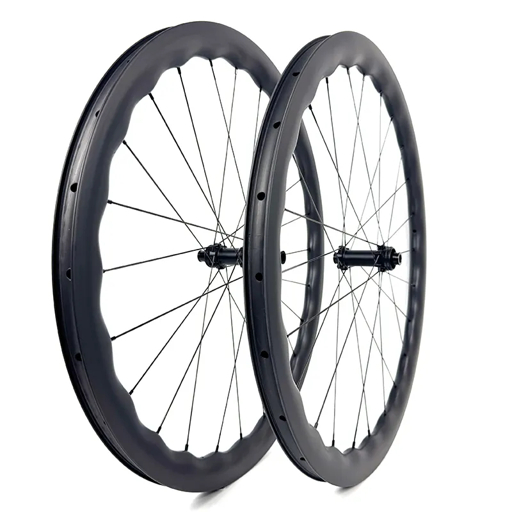
A material specification—not a wheel-quality score.
Higher published tensile strength and modulus.
Here is the useful answer: Toray T800S has higher published fiber tensile strength and tensile modulus than T700S, while both have the same listed density. Those differences can give a rim designer more options. They do not automatically make a T800-labeled carbon fiber wheelset lighter, tougher, safer or faster.
First, identify the material
T700 vs T800 is not
a complete wheel comparison.
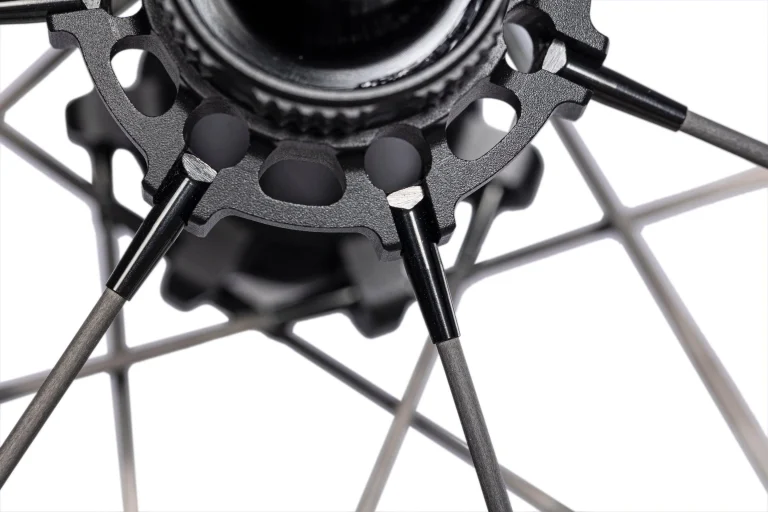
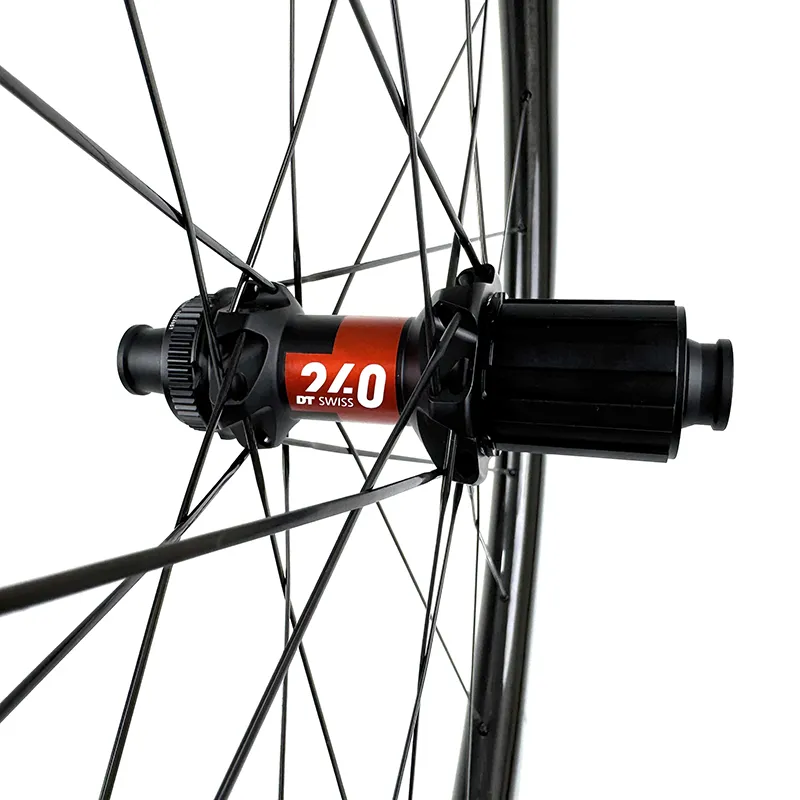
In a Toray materials context, T700 and T800 refer to fiber families. A bicycle rim is a finished composite structure, and a wheelset adds another layer of engineering through its hubs, spokes, nipples and assembly.
The exact fiber suffix matters. T700S, T700G, T800H and T800S are not identical products. This article uses T700S and T800S for its numerical comparison so the material claims remain specific.
Toray classifies T700S as standard modulus and T800S as intermediate modulus. Although cycling copy sometimes uses “high modulus” loosely, it is not the precise manufacturer classification for T800S.
The material evidence
What actually changes?
| Property | T700S | T800S |
|---|---|---|
| Tensile strength | 4,900 MPa | 5,880 MPa |
| Tensile modulus | 230 GPa | 294 GPa |
| Strain at failure | 2.1% | 2.0% |
| Density | 1.80 g/cm³ | 1.80 g/cm³ |
Technical basis: Toray Composite Materials America T700S and T800S datasheets. Values are typical fiber properties, not minimum guaranteed properties for a finished rim or wheelset. Toray describes its datasheet values as typical lot averages intended for material selection.
Strength and stiffness answer different questions
Tensile strength concerns the stress sustained before failure in a tensile test. Tensile modulus describes resistance to elastic stretching. T800S improves on both listed values, but neither figure describes the complete behavior of a carbon road wheel.
A wheelset does not become approximately 28% stiffer simply because its rim uses a fiber with approximately 28% higher tensile modulus. The laminate and structural geometry must translate that material property into a finished component.
The weight question
Why T800 can help a rim become lighter—without being less dense.
T700S and T800S both have a listed density of 1.80 g/cm³. Equal volumes of those fibers therefore do not provide a weight saving simply by changing the grade.
The opportunity comes from redesign. A higher-performance reinforcement may allow a designer to meet a particular structural target with a different material distribution or less material. Whether that is possible depends on the requirements governing the rim.
A carbon rim cannot be reduced to a longitudinal tensile specimen. It has a specific shape, interfaces and loading conditions. A material advantage is useful only when the revised structure still meets its intended requirements.
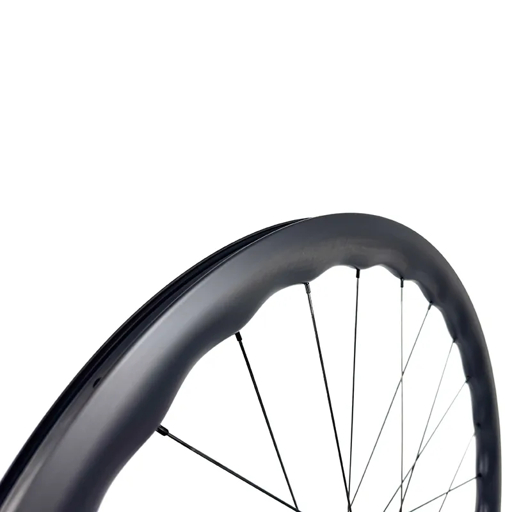
Inside a carbon rim
Layup turns material capability into wheelset behavior.
Carbon bicycle rims are composite structures: reinforcing fibers work with a resin matrix. Their properties depend on the material combination, fiber content, orientation and manufacturing process.
A unidirectional composite responds differently along its fibers than across them. Consequently, a carbon fiber’s longitudinal properties cannot be applied equally in every direction around a rim.
Fabrication matters too. Consolidation, fiber volume fraction and void control affect the resulting composite. Naming a higher fiber grade does not remove the need for controlled manufacturing and product validation.
From fiber data to actual wheelsets
Two wheelsets can share a carbon description
and still be very different builds.
A mixed T700-and-T800 specification is not inherently a weakness. Combining reinforcements can be part of a composite design. But the wording alone does not disclose where each grade is used or prove that the design is optimized.
XDRU’s CHASE 45 AERO SL and CHASE 60 AERO listings both describe their rims as Toray T800 + T700. Their published depths, widths and component specifications differ, showing why the same broad carbon description is not a complete wheelset specification.
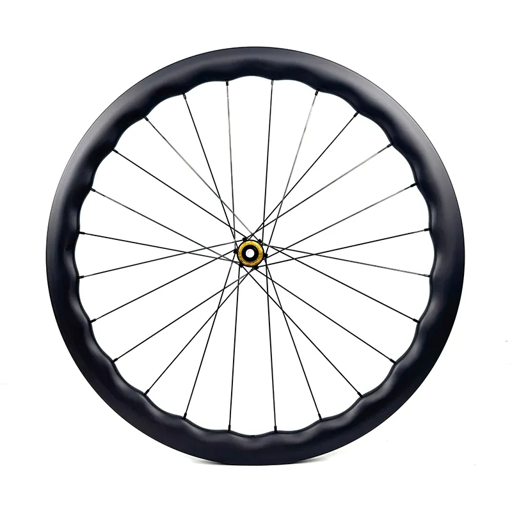
Product example / 45 mm
CHASE 45 AERO SL
Listed with a 28 mm external rim width, tubeless-ready construction and HG or XDR freehub options.
Explore the complete specification →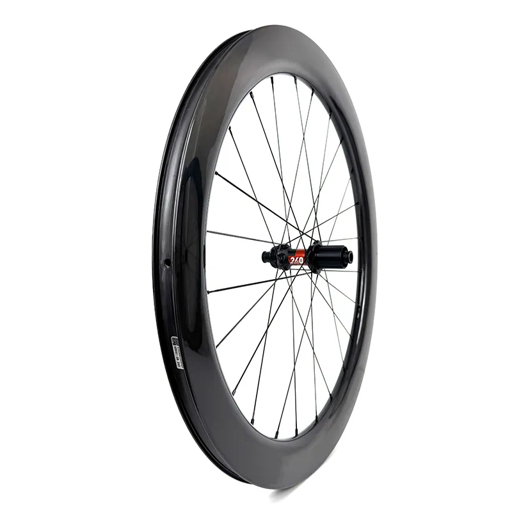
Product example / 60 mm
CHASE 60 AERO
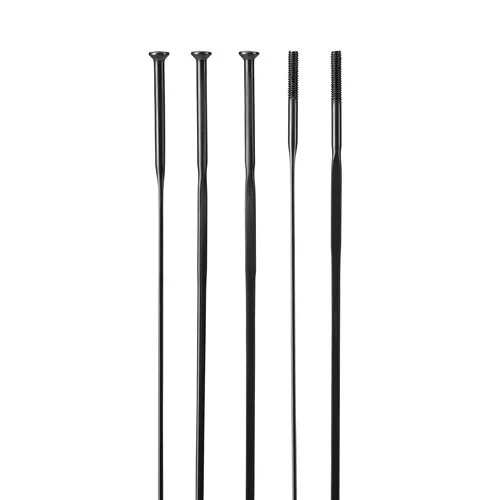
Listed with Sapim CX-Ray spokes, a 28 mm external rim width and HG or XDR freehub options. Its component specification differs from the 45 mm example.
Comparison example—not a ranking derived from carbon grade.
Product details above reflect manufacturer listings reviewed for this article. Confirm the current build before ordering. “T800 + T700” does not identify the exact suffixes, proportions or ply schedule; the T700S/T800S datasheet comparison is not verification of either product’s precise laminate. Product images do not independently establish material grade.
What about a T700 wheelset?
A lower material number is not a reason to dismiss a wheel.
XDRU’s CHASE 45 AR listing describes a Toray T700 rim combined with a 45 mm depth, 21 mm internal width, a 36T ratchet hub and a different spoke-and-nipple specification from the AERO SL.
That does not establish whether it is better or worse for a particular rider. It does establish that the comparison involves more than a change from T700 to T800. Components, geometry, assembly and intended use all remain part of the decision.
A carefully specified T700 wheelset can therefore remain a legitimate candidate. A higher fiber grade is useful when its capabilities contribute to a product-level benefit you can identify—not merely when the number is larger.
Claims worth slowing down for
Stronger does not mean “better at everything.”
“T800 wheels are stiffer.”
T800S has higher listed fiber tensile modulus than T700S. That does not establish a complete-wheel stiffness ranking. The actual rim structure and wheel build still need to be evaluated.
“T700 survives impacts better.”
The compared fiber datasheets do not prove that ranking for finished rims. Relevant impact testing of the actual structures is needed.
“T800 is more brittle.”
T800S has slightly lower listed fiber strain at failure than T700S, but also higher tensile strength. Neither observation alone is a complete assessment of rim damage resistance or durability.
“You can tell from the weave.”
Fiber grade and reinforcement format are different information. Visible weave, a UD texture or a glossy finish cannot verify the exact grade used inside a rim.
“T800 wheels last longer.”
A grade designation is not a service-life rating. Finished-product validation, operating conditions and the quality of the actual composite structure still matter.
A more useful buying checklist
What should a rider actually ask?
- What exact material claim is being made: a specific fiber grade, a mixed-grade construction or a general carbon description?
- What are the complete wheel’s published dimensions, weight and intended-use limits?
- What product-level testing supports the structural claims?
- Does the tire, brake, axle and cassette configuration match the bicycle?
- Are replacement parts, service information and warranty terms practical for long-term ownership?
Further questions
T700 vs T800 carbon wheelset
How much stronger is T800 than T700?
For Toray T800S versus T700S, listed fiber tensile strength rises from 4,900 to 5,880 MPa—a 20% increase. Other suffixes have different values. This percentage is not a finished-rim or complete-wheel strength claim.
Is a T800 carbon wheelset automatically lighter?
No. T700S and T800S have the same listed fiber density. A higher-performance fiber may support a lighter redesigned laminate, but the complete wheel’s weight also depends on its geometry and components.
Is T800 high-modulus carbon fiber?
Toray classifies T800S and T800H as intermediate-modulus fibers. T700S is classified as standard modulus. Use the precise grade and classification instead of treating “high modulus” as a general quality guarantee.
Is a T700 and T800 blend a good choice for road wheels?
It can be, but the mixed-grade label alone does not establish quality. Resin, orientation, reinforcement quantity, manufacturing and finished-product validation determine how the materials perform together.
Can a T700 wheelset be a better purchase than a T800 wheelset?
Yes, depending on the actual products and your needs. Compare compatibility, dimensions, validated performance, components, serviceability and price. Fiber grade is one part of that assessment, not a substitute for it.
Can you identify T700 or T800 from a rim photograph?
No. Visible texture does not verify fiber grade. Documentation and traceability are more meaningful than the appearance of a weave or surface finish.
Does T800 guarantee better impact resistance or fatigue life?
No. The fiber tensile figures do not establish either result for a completed rim. Ask for relevant finished-product testing rather than inferring durability from the grade number.