
Drivetrain interfaces / Road + gravel / The compatibility issue
Three interfaces.One cassette decides.
HG vs XDR vs Micro Spline is not a contest to find the best freehub. It is a compatibility decision: identify the cassette, match its mounting standard, then confirm the correct body for your rear hub.
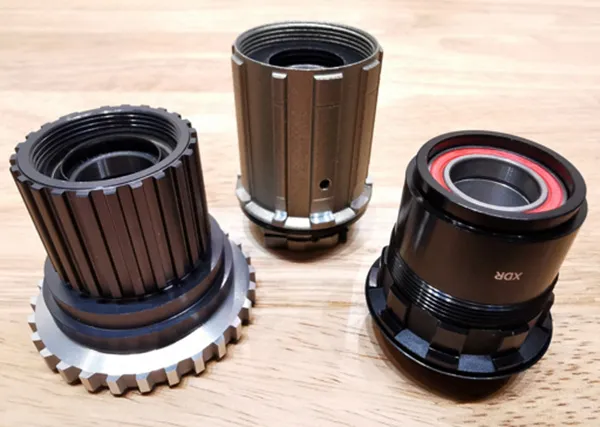
A family of splined interfaces. Road and older MTB body lengths differ.
SRAM’s longer XD-family interface, used by specified road and gravel cassettes.
Shimano’s 23-spline interface for specified MTB and gravel cassette applications.
The short answer
- Shimano 11- or 12-speed road cassette: typically a road-length HG body, with model-specific exceptions and spacer requirements.
- SRAM cassette specified for XDR: an XDR body. Do not infer this from “SRAM” or “12-speed” alone.
- Shimano 12-speed MTB cassette, including those used by specified GRX 1×12 setups: Micro Spline.
- SRAM XD cassette: an XD body, or an XDR body with the required 1.85 mm spacer behind the cassette.
These are starting rules. The cassette model and manufacturer’s compatibility documentation make the final decision.
What a freehub standard actually describes
In this guide, “freehub standard” means the external interface on which the cassette mounts. HG, XDR and Micro Spline use different shapes and dimensions; a cassette designed for one does not simply slide onto either of the others.
There is a second interface to consider: the connection between the freehub body and the hub itself. That connection depends on the hub manufacturer and mechanism. An XDR body for one hub is not automatically a replacement for an XDR body on another.
This distinction explains many incorrect purchases. “I need XDR” identifies the cassette-facing side. It does not yet identify the spare part that fits your wheel.
HG vs XDR vs Micro Spline at a glance
| Interface | Typical applications | Important limitation | Buying check |
|---|---|---|---|
| HG spline L | Shimano 11- and 12-speed road cassettes; certain SRAM splined road/gravel cassettes. | “HG” alone does not distinguish this longer body from shorter HG versions. | Confirm road-length HG and the cassette’s spacer instructions. |
| HG spline M | Many 8/9/10-speed HG applications and Shimano 11-speed MTB cassettes. | Not a general fit for Shimano 11- or 12-speed road cassettes. Specific 11-speed road exceptions exist. | Check the exact cassette, not just the number of sprockets. |
| XDR | SRAM XDR road/gravel cassettes; XD cassettes with a 1.85 mm spacer. | XDR cassettes do not fit the shorter XD body. | Distinguish XDR from XD in the cassette specification. |
| Micro Spline | Shimano 12-speed MTB cassettes and specified GRX 1×12 configurations using those cassettes. | Not the interface for Shimano 12-speed road cassettes. | Confirm the cassette model and a hub-specific conversion option. |
Shimano’s spline chart distinguishes HG L, HG M and Micro Spline; SRAM’s compatibility map distinguishes splined, XD and XDR cassette requirements. This table is a selection aid, not a substitute for the model-specific instructions.
Why “Shimano-compatible” is not precise enough
HG is familiar, but the name hides a critical difference. Shimano lists HG spline M with a 34.9 mm outer body length and HG spline L with a 36.75 mm outer body length. The latter is the familiar longer road 11/12-speed interface. The difference is 1.85 mm.
Most Shimano road upgrades need road-length HG
Shimano’s chart lists HG spline L as compatible with Shimano 11- and 12-speed road cassettes. It does not list HG spline M as a general fit for those road cassettes. Consequently, a wheel advertised merely as “HG 8/9/10-speed compatible” should not be assumed to accept your modern road cassette.
The 11-speed road exceptions matter
Shimano specifically lists CS-HG700, CS-HG800 and CS-RS400 11-speed road cassettes as compatible with the shorter HG M body. On the longer HG L body, those cassettes require a 1.85 mm low spacer. This is why “11-speed cassette” does not provide enough information to decide fit.
Older cassettes on a longer body need their own spacer check
Shimano’s chart specifies a 1.85 mm low spacer for relevant 8/9/10-speed applications on HG L, with an additional 1.0 mm spacer for certain listed 10-speed road cassettes. Do not assume that every cassette needs exactly one spacer of the same thickness.
A spacer compensates for an approved cassette/body length combination. It cannot make the shorter HG body long enough for a cassette that requires the longer interface.
XDR and XD: related, but not interchangeable
SRAM specifies that XDR is 1.85 mm longer than XD. The longer interface was developed for road-hub applications, retaining the space associated with 11-speed-road HG configurations.
Read the cassette first
SRAM’s cassette installation documentation explicitly states these relationships. Do not add the XD-on-XDR spacer merely because an XDR body is present; it depends on the cassette.
Not every SRAM cassette needs XDR
SRAM’s compatibility map lists XDR cassettes such as XG-1250 and XG-1270, but it also lists HG-style splined applications. The 12-speed PG-1231 XPLR 11–44 cassette uses an 11-speed-road splined body; the PG-1230 Eagle 11–50 cassette uses the conventional splined interface rather than XD or XDR.
The lesson is simple: brand, wireless shifting and sprocket count are not freehub specifications. Read the cassette’s model number.
Shimano 12-speed does not always mean Micro Spline
Shimano’s compatibility chart lists Micro Spline with 23 effective splines and a 26 mm outer body length. It is a different interface from conventional HG and from Shimano’s dedicated 12-speed road HG L2 interface.
Micro Spline is used by Shimano’s 12-speed MTB cassettes, including the 10–45 and 10–51 cassette applications adopted by the GRX RX820/RX610 1×12 platform. Shimano’s GRX introduction explicitly distinguishes those Micro Spline configurations from its HG-based 2×12 configuration.
Where does HG L2 fit?
Shimano also lists HG spline L2 as a road-12-speed-dedicated interface with 18 effective splines. It is not Micro Spline. The current compatibility chart lists road 12-speed cassettes for HG L2, but not road 11-speed cassettes. It also lists road 12-speed cassettes as compatible with conventional road-length HG L.
That gives an important direction-of-compatibility distinction: a compatible Shimano 12-speed road cassette can be used on HG L, but an older 11-speed road cassette is not thereby compatible with an HG L2-only body.
Which freehub do you need for your build?
A Shimano 12-speed road build
Start with road-length HG L. Shimano’s chart lists its road 12-speed cassettes as compatible with that interface. Do not choose Micro Spline simply because both options say “Shimano” and “12-speed.”
A SRAM road build using an XG-1250 cassette
Choose XDR. SRAM lists XG-1250 as an XDR cassette. Do not substitute XD, and do not add the 1.85 mm XD-cassette spacer to this XDR-cassette installation.
A GRX 1×12 build using a Shimano 10–45 or 10–51 MTB cassette
Choose Micro Spline, then verify the exact derailleur and drivetrain combination. Shimano identifies those cassette configurations as Micro Spline applications.
A mixed-terrain build using a SRAM XD cassette on an XDR wheel
Use the required 1.85 mm spacer behind the XD cassette. This solves the approved cassette-to-body length difference; it does not by itself prove the rest of the drivetrain is compatible.
Physical cassette fit and drivetrain compatibility are separate checks. SRAM’s compatibility map organizes cassette interfaces alongside drivetrain combinations; use the relevant complete system guidance rather than assuming that a cassette which mounts correctly will shift correctly with any derailleur.
Can you change the freehub without replacing the wheel?
Sometimes. The deciding factor is whether the hub manufacturer offers an approved body or conversion kit for your exact hub. Manufacturer parts guidance distinguishes different engagement systems and conversion options; sharing a brand name is not enough to establish compatibility.
For example, DT Swiss explains that Ratchet and Ratchet EXP bodies are not compatible with its older pawl hubs, and that Ratchet LN uses a different seal arrangement. This illustrates why a replacement must match the hub architecture, not merely the cassette interface.
- Identify the hub model and generation, not just the wheel brand.
- Confirm its engagement system and axle configuration.
- Find the manufacturer-approved conversion part number.
- Check whether the kit needs a different end cap or other supplied parts.
- Follow the installation, lubrication and inspection instructions.
Product-specific support pages can identify compatible conversion and spare parts, including whether a listed kit includes an end cap. Do not assume that every loose freehub body is a complete conversion package.
Before you order wheels
Send the cassette model, not just “Shimano or SRAM”
When selecting a road carbon wheelset, treat the freehub option as part of the build specification. Give the supplier the cassette’s exact model and gearing, then request confirmation of the supplied body and any required spacer.
A useful order note looks like this:
“My cassette is [manufacturer and model], [number of speeds], [smallest–largest sprocket]. My bicycle uses [axle specification]. Please confirm the correct freehub body, any required cassette spacer and the supplied end-cap configuration.”
Make the decision around compatibility, not an assumed hierarchy. HG is not obsolete simply because XDR exists; Micro Spline is not a universal Shimano upgrade. The right body is the one approved for your cassette and your hub.
HG, XDR and Micro Spline: common questions
Can I fit a Shimano 12-speed road cassette to an HG freehub?
Shimano’s current compatibility chart lists road 12-speed cassettes as compatible with HG spline L, the road-length interface. Do not extend that approval to the shorter HG M body.
Can I install an XDR cassette on an XD body?
No. SRAM specifies that XDR cassettes require XDR bodies. The supported reverse combination is an XD cassette on XDR with a 1.85 mm spacer behind the cassette.
Does every SRAM 12-speed cassette require XDR?
No. SRAM’s PG-1231 uses an 11-speed-road splined body, while PG-1230 uses the conventional splined interface. Other cassette models use XD or XDR. Check the exact model against SRAM’s compatibility map.
Is Shimano HG L2 the same as Micro Spline?
No. Shimano lists HG L2 as an 18-spline road-12-speed-dedicated interface and Micro Spline as a separate 23-spline interface. They accept different cassette types.
Does GRX always use the same freehub?
No. Shimano’s RX820/RX610 12-speed platform includes Micro Spline 1× configurations using 10–45 or 10–51 cassettes, while its 2×12 configuration uses HG. Identify the cassette rather than choosing from the GRX name alone.
Will a spacer convert HG into XDR or Micro Spline?
No. Those are different mounting interfaces. Approved spacers address particular length differences within supported combinations, such as an XD cassette on an XDR body; they do not change the spline or mounting standard.
Can any XDR replacement body fit my existing hub?
No. XDR identifies the cassette-facing interface. The replacement body must also match the hub’s internal mechanism, seals and associated components. Use the hub manufacturer’s approved conversion information.