
Beyond the rim.
Understand the wheel.
Carbon fiber wheels explained: what they are made of, what their specifications actually mean, and how to choose the right wheelset for the riding you do.
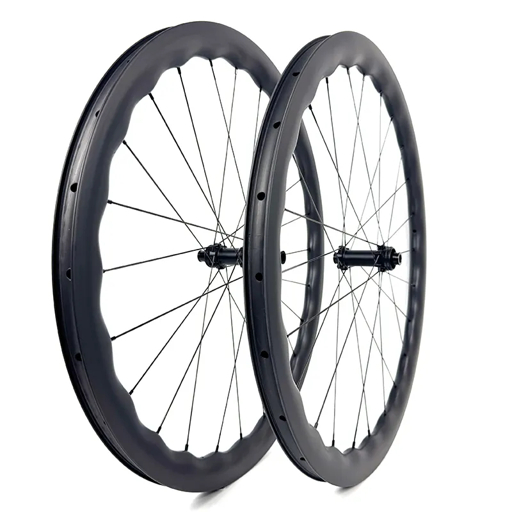
A good carbon wheelset is a coordinated structure: rim, spokes, nipples, hubs and interfaces, working with the tires and bicycle. Carbon enables designers to tune that structure. It does not automatically make every wheel lighter, faster, more comfortable or more durable than every aluminum alternative.
What is a carbon fiber wheelset, exactly?
In most conventional spoked wheelsets, “carbon” describes the rim. The spokes may be steel, the nipples aluminum or brass, and the hubs largely aluminum with steel bearings and drivetrain parts. Some designs use carbon spokes or more extensively integrated construction, but the name alone does not tell you that.
The rim itself is a composite: carbon fibers embedded in a resin matrix. Fiber orientation, material selection, laminate thickness, local reinforcement and manufacturing quality all help determine how the finished rim carries loads.
That is why a fiber designation such as T700 or T800 cannot rank complete wheels. It describes part of the material story—not the finished laminate, impact performance, quality control or wheel build.
- The rim
- Supports the tire, anchors the spokes and contributes to aerodynamics, stiffness, impact behavior and tire compatibility.
- The spokes
- Form a tensioned structure between hub and rim. Their dimensions, material, lacing and tension affect the build.
- The nipples
- Provide the threaded adjustment used to set spoke tension and true the wheel in conventional builds.
- The hubs
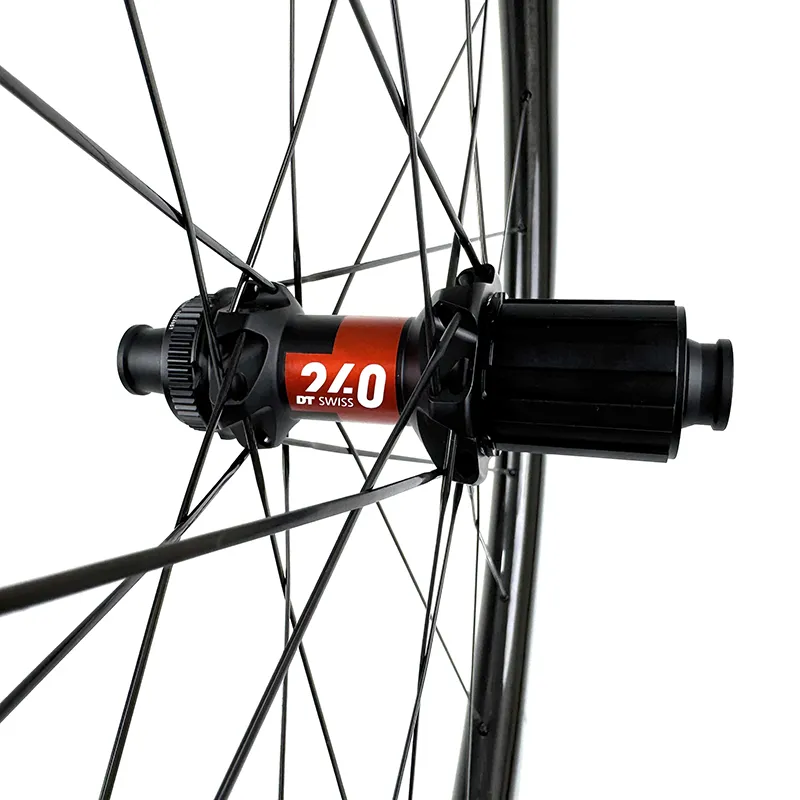
- Support rotation, connect to the axles and, at the rear, house the freehub mechanism that transfers pedaling torque.
Why choose carbon wheels—and where are the limits?
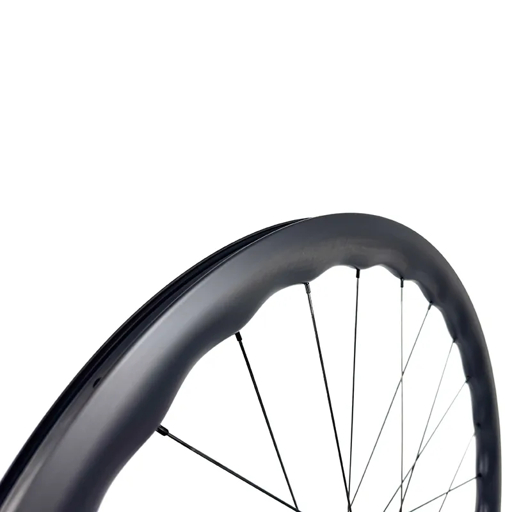
Carbon’s attraction is design flexibility. A manufacturer can create deep aerodynamic sections, reinforce specific load paths and tune properties for a particular use. Depending on the design, this can produce an appealing balance of weight, stiffness and shape.
But material is not a substitute for engineering. Two carbon wheels with similar dimensions may differ substantially in mass, tire approvals, impact tolerance and repairability. An aluminum wheel can still be the more appropriate purchase when cost, parts availability or a particular application matters more.
Comfort also deserves perspective. Tires and pressure make a major contribution to how road irregularities reach the rider. A claim that “carbon absorbs vibration” is not enough to predict the ride of a complete wheel-and-tire system.
The design is the product.
Read the specifications without being misled by them.
Depth is a design variable, not a speed score.
A deeper section gives designers more profile to shape. Aerodynamic performance still depends on rim geometry, spokes, tires and airflow. Compare tested combinations, not depth alone.
Crosswind handling also involves steering moment and how loads change with wind angle. A rounded profile or shallow rim is not a guarantee of calm handling.
The tire must suit the rim bed.
Internal rim width affects tire support and mounted shape. Wider is not universally better: the tire model, bead design, pressure and approved width range must all match.
Do not use frame clearance as proof of rim compatibility. A tire can fit inside the frame yet remain unsuitable for the wheel.
The outside dimension tells a different story.
External width helps describe the tire-to-rim aerodynamic transition and, on rim-brake systems, brake clearance. It is not interchangeable with internal width.
A sidewall marked “28mm” does not prove that the mounted tire is narrower than a 28mm-wide rim. Measure the installed tire.
Compare like with like.
Ask whether the quoted figure includes tape, valves, freehub body and other accessories. Distinguish a rim weight from a single-wheel weight and a complete-pair weight.
Lower mass helps uphill and during acceleration. At steady speed, rotational inertia is not a continuous power loss. Mass distribution matters during acceleration.
Count is only one part of the build.
Spoke count, gauge, material, flange geometry and lacing affect how the wheel behaves. More spokes do not automatically make one complete wheel stronger than another.
Correct tension and controlled variation are fundamental. Appropriate tension can differ between sides; “every spoke must have the same tension” is not a universal rule.
A road rating is not a trail rating.
Check intended use, maximum load and any e-bike approval. System weight commonly includes rider, bicycle and equipment, but follow the manufacturer’s definition.
Low weight, a high price or carbon construction does not establish approval for jumps, loaded bikepacking or aggressive mountain biking.
Stiffness is not one property.
Lateral stiffness concerns sideways deflection. Torsional stiffness concerns twist between hub and rim. Radial stiffness concerns deformation under radial loading. “Extremely stiff” is incomplete without the direction, measurement and intended use. More stiffness is not automatically the best target in every direction.
Wheel size: 700C is not a complete compatibility answer.
Use the standardized tire and rim diameter rather than relying only on traditional names. In a tire marking such as 28-622, 28 denotes nominal tire width in millimeters and 622 denotes bead-seat diameter.
Modern 700C road wheels and 29-inch mountain bike wheels commonly share a 622mm bead-seat diameter. That does not make the complete wheels interchangeable: internal width, tire requirements, axle spacing, brake interfaces and intended use can differ dramatically.
Likewise, 650B and modern 27.5-inch wheels commonly use a 584mm bead-seat diameter. Diameter is the first check, not the last.
| Check | What to match | A common mistake |
|---|---|---|
| Diameter | Rim bead-seat diameter and tire diameter | Assuming every wheel described as “700” is fully interchangeable |
| Axle system | Diameter, spacing and approved end caps | Assuming an adapter exists for every hub and frame |
| Brake format | Rim brake or disc brake; appropriate rotor interface | Buying a disc-brake wheel for a rim-brake bicycle |
| Freehub | Exact cassette model and required body | Choosing by speed count alone |
| Tire system | Approved width, bead type and pressure limits | Treating “tubeless ready” as universal tire approval |
| Clearance and load | Mounted tire size, frame/fork clearance and rated use | Checking the wheel without the installed tire |
Clincher, tubeless, tubular, hooked, hookless: separate the terms.
These words describe different parts of the system. A conventional tube-type clincher uses tire beads retained by the rim and an inner tube to hold air. A tubeless system retains air through a compatible tire-and-rim interface, valve and rim bed, generally with sealant.
A tubular tire is different again: its enclosed casing is glued or attached with suitable tape to a dedicated tubular rim. It does not mount to an ordinary clincher rim.
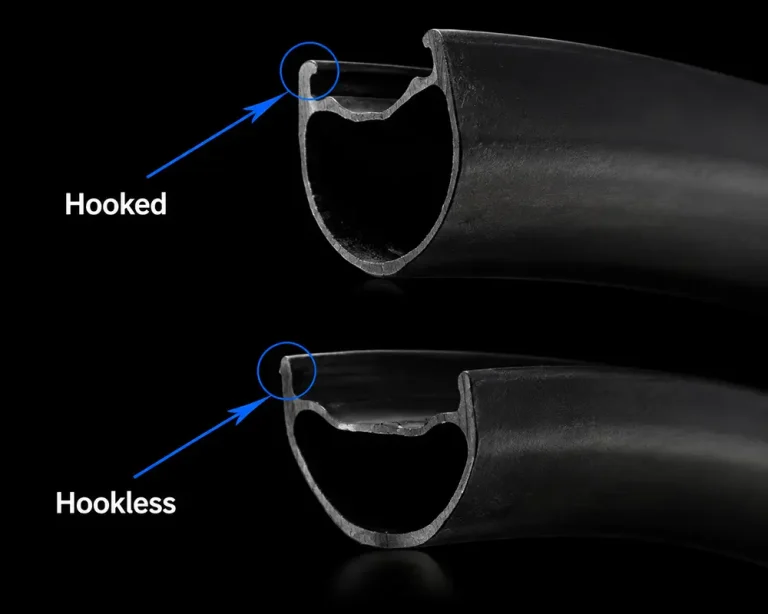
Hooked and hookless describe the bead-seat/rim-sidewall design. Many hooked rims are tubeless ready. Hookless is not a synonym for tubeless, and a tubeless label does not identify which bead-retention design the rim uses.
Hookless safety starts with the exact combination.
Use only tire models and widths approved for the rim, and obey the lowest applicable pressure limit. Schwalbe’s road hookless guidance cites a 5 bar ceiling, while its width-specific guidance applies lower limits to wider tires. Do not assume 5 bar is permitted for every tire.
Installing an inner tube does not make an otherwise unapproved tire safe on a hookless rim. If the required pressure for your load exceeds the permitted limit, choose a different approved tire/rim arrangement rather than exceeding it.
Hubs and freehubs: understand the interface before the sound.
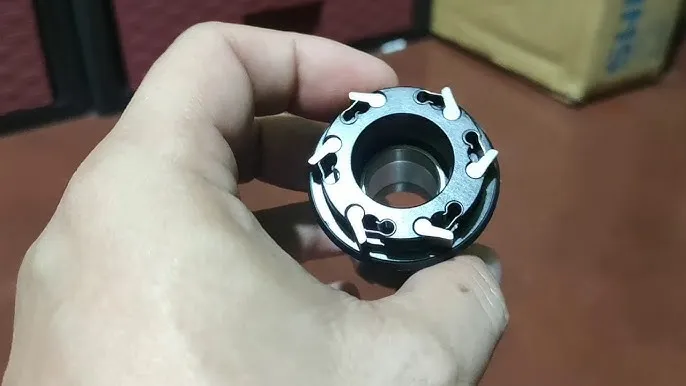
The hub needs suitable bearings, seals, axle interfaces and service support. At the rear, the freehub also needs to match the cassette and engage reliably when you pedal.
HG, XD, XDR and Micro Spline are different interface families. “Shimano compatible” or “12-speed compatible” is not specific enough to select a body. Check the exact cassette model, required spacers and manufacturer-approved freehub option.
Engagement specifications describe pickup behavior, not overall efficiency. If a mechanism truly provides 36 equally spaced engagement positions per revolution, the nominal spacing is 10 degrees. Mechanisms differ, so tooth count alone should not be used to infer every design’s effective engagement angle.
Faster pickup can matter when restarting pedaling, especially in technical riding. It does not prove lower drag during continuous pedaling, and a louder freehub is not evidence of better quality.
Choose carbon wheels by riding purpose.
There is no single best carbon wheelset for every bicycle. Start with the discipline and the route, then select a design with the right approval, tire support and handling characteristics.
| Riding purpose | A useful starting direction | What deserves priority |
|---|---|---|
| Long climbs and mountainous road rides | Lower-mass road builds; often investigate roughly 30–45mm depths | Climbing mass, descending control, braking and tire grip |
| Rolling terrain and one-wheelset road use | Balanced middle-depth builds; roughly 40–50mm is a useful shortlist | Complete-system weight, handling, tire fit and serviceability |
| Fast flat-road riding and road racing | Investigate roughly 50–65mm options with credible tire-specific aero evidence | Aerodynamics, front-wheel control and maintaining riding position |
| Endurance road riding | Compatible tire volume and a manageable rim profile | Pressure range, comfort, reliability and real frame clearance |
| Gravel and mixed surfaces | Purpose-approved gravel wheels with suitable internal width | Tire support, impact demands, sealing and load capacity |
| XC, trail and enduro mountain biking | Discipline-specific MTB wheels and approved tire pairings | Impact behavior, lateral support, axle standards and intended-use rating |
| Time trial and triathlon | Event-legal deep-section or rear-disc options where appropriate | Handling, event rules, tire pairing and complete bike–rider aerodynamics |
Disc brake and disc wheel do not mean the same thing.
A disc-brake wheel uses a brake rotor at the hub. A rear disc wheel is a largely closed aerodynamic wheel design. A wheel can be one, both or neither, depending on the product.
Wind deserves its own decision. Front-wheel steering behavior depends on more than side force: the magnitude and progression of steering moment matter. Manufacturer testing on one rim cannot establish the behavior of another rim with the same depth.
A wheel that makes you sit up, grip harder or hesitate may undermine the practical value of its aerodynamic potential. Choose for the conditions you actually ride, not only the best-case conditions in a test.
Tires and pressure finish the wheelset.
A carbon wheel upgrade is incomplete until the tire system is considered. Casing, compound, width, tube or tubeless setup and pressure all affect rolling performance and handling.
Higher pressure can reduce tire-casing deformation on a smooth test drum. On real pavement, excessive pressure can increase vibration-related losses through the bicycle and rider. That is why maximum pressure is a limit, not an optimization target.
Too little pressure brings different problems: excessive deformation, rim strikes, vague support and, depending on the system, pinch flats or burping. Start with measured tire width, total load, surface and manufacturer guidance, then refine within the permitted range.
On road bikes, compatible 28–30mm performance tires are common candidates; rougher routes may justify more volume. On gravel and MTB, the appropriate range changes substantially. No article-wide tire recommendation overrides the exact rim and tire approvals.
Two XDRU builds.
Read beyond the depth.
These road wheelsets illustrate how dimensions, weight and interfaces form a complete configuration. The figures below are manufacturer-published, not independently measured.
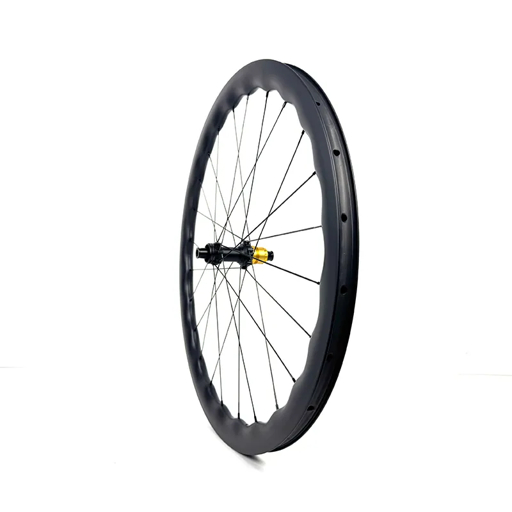
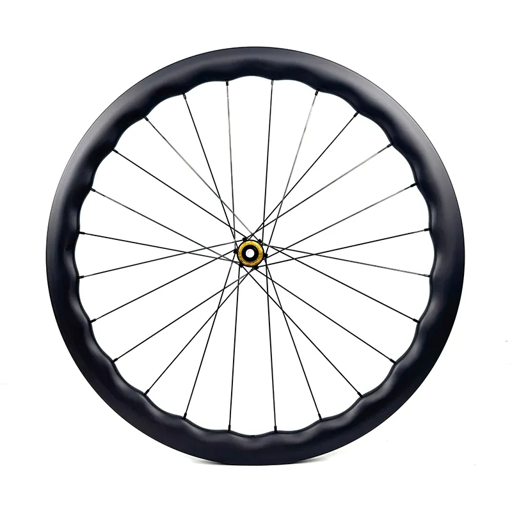
CHASE 45 AERO SL
A middle-depth road candidate for riders considering a lower published wheelset weight alongside mixed-route use.
Internal / external width: 22 / 28mm
Published wheelset weight: 1244 ± 30g
Hub: 36T ratchet
Spokes: 24 front / 24 rear
Brake interface: Centerlock disc
Axles: 12 × 100mm / 12 × 142mm
Freehub options: HG / XDR
Rim format: tubeless ready
Construction reference image: CHASE 45 AERO SL.
CHASE 50 AERO
A 50mm carbon road wheelset to investigate when faster road riding is central to the brief. Extra depth alone does not establish an advantage over the 45mm model.
Internal / external width: 21 / 28mm
Published wheelset weight: 1500 ± 30g
Hub: 36T ratchet
Spokes: 24 front / 24 rear
Brake format: disc brake
Axles: 12 × 100mm / 12 × 142mm
Freehub options: HG / XDR
Rim format: tubeless ready
Confirm the exact supplied build, freehub, rotor interface, tire approvals, bead design, pressure limits and maximum load before ordering. Ask what is included in the quoted weight. These are different complete builds, not a controlled test of 45mm versus 50mm rim depth. No comparative aerodynamic, strength or handling result is claimed.
Ownership matters as much as the first ride.
Check tire pressure, tire condition, axle security and obvious wheel damage before riding. Watch for new rubbing, a change in trueness, loose spokes, bearing play or unfamiliar noises. A wheel that still rolls is not necessarily safe.
After a significant impact or suspected damage, stop using the wheel and seek assessment from the manufacturer or a qualified specialist. Visual inspection alone cannot establish the full condition of a composite structure. A home “tap test” is not reliable clearance to continue riding.
Follow the manufacturer’s cleaning, storage and service instructions. Avoid unapproved solvents, excessive heat and directing high-pressure water at bearings. Refresh sealant according to the tire/sealant instructions and inspect tape and valves when servicing the tire system.
Carbon rim-brake wheels also require approved pads and specific heat-management guidance. Do not reuse pads contaminated with aluminum debris unless the wheel manufacturer explicitly permits it.
Before purchase, ask about replacement spokes, nipples, bearings, freehub bodies and crash-replacement terms. A repairable, supported wheel can be a better long-term purchase than a slightly lighter wheel with scarce parts.
A practical carbon wheelset buying checklist.
- Define the riding: road, gravel or MTB; usual surfaces; climbing, speed, wind and load.
- Confirm diameter, axle standards, brake format, rotor interface and exact cassette/freehub compatibility.
- Select an approved tire system, then check mounted dimensions, clearance and pressure requirements.
- Shortlist rim depths and weights that suit the route rather than chasing the largest or smallest number.
- Ask for meaningful performance evidence: test speed, tire model, mounted width, wind angles and the comparison baseline.
- Check maximum load, intended-use rating, warranty, spare parts and realistic servicing options.
Carbon wheel questions, answered plainly.
Are carbon wheels worth the upgrade?
They can be when their design addresses a real priority: aerodynamics, mass, handling or a specific tire platform. The material label alone does not establish value or a guaranteed speed gain over your existing wheels.
Are deeper carbon wheels always faster?
No. Shape, tires, wind, speed and rider control matter. Compare complete tested systems. A deeper front wheel that compromises confidence may not improve real-world performance.
Do carbon wheels require tubeless tires?
No. Carbon describes construction, not the tire system. Tube-type clincher, tubeless and tubular carbon rims exist. Use only the tire arrangements approved for the exact rim.
How long do carbon wheels last?
There is no universal mileage limit. Service conditions, impacts, maintenance and the specific design matter. Follow inspection and replacement guidance rather than treating a calendar age or mileage figure as proof of safety.
Can a heavier rider use carbon wheels?
Yes, if the particular wheelset is approved for the complete system load and intended use. Check the manufacturer’s rating and tire-pressure requirements; do not infer capacity from material, price or spoke count alone.
Can a carbon wheel be repaired?
Some conventional wheel components can be replaced or serviced. Structural rim damage is a separate assessment. Do not assume a composite repair is suitable or approved; consult the manufacturer and a qualified specialist.
Choose the system.
Let the specifications explain why.
Start with compatibility and intended use. Match the tire to the rim, the depth to the route and the build to the load. Then compare weight, performance evidence and long-term support.
That is how a carbon wheelset becomes more than an attractive upgrade: a coherent part of a bicycle that works for the way you ride.