
Introduction of the best spoke brands in the market
Every wheel you’ve ever ridden tells two stories. One is the rim — the part you see, the part that catches the light. The other is far less glamorous, yet it carries the entire load of your body, your bike, and every watt you put through the pedals. That story belongs to the spoke.
Spokes are the unsung heroes of wheel building. A carbon rim can be flawless, a hub can spin on ceramics, but if the spokes connecting them are mediocre, the wheel will feel dead — or worse, fail when you least expect it. Whether you’re lacing up a set of carbon road wheels, building a bombproof gravel setup, or assembling a lightweight climbing wheelset, the spokes you choose will define how that wheel rides, for how long, and at what weight.
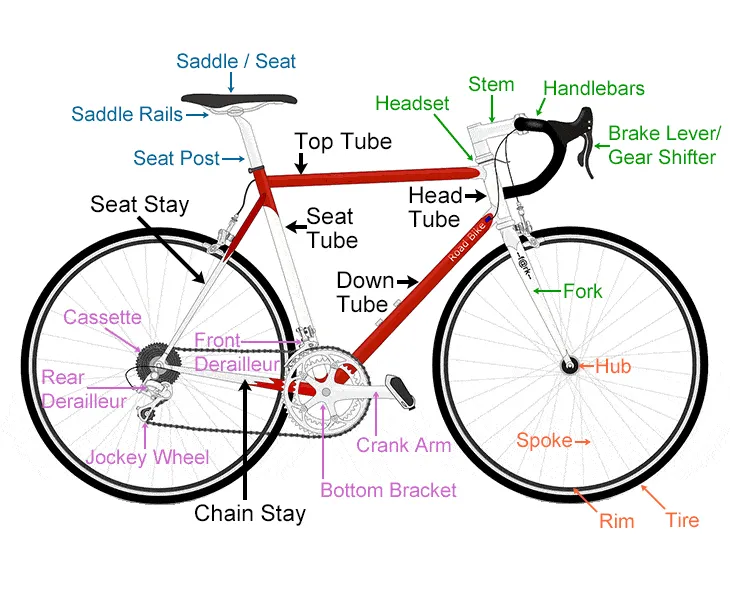
In this guide, we’ll walk through ten of the most respected spoke brands in the world. We’ll look at where they come from, what makes their technology distinct, and which type of rider each one serves best. If you’ve ever stood in front of a spoke catalog feeling overwhelmed, this is the article that will make it all click. You can also brush up on the fundamentals of spoke geometry in this neutral overview of spoke terminology before diving in.
Quick Comparison: Top 10 Spoke Brands at a Glance
| Brand | Origin | Founded | Best Known For | Signature Spoke |
|---|---|---|---|---|
| Sapim | Belgium | 1918 | Premium bladed & butted spokes | CX-Ray |
| DT Swiss | Switzerland | 1994 | Versatile OEM & aftermarket range | DT Competition |
| Pillar | Taiwan | 1984 | Aero bladed spokes, OEM supply | PSR Wing 20 |
| Wheelsmith | USA | 1975 | Custom wheel building heritage | DB14 |
| cnSPOKE | Taiwan | 1970 | High-tension spokes, OEM manufacturing | High-Tension Series |
| Berd | USA | 2015 | Polymer (Dyneema) spokes | PolyLight |
| ACI (Alpina) | Italy | 1926 | European OEM wheelset supply | Double-Butted Series |
| Hoshi | Japan | 1921 | Steel wire expertise, Japanese market | Bladed Series |
| Mach1 | France | 1937 | French wheel components, value range | Plus / Track |
| Union | Germany | 1899 | Traditional German steel spokes & pedals | Standard Gauge |
Now let’s take a closer look at each brand — what sets them apart, and where they shine.
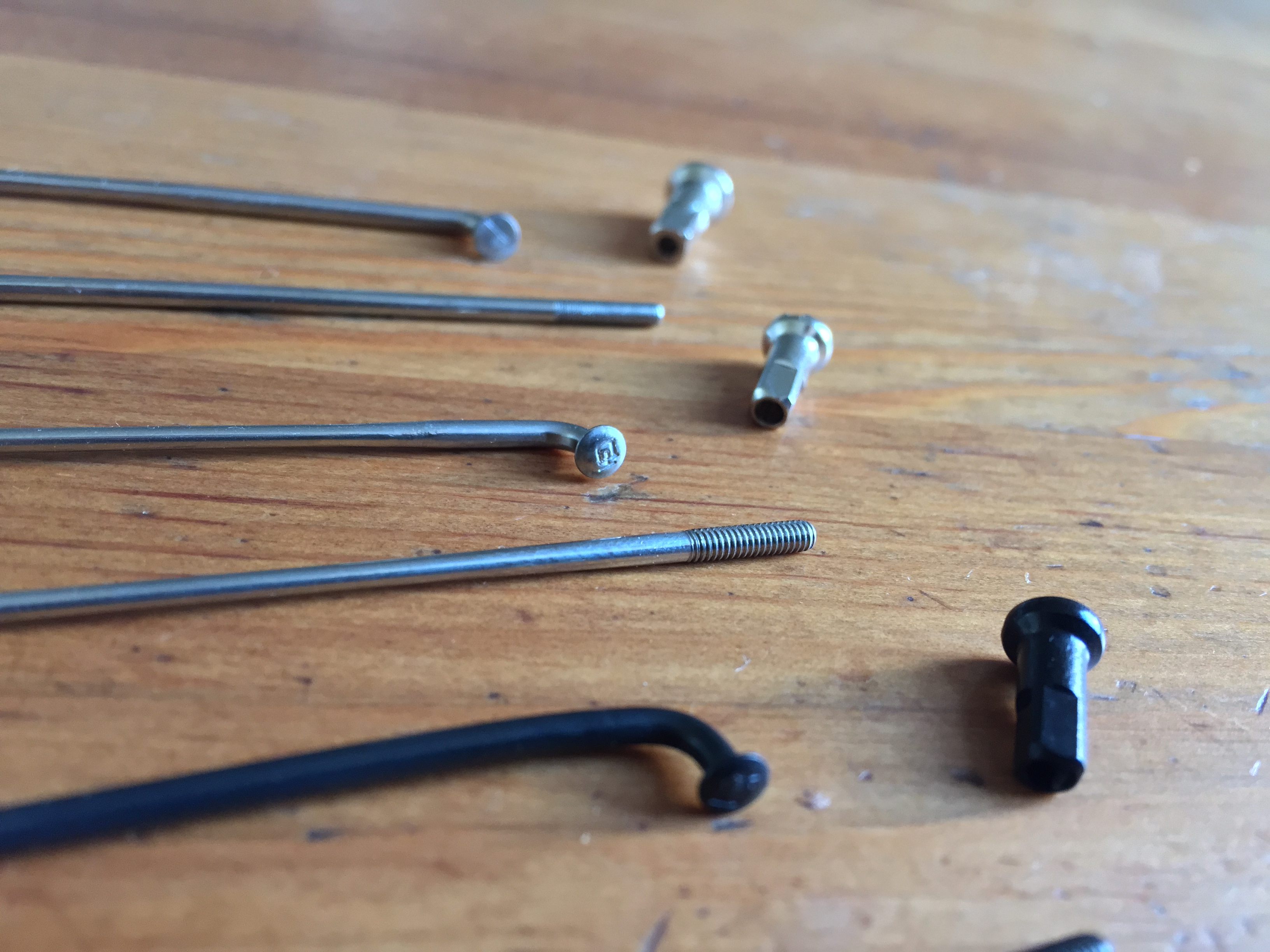
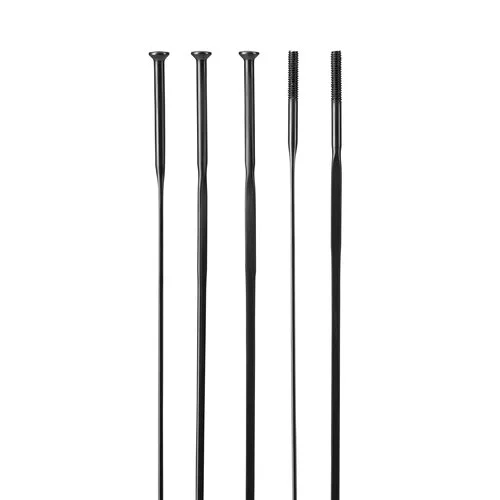
A close look at spoke profiles — butted, bladed, and everything in between.
1. Sapim — The Belgian Gold Standard
1Sapim NV
If there’s one name that comes up in every serious wheel-building conversation, it’s Sapim. Founded in 1918 by Herman Schoonhoven in Belgium, Sapim has spent over a century perfecting the art and science of spoke manufacturing. That’s not a marketing claim — it’s a century of cold-forging, wire-drawing, and metallurgical refinement that very few companies in any industry can match.
The crown jewel of the Sapim lineup is the CX-Ray. This bladed spoke, introduced in 1995 alongside their Polyax nipple design, has become the benchmark by which all other aero spokes are measured. Forged from high-tensile 18/8 stainless steel, the CX-Ray features a 2.0mm neck that transitions into a 0.9 × 2.3mm blade, then back to a 2.0mm threaded end. At roughly 4.4 grams per spoke (282g for 64 spokes at 264mm), it delivers an extraordinary strength-to-weight ratio that has made it the default choice for professional racing wheelsets worldwide.
But Sapim’s range goes well beyond the CX-Ray. The Laser is a double-butted round spoke (2.0/1.5/2.0mm) weighing just 273g per 64 spokes at 260mm — ideal for lightweight climbing wheels. The Race (2.0/1.8/2.0mm) offers a robust middle ground for everything from road to light off-road. And the Strong, with its thicker 2.3/1.8/2.0mm profile, handles the demands of heavier riders and e-bikes without flinching.
2. DT Swiss — Swiss Precision, Industrial Scale
2DT Swiss
DT Swiss as we know it was founded in 1994, but the company’s roots run far deeper. Its lineage traces back to a wire-drawing operation established in 1634 — nearly four centuries of metallurgical expertise distilled into every spoke that leaves the factory in Biel, Switzerland. That heritage matters. It means DT Swiss doesn’t just make spokes; they understand wire at a molecular level.
The DT Competition is perhaps the most versatile spoke on the market. This double-butted spoke (2.0/1.8/2.0mm) weighs 382g per 64 spokes at 264mm and covers an enormous range of applications — from road wheels to enduro MTB. Its cold-forged center section saves 62g compared to a straight-gauge equivalent while maintaining nearly identical strength. The DT Competition Race takes this further, shedding an additional 70g (313g per 64 at 264mm) by reducing the mid-section to just 1.6mm — making it ideal for riders chasing every gram.
For those who want the lightest round spoke in the range, the DT Revolution (2.0/1.5/2.0mm) weighs just 283g per 64 at 264mm. And for aero gains, the DT Aero Comp brings a bladed profile (1.2 × 2.3mm blade width) at 380g per 64 spokes, cold-forged for strength and optimized for aerodynamic performance.

Precision threading — the difference between a spoke that holds tension and one that doesn’t.
What sets DT Swiss apart is their sheer range. They offer J-bend and straight-pull variants, multiple blading options, e-bike-approved ratings, and lengths from 160mm to 340mm. If a spoke exists for your application, DT Swiss probably makes it.
3. Pillar — Taiwan’s Aero Specialist
3Pillar
Pillar has been manufacturing bicycle spokes and nipples since 1984, operating out of New Taipei City. While less famous in consumer circles than Sapim or DT Swiss, Pillar is a major force in OEM supply — producing spokes for some of the world’s most recognizable bicycle brands. If you’ve ridden a factory-built wheelset in the last decade, there’s a decent chance Pillar spokes were holding it together.
The standout in Pillar’s catalog is the PSR Wing 20, a bladed stainless steel spoke with a 2.2 – (1.2 × 2.0) – 2.0mm profile that weighs just 4.30g per spoke at 260mm. It’s designed for aerodynamic performance with improved torsional stability — meaning the spoke resists the twisting that can occur under high tension, a critical factor in wheel longevity.
Pillar’s range also includes the PSR X-Tra series, featuring bladed profiles in various widths (including a 2.0 × 0.95mm blade at 4.3g), and the PSR TB 2016, a double-butted option at 2.2/2.0/1.5/2.0mm. The variety here is impressive, and the quality is consistently high across the board.
4. Wheelsmith — The American Custom Builder’s Choice
4Wheelsmith
Wheelsmith began in 1975 when brothers Ric and Jon Hjertberg opened a bike shop in Palo Alto, California. What started as a retail operation quickly evolved into a spoke and wheel-building brand that would become a favorite of custom wheel builders across North America. Today, Wheelsmith operates out of Big Timber, Montana, and their spokes are prized for their consistency and quality.
The DB14 is Wheelsmith’s flagship — a double-butted spoke measuring 2.0/1.7/2.0mm, made from 304-grade stainless steel, weighing approximately 5.38g per spoke. It’s a workhorse that handles road, gravel, and light mountain use with aplomb. For lighter builds, the DB15 (1.8/1.55/1.8mm, ~4.38g/spoke) offers a weight savings for climbing and endurance wheels. And the AE15 brings an aero bladed profile to the lineup for riders seeking aerodynamic gains.
What makes Wheelsmith special isn’t just the spokes — it’s the philosophy. The Hjertberg brothers built their brand around the idea that wheel building is an art, and their spokes are designed to make that art accessible. Every Wheelsmith spoke is checked for consistency in a way that larger manufacturers simply can’t match at scale.

A beautifully built wheel — every spoke tensioned with precision.
5. cnSPOKE — High-Tension Expertise from Taiwan
5cnSPOKE
cnSPOKE has been in the metal-processing business since 1970 — over 50 years of experience in wire manufacturing, with two decades specifically devoted to high-tension spokes. That focus on high-tension applications is significant: as carbon rims became stiffer and lighter, spoke tensions crept upward, and cnSPOKE positioned itself at the forefront of this shift.
While cnSPOKE keeps a lower profile than some of its competitors — it’s primarily an OEM manufacturer — its spokes are trusted by top global brands. The company produces both spokes and nipples, and its expertise in high-tension engineering makes it particularly well-suited for modern carbon wheelset applications where spoke tensions can exceed 120 kgf.
The brand’s tagline, “Reserving Tension since 1970,” speaks to a core engineering philosophy: a spoke should not just hold tension, it should retain it. That’s the difference between a wheel that stays true for thousands of kilometers and one that needs a truing stand every few months.
6. Berd — Reinventing the Spoke with Polymer
6Berd LLC
Berd is the disruptor on this list. Founded in 2015 in Hopkins, Minnesota, by University of Minnesota engineering graduates Charlie Spanjers and Kyle Olson, Berd set out to challenge a fundamental assumption: that spokes must be made of metal.
Their PolyLight spokes are made from Ultra High Molecular Weight Polyethylene (UHMWPE) fibers — the same material marketed as Dyneema, used in bulletproof vests and aerospace applications. The result is a spoke that is up to 12 times stronger than steel by weight, significantly lighter, and remarkably resistant to fatigue. At roughly $9 per spoke, they’re not cheap, but the performance envelope is genuinely revolutionary.
The proof came at the 2024 Paris Olympics, where both Pauline Ferrand-Prévot (France) and Tom Pidcock (Great Britain) won mountain bike gold medals riding wheels built with Berd polymer spokes. That’s not marketing — that’s Olympic-level validation under the most demanding conditions in the sport.
Berd spokes do behave differently from steel. They offer superior vibration damping, which can make for a more comfortable ride on rough terrain. They’re also immune to corrosion. However, they require specific building techniques, and tensioning differs from traditional steel spokes. For riders willing to embrace the new, Berd represents the future.
7. ACI (Alpina) — Italian Heritage, European Scale
7ACI / Alpina Raggi
Alpina Raggi SpA was founded in 1926 in Lomagna, in the heart of Lombardia, Italy. ACI is the bicycle spoke brand under the Alpina umbrella, and the company operates a sprawling 28,000-square-meter facility dedicated entirely to the production of spokes and nipples. That single-minded focus has made Alpina one of the most important spoke suppliers in European cycling.
While Alpina is less of a household name among consumers, its spokes are everywhere. Major European wheelset manufacturers have relied on Alpina spokes for years, and the company also produces complete wheels for motorcycles — including the world’s first spoked tubeless motorcycle wheel, introduced in 2006. That cross-disciplinary expertise in both bicycle and motorcycle spokes gives Alpina a unique engineering perspective.
ACI bicycle spokes cover the full spectrum — double-butted, bladed, and straight-gauge options for road, gravel, and mountain applications. The quality is consistently high, and the brand’s deep integration into the European supply chain means excellent availability across the continent.
8. Hoshi — Japan’s Century-Old Wire Master
8Hoshi Industries
Hoshi Industries was founded in 1921 in Sakai, Osaka — historically the bicycle manufacturing center of western Japan. The company began as a bicycle spoke and nipple manufacturer and has spent over a century pursuing the development of steel wire manufacturing technology. Today, Hoshi is part of the Sumitomo Electric group, one of Japan’s largest industrial conglomerates.
What makes Hoshi remarkable is the breadth of their wire expertise. Beyond bicycle spokes, they manufacture CO2 welding wires and high-carbon steel wires for fish hooks — applications that demand extraordinary precision in wire drawing and heat treatment. That metallurgical knowledge transfers directly to their bicycle spoke production.
In the early 1990s, Hoshi introduced an innovative bladed spoke with a special head design that could be inserted into a standard hub flange — a clever solution that eliminated the need for specialized hub drilling. While that particular design had its challenges, it demonstrated Hoshi’s willingness to push the boundaries of conventional spoke design.

The butted center section — where weight is saved without sacrificing strength.
9. Mach1 — French Wheel Components Since 1937
9Mach1
Mach1 traces its origins to 1937, when the company “Rayons Bernard” was established in France to manufacture spokes and spoke heads for bicycle wheel assembly. Nearly 90 years later, Mach1 has grown into a recognized expert in the design and manufacture of complete wheel components — rims, spokes, and nipples — with products equipping millions of bicycles worldwide.
Mach1’s spoke range includes the Plus, Steel, and Track models, covering everything from city bikes to track racing. The brand positions itself in the value-to-midrange segment, offering dependable quality at accessible pricing. Their products are particularly popular on city, gravel, and electric bikes, where durability matters more than shaving grams.
What Mach1 brings to the table is consistency at scale. They understand that not every rider needs a 4.4g bladed spoke — some need a spoke that simply works, year after year, on a commuter or a touring bike. That pragmatic approach has earned Mach1 a solid reputation in the European market.
10. Union — A Century of German Engineering
10Union (Marwi Group)
Union’s story begins in 1899, when Wilhelm Feuerhake founded the company in Fröndenberg, Germany — a town that would become synonymous with wire and pedal manufacturing. Initially specializing in pedal chains for bicycles, Union gradually expanded its portfolio over the decades. By the mid-20th century, the company was producing spokes, nipples, hubs, and pedals, becoming a comprehensive bicycle component supplier.
Since 1995, Union has been part of the Marwi Group, a Dutch-headquartered manufacturer with production facilities in Taiwan, Indonesia, the Czech Republic, and Germany. Under Marwi’s stewardship, Union continues to produce spokes and nipples alongside its better-known pedal line, shipping over 380,000 pairs of pedals annually. The brand’s spoke range covers traditional straight-gauge and double-butted steel options in standard gauges, serving the commuter, touring, and utility segments.
What Union brings to the table is the reliability of scale. With the Marwi Group’s global manufacturing infrastructure behind it, Union can deliver consistent quality at accessible pricing — the kind of spokes that quietly hold together millions of everyday bicycles around the world. They may not have the aero bladed profiles of a Sapim CX-Ray, but for the rider who values simplicity and proven performance, Union has earned its place.
How to Choose the Right Spokes for Your Wheel Build
Knowing the brands is only half the battle. The other half is matching the right spoke to your specific needs. Here’s a practical framework to guide your decision.
Consider Your Riding Discipline
Road racing demands lightweight, aerodynamic spokes. Bladed options like the Sapim CX-Ray or DT Aero Comp excel here, slicing through the air while maintaining the stiffness needed for sprinting. For climbing wheels, the Sapim Laser or DT Revolution shed every possible gram.
Gravel and endurance riding calls for a balance of durability and compliance. Double-butted spokes like the Sapim Race or DT Competition offer the perfect middle ground — strong enough for rough surfaces, light enough for long days in the saddle.
Mountain biking, especially enduro and downhill, requires thicker gauges and higher spoke counts. The Sapim Strong or DT Competition in a 2.0/1.8/2.0mm profile handles the impacts. For XC racing, lighter double-butted options work well.
Material Matters
Stainless steel remains the gold standard for the vast majority of applications. It’s strong, corrosion-resistant, and readily available. The specific grade matters — 18/8 stainless (used by Sapim) and 304-grade stainless (used by Wheelsmith) are both excellent choices.
Polymer spokes (Berd PolyLight) are the wild card. They’re lighter, stronger by weight, and offer superior vibration damping, but they require specific building techniques and are significantly more expensive. If you’re building a race-only wheel where every gram counts, they’re worth considering.
Bladed vs. Round: The Aero Question
Bladed spokes offer measurable aerodynamic advantages, particularly at speeds above 30 km/h. The flattened profile reduces frontal area and creates a cleaner airflow path. The savings are real but modest — noticeable for racers, less so for casual riders. However, bladed spokes require hubs with compatible slot widths and can be more challenging to build with — you need a spoke holder tool to prevent twisting during tensioning.
Round spokes are simpler to build with, universally compatible, and slightly easier to true. For most riders, the aero difference between a well-built round-spoke wheel and a bladed-spoke wheel is measurable but not transformative. Choose bladed if you’re chasing every watt; choose round if you value simplicity.
Spoke Count and Lacing Pattern
Fewer spokes mean less weight and better aerodynamics, but each spoke must work harder. While a well-built 24-spoke wheel with quality double-butted spokes can be remarkably durable, the margin for error is smaller than with higher spoke counts. For heavier riders (above 90kg) or rough terrain, more spokes with thicker gauges is the safer choice.
The lacing pattern also affects spoke length. A 2-cross pattern is standard for most wheels, but 3-cross is common for rear wheels and larger flange hubs. Always calculate spoke length precisely — a spoke that’s 1mm too long or too short can cause problems. For a deep dive on spoke geometry and how it affects your wheel, check out our guide on straight-pull vs. J-bend spokes.
Don’t Forget the Nipples
A spoke is only as good as the nipple securing it. Brass nipples are the durable, corrosion-resistant choice for most applications. Alloy nipples save weight (roughly 0.5g each) but are more prone to corrosion and rounding out. Sapim’s Polyax nipple, with its spherical contact surface, is a standout — it allows the nipple to self-align with the spoke, reducing stress concentrations at the thread interface.
Spoke Weight Reference Table
| Brand | Model | Type | Profile (mm) | Weight (per 64, 264mm) |
|---|---|---|---|---|
| Sapim | CX-Ray | Bladed | 2.0 – (0.9×2.3) – 2.0 | ~282g |
| Sapim | Laser | Double-butted | 2.0 / 1.5 / 2.0 | ~273g (260mm) |
| DT Swiss | Competition | Double-butted | 2.0 / 1.8 / 2.0 | 382g |
| DT Swiss | Competition Race | Double-butted | 2.0 / 1.8 / 2.0 | 313g |
| DT Swiss | Revolution | Double-butted | 2.0 / 1.5 / 2.0 | 283g |
| DT Swiss | Aero Comp | Bladed | 2.0 / 1.8 / 2.0 (1.2×2.3) | 380g |
| Pillar | PSR Wing 20 | Bladed | 2.2 – (1.2×2.0) – 2.0 | ~275g (260mm) |
| Wheelsmith | DB14 | Double-butted | 2.0 / 1.7 / 2.0 | ~5.38g per spoke |
| Wheelsmith | DB15 | Double-butted | 1.8 / 1.55 / 1.8 | ~4.38g per spoke |
Note: Weights are approximate and vary by exact length and finish. Always verify with the manufacturer for your specific build.
Frequently Asked Questions
What is the best spoke brand for carbon wheelsets?
For carbon wheelsets, Sapim and DT Swiss are the most commonly recommended brands. The Sapim CX-Ray is particularly popular for carbon aero wheels due to its excellent strength-to-weight ratio and aerodynamic profile. DT Swiss Competition or Competition Race spokes are excellent for all-around carbon builds. The key is matching the spoke to your rider weight, riding style, and the rim’s recommended tension range.
Are bladed spokes worth it?
For riders who regularly exceed 30 km/h — road racers, triathletes, and strong recreational riders — bladed spokes offer measurable aerodynamic benefits. The savings are modest (typically 5-15 watts at race speeds), but they’re real and free once the wheel is built. For casual riders or those who rarely ride fast, the difference is negligible, and round spokes are simpler to work with.
How many spokes do I need?
For road wheels, 24 spokes front and 28 rear is a common and reliable configuration. For gravel, 28 front and 32 rear is typical. Mountain bike wheels often use 28 or 32 spokes, with enduro and downhill builds going up to 32 per wheel. Heavier riders (above 90kg) should consider adding spokes rather than using thicker gauges — more spokes distribute load more evenly.
Can I mix spoke brands in one wheel?
For a new build, it’s best to use a single brand and model of spoke throughout each wheel. Different brands use slightly different wire alloys, forging processes, and even thread profiles, which can lead to uneven tension distribution and unpredictable fatigue characteristics. For emergency repairs on the road, a matching length, gauge, thread, and profile from a different brand can work as a temporary fix — but replace it with the correct spoke as soon as possible.
How long do bicycle spokes last?
Quality stainless steel spokes can last tens of thousands of kilometers if the wheel is properly built and maintained. The most common failure mode is fatigue at the J-bend, which typically occurs after extended use under high tension. Regular tension checks and prompt replacement of any spokes that show signs of fatigue will extend the life of the entire wheelset.
Are polymer spokes like Berd PolyLight safe?
Yes. Berd PolyLight spokes have been validated at the highest level of competition, including Olympic gold medal performances. The UHMWPE fibers used are stronger by weight than steel and offer excellent fatigue resistance. However, they require specific building techniques and are best suited for riders who understand their unique characteristics. Always follow the manufacturer’s guidelines for tension and installation.
The Bottom Line
Choosing the right spoke brand is not about finding the “best” — it’s about finding the best fit for your specific wheel, your riding style, and your budget. Sapim and DT Swiss dominate the premium segment for good reason. Pillar and cnSPOKE offer exceptional value with strong OEM pedigree. Wheelsmith brings American craftsmanship. Berd represents the future. And ACI, Hoshi, Mach1, and Union each bring their own regional heritage and engineering philosophy to the table.
The spoke is the connection between your power and the road. It deserves as much thought as any other component on your bike. Choose wisely, build carefully, and your wheels will reward you with years of reliable performance.
Ready to Build Your Dream Wheelset?
Every great wheel starts with great components — and the right spokes are just the beginning. Explore our handcrafted carbon wheelsets, each built with premium spokes and precision-engineered hubs, designed to take your riding to the next level.
Whether you’re a weekend warrior chasing PRs or a professional racer looking for every advantage, the right spokes make all the difference. And when you’re ready to experience what a properly built carbon wheelset can do for your ride, we’re here to help.