
Not a substitute for a specification.
Small budget.
No room for guesswork.
Can cheap carbon wheels be a sensible purchase? Yes—if the compromises are visible, the fit is correct and the support is real. Here is what a budget buyer can give up, what should remain non-negotiable, and when aluminum is the better answer.
Consider a sub-$500 carbon wheelset only when the exact pair, delivered cost, compatibility, intended use and service terms can be verified. Accept ordinary weight, simpler hubs and fewer premium features. Do not accept unknown tire limits, questionable assembly or unclear responsibility when something goes wrong.
Define the deal
Under $500 for what, exactly?
“Carbon wheelset under $500” is a useful search phrase, but listings do not always describe the same purchase. A displayed price may cover one wheel, a bare rim, a base configuration or a pair without the freehub option your bike requires.
Before comparing brands, make the quote describe the complete front-and-rear set in the exact specification you need. Then distinguish the advertised price from the installed cost.
AN ILLUSTRATIVE COST CHECK
The remaining costs still count.
Taxes or import charges, tires, sealant, tubes, cassette spacers, rotor hardware and workshop labor can change the final number. Some purchases need none of these; others need several.
The figures at left are a budgeting example, not a market quotation or a prediction of shipping, taxes or service costs.
Separate two budgets.
“$500 for the wheels” and “$500 ready to ride” are different briefs. If $500 is a hard all-in ceiling, calculate the required setup costs before deciding what you can spend on the wheelset itself.
Choose the trade-offs
What a low-budget buyer can reasonably accept.
A lower price does not prove poor construction. It may reflect a simpler specification, an older model, fewer options, a clearance sale or a different sales model. None of those explanations proves quality either: the individual product still needs scrutiny.
Spend less by removing features you do not need—not by removing information you do need.
Ordinary rather than headline weight
Accept a complete weight that is not class-leading if it suits the intended use and is quoted honestly. A carbon label does not guarantee a weight saving over your existing aluminum wheels.
A simpler, serviceable hub
A conventional hub can make sense if the supplied freehub fits your cassette and replacement bearings, end caps and driver parts are obtainable. A prestigious logo is optional. Identifiable parts are not.
Standard steel spokes
Steel spokes are not evidence of an inferior carbon wheel. Correct specification, build quality and replacement availability matter more than having carbon spokes for their own sake.
Less choice in finish or configuration
A limited decal palette or one suitable rim depth is a reasonable concession. The one available axle or freehub option must still match your bicycle.
No independently demonstrated aero advantage
You can buy a wheel without a published wind-tunnel report if you do not treat unverified watt-saving claims as fact. Buy it for the documented specification—not a promised race result.
Slower delivery, if planned
Longer lead times can be acceptable when clearly stated. They are a poor fit if you need guaranteed delivery before an event or cannot tolerate downtime.
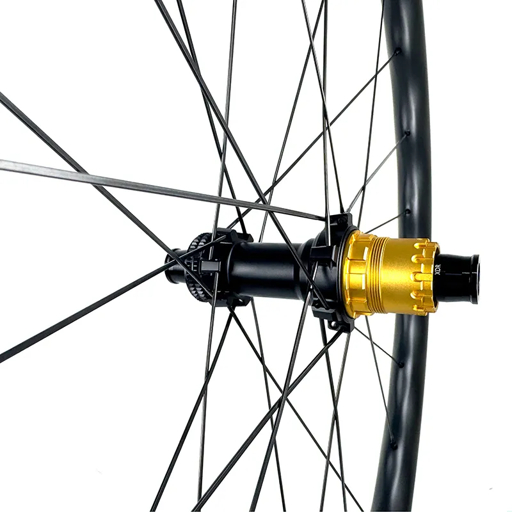
Keep the essentials
The compromises that should end the conversation.
Unclear tire compatibility or pressure limits
You need the rim’s bead design, approved tire requirements, permitted widths and pressure limits. “Tubeless ready” alone does not tell you whether a rim is hooked or hookless.
Do not treat an inner tube as a workaround for an unapproved hookless tire. Schwalbe explicitly requires suitable tubeless-design tires on hookless rims even when a tube is used. Confirm the exact wheel-and-tire combination.
No identifiable intended use or load rating
A road wheel is not automatically approved for loaded gravel, jumps or aggressive MTB use. Ask what the maximum load includes and whether the rating applies to the exact build. If the seller cannot clarify, do not infer capacity from spoke count or a carbon-fiber designation.
Incomplete compatibility information
Match axle diameter and spacing, brake format, rotor interface, cassette/freehub and actual tire clearance. “700C,” “disc compatible” and “12-speed” each leave important questions open.
Assembly problems presented as normal
A newly delivered wheel should not require you to accept visibly loose spokes, unexplained hub play or significant runout as part of the bargain. Tension, trueness and dish belong to the complete-wheel assessment.
A wheel can appear straight yet have unsuitable tension. Park Tool explains that both too little and too much tension can create failure risks. Do not tighten an unfamiliar carbon wheel by feel to make an unsatisfactory delivery usable.
No clear party responsible for a defect
Establish who handles the claim, what evidence is required and where the wheel must be sent. A nominal warranty term means little if the process and costs are undefined.
Do not accept less clarity.
Audit the claims
What the specification sheet cannot prove.
| The claim | What it may tell you | What it does not establish |
|---|---|---|
| “T700 / T800 carbon” | A stated fiber-material specification | Finished laminate quality, impact tolerance or complete-wheel reliability |
| “50mm aero profile” | A nominal rim-depth category | A measured drag saving or predictable gust response |
| “1500g wheelset” | A claimed mass, if the inclusion basis is defined | Stiffness, structural safety or whether it is lighter than your current setup |
| “Hand built” | A description of assembly | A documented tension map, quality-control procedure or test result |
| “Tested” or “certified” | Potentially useful evidence if traceable and relevant | Proof for your exact model without the standard, scope and identification |
| “High engagement hub” | A pickup characteristic when correctly specified | Lower drag while pedaling or better durability |
Useful test information identifies the model and configuration, test procedure, acceptance criteria and who performed the work. Independent evidence is helpful, but a report for a different rim or older build is not the same thing as evidence for the wheels in your cart.
Do not assume an expensive wheel is proven because it is expensive, or that an inexpensive wheel is unsafe because it is inexpensive. Ask the same concrete questions of both.
Choose the system
Disc-brake and rim-brake bargains deserve different scrutiny.
On a disc-brake bicycle, the rotor provides the braking surface. The wheel still needs correct rotor compatibility, secure interfaces, appropriate spoke construction and safe tire fit.
On a carbon rim-brake wheel, the rim also acts as the braking surface. Approved pads, brake-track condition, heat-related instructions and descending use become additional parts of the buying decision.
For a budget buyer who regularly rides long, technical descents, a carbon rim-brake wheel with vague heat-management guidance is not a sensible unknown to accept. A compatible aluminum rim-brake wheel may be the more conservative purchase.
Disc brake does not automatically mean better wheel quality. It simply changes the system requirements and removes the rim’s role as the braking track.
Never spend the tire budget to obtain the carbon rim.
If the wheel purchase leaves you unable to fit suitable tires, replace worn braking components or pay for necessary installation, the upgrade is not complete. Keep money for the parts that make the bicycle safe and usable.
Compare the alternatives
New budget carbon, used carbon or aluminum?
| Option | Potential advantage | Main question |
|---|---|---|
| New budget carbon wheelset | Known first-owner history and potentially useful rim depth | Are the build, limits and after-sales responsibility documented? |
| Discounted previous-generation carbon | A clearly identified model at a reduced price | Do warranty, parts and modern compatibility still suit you? |
| Used carbon wheels | Access to a higher original specification | Can condition, impact history, ownership and warranty eligibility be established? |
| New aluminum wheels | A different material option within the same budget | Does the complete build offer better support and suitability? |
| Service existing wheels | Avoids an unnecessary replacement if the wheels are sound | Would tires, bearings or a professional wheel service address the actual problem? |
Used carbon: a recognizable logo is not a condition report.
Ask about impacts, repairs, service history and ownership. Inspect spoke attachments, rim condition, hub bearings and, where relevant, the brake track. Confirm whether warranty coverage transfers.
Visual inspection cannot guarantee the absence of composite damage. A home tap test is not proof that a wheel is safe. When impact history is uncertain or damage is suspected, seek qualified assessment—or walk away.
Aluminum is a legitimate answer, not a failed upgrade.
Compare the actual products rather than treating carbon as a minimum requirement. A well-supported aluminum build that fits your load and riding may be a better purchase than a carbon wheel with unresolved specifications.
Read the fine print
Warranty length is not the same as usable support.
Before paying, establish the difference between a manufacturing defect claim, normal wear, crash damage and a change-of-mind return. They may follow completely different processes.
- Who pays outbound and return shipping for a claim?
- Is a refund, repair, replacement or discount the remedy?
- Does coverage apply only to the original owner?
- Does the policy cover labor or only replacement parts?
- Can you obtain spokes, bearings, end caps and a freehub later?
- Must the wheels remain unused to qualify for a normal return?
- What happens if a replacement model is discontinued?
A longer written term does not automatically mean a smoother outcome. Clear procedures and realistic access to parts make the promise more meaningful.
No invented “under $500” product recommendation.
No qualifying complete XDRU wheelset under $500 was verified in the listings reviewed for this article. The examples below are above-budget reference links—not sub-$500 recommendations and not a reason to abandon a firm spending limit.
They also serve different disciplines. An XC MTB product is not a cheaper substitute for a road wheelset simply because its price is closer to the target.
DURAX 25 XC
Listed at $599Not within a $500 wheelset budget
An XC-labeled product reference. Confirm the exact supplied specification and bicycle compatibility rather than relying on the category name alone.
Review DURAX 25 XC listing →CHASE 50 AERO
Listed at $799Not within a $500 wheelset budget
A road-specific reference listing a 50mm rim, 21mm internal width and HG/XDR options. Its price does not establish a measured advantage over a particular budget wheel.
Review CHASE 50 AERO listing →USD listing prices checked October 27, 2026. Prices, availability, configurations and delivery terms may change. Neither example is represented as a landed-cost quotation or a verified alternative below $500.
The questions to send the seller.
- Is this price for a complete front-and-rear wheelset in my selected configuration, and what is included?
- What is the full delivered cost to my address, and which charges remain my responsibility?
- Which axle, freehub and rotor interfaces will actually be supplied?
- Is the rim hooked or hookless, and where are its tire-width, tire-model and pressure requirements documented?
- What is the intended-use category and maximum system load for this exact build?
- What checks are performed for spoke tension, trueness, dish and hub function before shipment?
- What testing applies to this model, and can the scope and identification be provided?
- Which service parts are available, and what happens if a defect appears after installation?
The quality of the answer is part of the product.
Specific, consistent replies make a low-cost purchase easier to evaluate. Repeatedly changing specifications, generic reassurance and missing limits are reasons to pause—not reasons to rush before the discount expires.
Cheap carbon wheels: the questions behind the price.
Are carbon wheels under $500 safe?
Price alone cannot establish safety. Assess the exact model, approved use, tire compatibility, component condition, assembly and support. This guide does not certify an unspecified sub-$500 wheelset.
Will budget carbon wheels make my bike faster?
Not necessarily. The result depends on the wheels you own, tires, pressure, aerodynamics, weight and riding conditions. A deep profile or carbon construction is not proof of a speed gain.
Should I choose the lightest cheap carbon wheelset?
Only after the non-negotiables are resolved. Verify what the claimed weight includes and whether the build suits the load. A few saved grams do not compensate for unclear compatibility or unavailable replacement parts.
Are lesser-known hubs a deal breaker?
Not automatically. An identifiable design with documented service procedures and available parts can be suitable. An unnamed hub with no replacement freehub or end caps presents a different ownership risk.
Is used premium carbon better than new budget carbon?
There is no automatic answer. Original specification, present condition, impact history, warranty eligibility and service access all matter. A premium logo does not resolve unknown damage.
When should I wait instead of buying?
Wait when the full cost exceeds your limit, the seller cannot resolve an important specification, or the purchase leaves no money for essential setup. Keeping sound existing wheels is preferable to an incomplete or uncertain upgrade.
A small budget can justify fewer features.
It should not justify unanswered questions.
Buy sub-$500 carbon wheels only when the exact purchase survives the fit check, cost check and ownership check. Accept a less glamorous specification when it is appropriate and well supported.
If the essentials cannot be verified, choose a better-documented alternative, service what you already own or wait. The objective is a bicycle you can trust—not a carbon label at any cost.