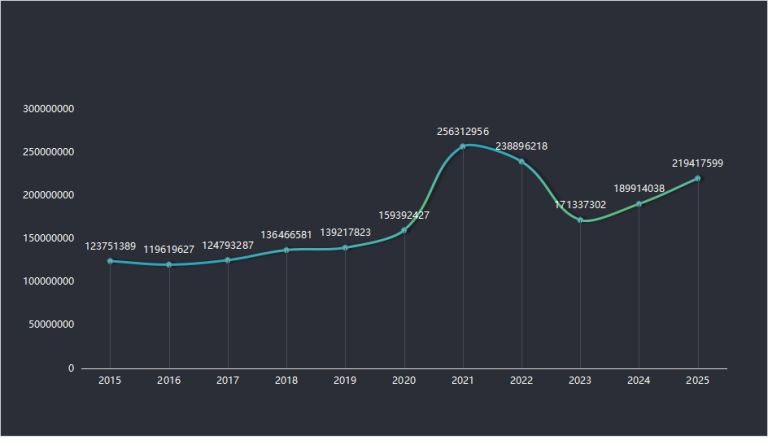

The most important thing to understand is that high rim imports do not necessarily mean high bicycle consumption. In many cases, they reflect a country’s role in the global bicycle supply chain.
The data is less about where people ride bikes and more about where bicycle wheels and bikes are built, assembled, and distributed.
1. Taiwan: The Global Wheel Manufacturing Hub
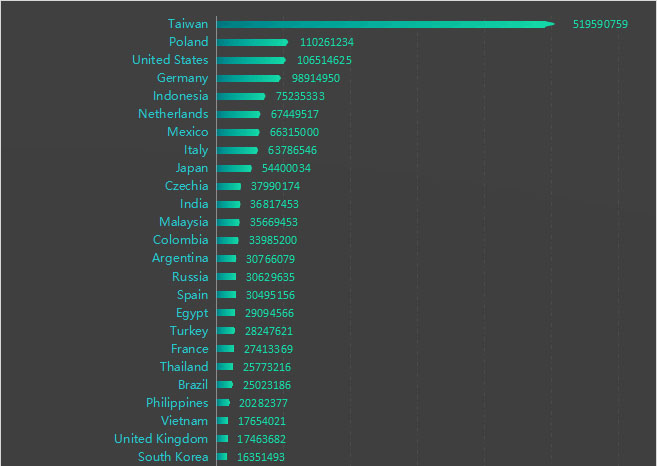
Taiwan’s import value is nearly five times higher than the second-ranked country. This is not because Taiwan consumes more bicycle rims than the rest of the world.
The real reason is that Taiwan serves as one of the world’s most important bicycle manufacturing and assembly centers.
Taiwan hosts:
- Major bicycle brands and OEM manufacturers
- High-end wheel builders
- Global sourcing and procurement offices
- Extensive bicycle component supply chains
Many rims are imported into Taiwan, assembled into wheelsets, integrated into complete bicycles, and then exported to North America, Europe, and Japan.
As a result, Taiwan’s import volume reflects its position as a global production and export platform, not a domestic consumer market.
2. Poland: Europe’s New Bicycle Manufacturing Center
Poland’s position is one of the most significant signals in the dataset.
Over the past decade, European bicycle production has gradually shifted eastward due to rising labor costs in Western Europe.
Many manufacturers now use Poland as a strategic assembly location because it offers:
- EU membership
- Lower labor costs
- Efficient logistics access to European markets
- Strong industrial infrastructure
A common supply chain looks like this:
China → Rim Production
↓
Poland → Wheel/Bike Assembly
↓
Germany, France, Benelux, Scandinavia → Final Sales
Poland’s high import volume therefore reflects its role as a manufacturing and assembly hub serving the broader European market.
3. The United States: A Consumption-Driven Market
The United States ranks highly, but for different reasons.
Unlike Taiwan or Poland, the U.S. is primarily a consumption market rather than a manufacturing center.
Imports are driven by:
- OE bicycle assembly
- Replacement parts
- Aftermarket wheel upgrades
- Performance cycling segments
American cyclists tend to spend heavily on:
- Carbon wheels
- Lightweight components
- Gravel upgrades
- MTB performance products
However, one important limitation is that HS 87149210 primarily tracks rims. Many complete wheelsets enter under different classifications, meaning the true size of the U.S. wheel market is likely larger than this dataset suggests.
4. Germany: Manufacturing Meets Consumption
Germany consistently appears among the largest importers because it combines both production and consumption.
Germany has:
- Large bicycle brands
- Engineering and testing expertise
- Wheel builders
- One of Europe’s strongest cycling markets
Unlike Taiwan, which is heavily production-oriented, or the U.S., which is heavily consumption-oriented, Germany benefits from both sides of the market.
This creates stable and sustained demand for rims and wheel components.
5. Southeast Asia: Supply Chain Migration in Action
Countries such as:
- Indonesia
- Malaysia
- Thailand
- Vietnam
- Cambodia
have become increasingly important in recent years.
This is largely the result of global supply-chain diversification.
Many bicycle brands now spread manufacturing across multiple countries to reduce:
- Tariff exposure
- Labor costs
- Supply-chain concentration risk
A common flow today is:
China → Carbon Rim Production
↓
Vietnam / Indonesia → Wheel Assembly
↓
United States / Europe → Final Sales
The growth of Southeast Asian imports reflects industrial relocation rather than a sudden surge in local bicycle demand.
6. Why Latin America Matters More Than Many Expect
Countries such as:
- Mexico
- Colombia
- Argentina
- Chile
show surprisingly strong import figures.
Colombia is particularly noteworthy.
Several factors drive demand:
Strong Cycling Culture
Cycling is deeply embedded in Colombian sports culture.
Mountainous Terrain
The country’s geography naturally supports:
- Road climbing
- Mountain biking
- Gravel riding
Growing Enthusiast Market
An expanding middle class has increased demand for premium bicycles and wheel upgrades.
As a result, rim imports are disproportionately high relative to the country’s economic size.
7. What This Means for Hub Manufacturers
For a hub brand, the most valuable insight is not simply identifying where rims are imported.
The key question is:
Which countries import rims and then turn them into complete wheelsets?
Those are the locations where hub demand is strongest.
Tier 1: Wheel Manufacturing and Assembly Centers
Highest strategic value:
- Taiwan
- Poland
- Germany
- Czechia
These markets contain:
- OEM wheel manufacturers
- Wheel builders
- Bicycle assembly plants
- Component sourcing teams
Tier 2: Premium Aftermarket Markets
Highest retail value:
- United States
- Japan
- Germany
Tier 3: Emerging Production Bases
Fastest growth potential:
- Vietnam
- Indonesia
- Thailand
- Cambodia
These countries are becoming increasingly important in global bicycle manufacturing.
Key Takeaway
HS 87149210 does not tell us where the most bicycles are ridden.
It tells us where the bicycle industry is creating value through the transformation of:
Rims → Wheelsets → Complete Bicycles
Viewed through that lens:
- Taiwan is the global high-end wheel manufacturing center.
- Poland is Europe’s emerging assembly hub.
- Germany combines production capability with strong domestic demand.
- The United States is the world’s largest premium consumption market.
- Southeast Asia represents the next major wave of bicycle supply-chain expansion.
For hub manufacturers and wheel brands, these locations often matter more than raw consumer bicycle sales because they sit at the center of the industry’s purchasing and assembly decisions.
- Top 10 Best Spoke Brands for Bicycle Wheels in 2026
- Straight-Pull vs J-Bend Spokes: Complete Bicycle Wheel Guide
- Ratchet vs Pawl Hub Systems: Which Is Better for a Carbon Wheelset?
- Are 29 inch carbon mountain bike wheels worth it?
- 700c Carbon Disc Wheelset: What Really Matters Before You Buy
- Are Carbon Gravel Wheels Worth It? Performance, Ride Feel & Buying Guide
- Wheel Guide · Materials & Ride Feel
- Wide vs. Narrow Rims: The Quiet Revolution in Cycling Performance
- Can Beginners Ride Carbon Wheels?
- Bicycle Hub Bearing Maintenance Guide: Service, Adjustment & Replacement