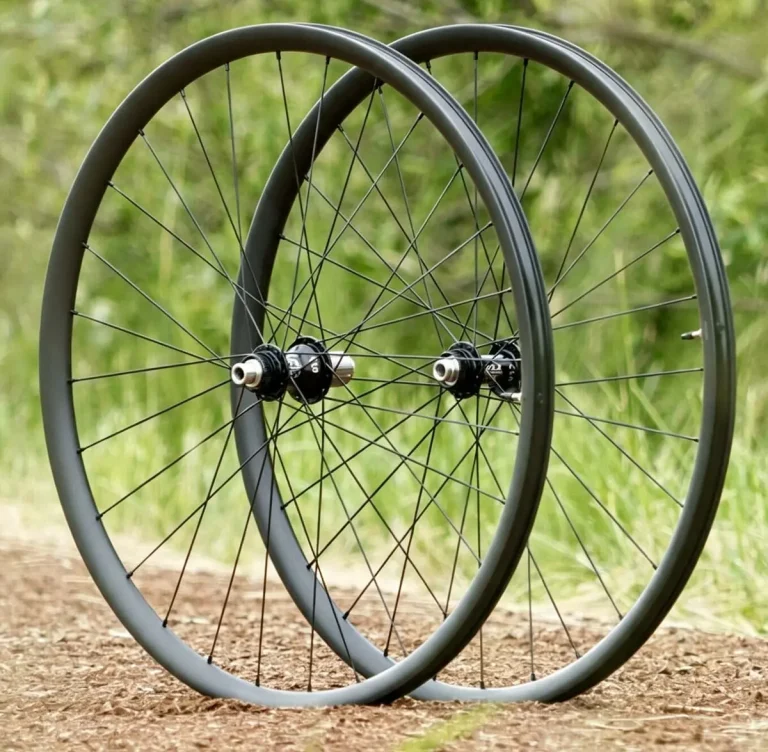

Many riders focus on carbon fiber grade, overall weight, and rim height when choosing wheelsets, but this approach is incomplete. The rim alone doesn’t determine the entire performance of a wheelset. The core component that truly influences wheel dynamics, force distribution, and riding feedback is the hub.
If you compare a bicycle wheelset to the human body: the rim is like the outer shoe, the spokes are like the tendons that bear pressure and generate force, and the hub is the core center, integrating the heart, nervous system, and power output.
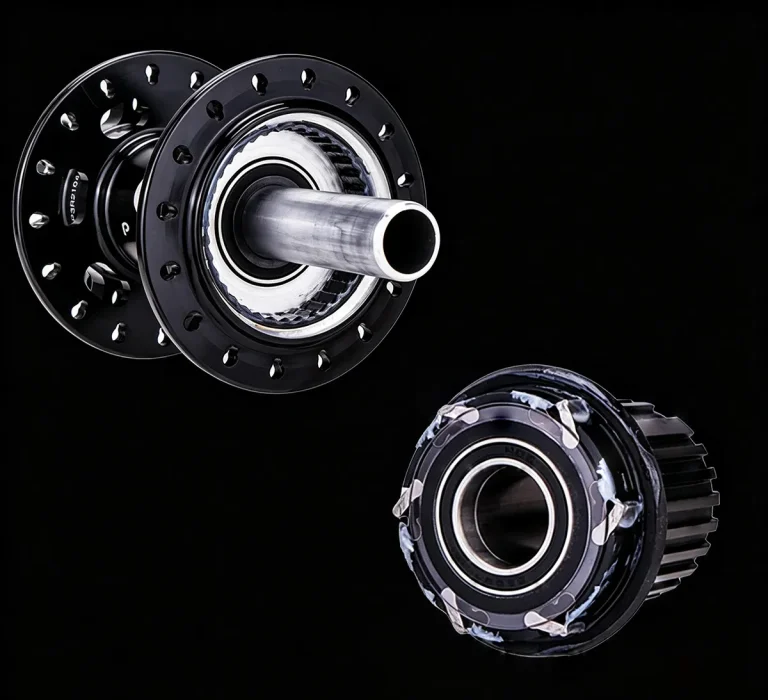
Many people unfamiliar with bicycles mistakenly believe that pedaling directly drives the wheels, but this is not the case. The force generated by pedaling first acts on the ratchet mechanism of the hub, which receives, transmits, and outputs power. The key to determining pedaling response speed is the engagement angle.
In principle, a smaller engagement angle (corresponding to a high number of ratchet teeth and a high TPI structure) results in more responsive pedaling, achieving immediate and zero-delay action, and superior explosive power, making it ideal for climbing, sprinting, and riding on challenging terrain. Conversely, a larger engagement angle can lead to brief periods of free pedaling and delayed power delivery, resulting in a sluggish overall riding experience.
So, is a smaller engagement angle always better? The answer is no. While the engagement angle is important, a smaller angle is not always better; mechanical structures never offer a perfect balance.
A smaller engagement angle requires more meshing teeth: 36T represents 36 meshing teeth, and 54T, 90T, 120T, 180T, and so on. As the number of teeth increases, individual teeth become smaller, and smaller teeth have a weaker load-bearing capacity.
For example, when a rider sprints at full power, outputting 1500W of power, all the torque is concentrated on the ratchet teeth. The smaller the teeth, the greater the pressure per unit area, significantly increasing the probability of problems such as tooth breakage, surface pitting, and tooth deformation.
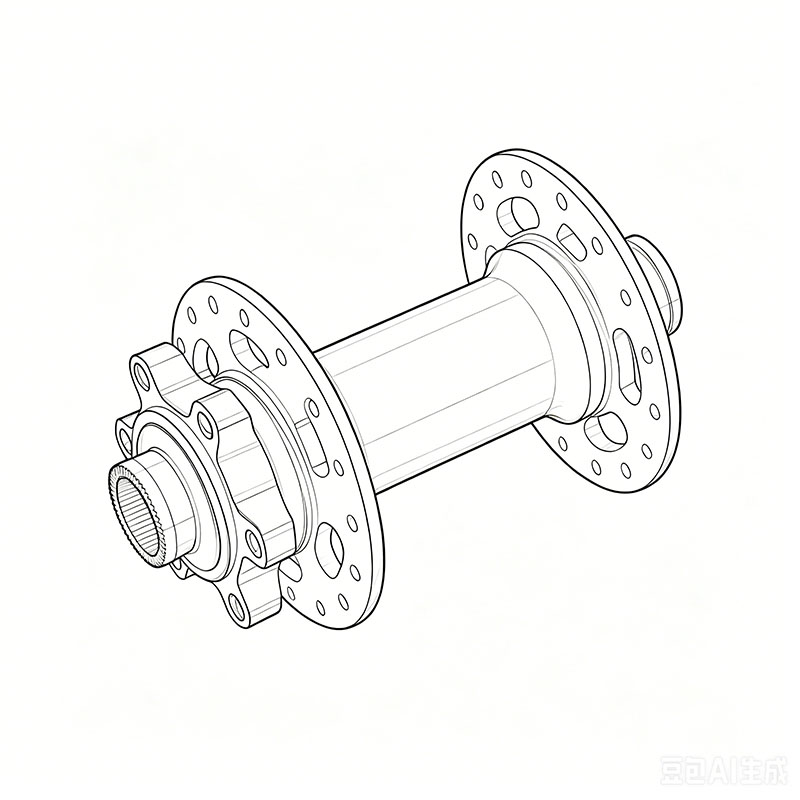
Therefore, high-tooth-count hubs have extremely high requirements for the materials themselves; at the same time, the fine-tooth structure is also very sensitive to machining precision. 54T hubs have a relatively higher tolerance for error, while 120T and above ultra-high-tooth-count hubs have stringent requirements for CNC machining, heat treatment, and wheel concentricity error control. Any failure to meet precision standards can easily lead to abnormal noises, skipped teeth, uneven wear, and other malfunctions.
In addition, high-tooth-count structures are particularly demanding in terms of lubrication, a detail often overlooked. The ratchet teeth of ultra-high-tooth-count hubs are very shallow. If the grease used is too viscous, it will press against the pawl, preventing it from fully springing back, thus causing slippage and pedaling lag. This is why most ultra-high-tooth-count hubs must be used with special grease. If you’re not a professional racer, there’s no need to blindly pursue extreme responsiveness and choose hubs with an excessively high number of teeth.
Besides the ratchet mechanism, the hub flange spacing directly impacts the riding experience: a wider flange spacing allows for a larger spoke spread angle, resulting in stronger lateral support and better stability during cornering and high-speed riding; a narrower flange spacing results in more overall wheel resilience, leading to a softer, more responsive ride.
With identical rims and spokes, simply changing the hub size will drastically alter the overall riding feel and handling characteristics of the bike. The difference in support and resilience caused by flange spacing directly affects cornering support and stability during full sprints.
III. Wheelset smoothness is a comprehensive performance of the entire hub system. Many people choose wheelsets solely based on bearing quality, but the overall rolling resistance of a wheelset is never determined by a single component, but rather by the combined effect of the entire hub’s resistance system.
Key factors affecting smoothness include: bearing material and workmanship, axle alignment accuracy, resistance from the sealing structure, freehub friction coefficient, and internal lubrication design.
Many hubs on the market share a common problem: they feel smooth when spinning freely, but when actually pedaling, a subtle yet noticeable drag is felt. This hidden riding resistance is the core difference between high-end and ordinary hubs. Top-tier hubs like DT Swiss and Chris King don’t simply offer “smoother spinning,” but rather maintain low wear and high stability over the long term, providing a far superior user experience and durability compared to ordinary products.
IV. Hubs: Determining the Bike’s Riding Style
This is a core logic understood by experienced riders: even with identical rims and spokes, changing the hub style can completely alter the bike’s riding character.
– High ratchet tooth count + lightweight hub: Provides rapid pedaling response and maximum power, geared towards competitive sprinting, suitable for racing and competition scenarios;
– Thickened bearing + high-stability hub: Smooth operation, quiet operation, high tolerance for errors, making it the preferred choice for long-distance endurance riding;
– Wide flange + high-rigidity adjustable hub: Offers excellent support, direct pedaling force transmission, crisp and clean power delivery, and stronger aggressiveness.
The hub is not merely a simple connecting component, but a key element defining the overall riding style of the bike.
V. Hubs: Defining the Upper Limit of Wheelset Lifespan While rim damage can be repaired or replaced, and broken spokes can be re-laced and adjusted, hub design flaws are irreversible and can create long-term riding problems.Premature bearing pitting, rapid freehub wear, ratchet slippage, abnormal riding noises, uneven force distribution, and other malfunctions are mostly not simply normal wear and tear, but rather caused by inherently flawed hub design that fails to properly distribute and channel riding forces.
- Top 10 Best Spoke Brands for Bicycle Wheels in 2026
- Straight-Pull vs J-Bend Spokes: Complete Bicycle Wheel Guide
- Ratchet vs Pawl Hub Systems: Which Is Better for a Carbon Wheelset?
- Are 29 inch carbon mountain bike wheels worth it?
- 700c Carbon Disc Wheelset: What Really Matters Before You Buy
- Are Carbon Gravel Wheels Worth It? Performance, Ride Feel & Buying Guide
- Wheel Guide · Materials & Ride Feel
- Wide vs. Narrow Rims: The Quiet Revolution in Cycling Performance
- Can Beginners Ride Carbon Wheels?
- Bicycle Hub Bearing Maintenance Guide: Service, Adjustment & Replacement